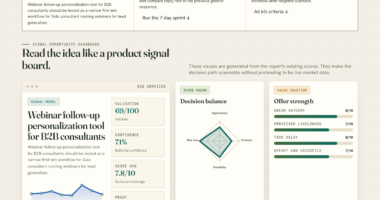
📊 Full opportunity report: How Human-Review Tracking Shapes Better Agency Delivery Outcomes on IdeaNavigator AI — validation score, market gap, and execution plan.
TL;DR
A pilot program introducing a human-review tracker for AI-assisted agency workflows shows promise in catching errors earlier and improving delivery quality. The tracker helps agencies monitor which tasks are AI-generated, human-owned, and require review, addressing a key visibility gap.
A new human-review tracker designed specifically for AI-assisted agency workflows is being tested as a targeted solution to improve delivery quality and visibility. Developed for delivery leads at AI-enabled service agencies, this tool aims to address the gap where agencies cannot easily see which client tasks are AI-generated, which are human-owned, and where work is stalled, potentially leading to errors and client dissatisfaction.
The tracker functions as a delivery board where a lead logs each client task as either AI-generated or human-owned, marks review status, and views a consolidated dashboard of tasks pending human sign-off. This approach is a response to the rapid integration of AI into service workflows, where existing project management tools lack the capacity to differentiate between AI and human work, creating a visibility gap.
Initial testing involves eight AI-services agencies, each running a live client engagement through the tracker over three weeks. The goal is to measure whether the new review gates can identify issues earlier than traditional workflows, thereby reducing errors and improving overall quality. The tracker is offered on a per-seat monthly subscription basis, targeting the growing market of service-delivery operations software.
According to an anonymous researcher involved in the project, early feedback indicates that the tracker helps teams better manage AI outputs and prioritize human review, but comprehensive results are still being analyzed.
Implications for AI-Enabled Service Delivery
This development addresses a critical challenge faced by agencies integrating AI: lack of visibility into which tasks require human oversight. By providing a dedicated tracking system, agencies can catch errors earlier, improve quality assurance, and enhance client satisfaction. If successful, this approach could set a new standard for managing AI-assisted workflows and reduce costly mistakes, ultimately reshaping how service agencies operate in an AI-driven environment.
AI project management software with human review tracking
As an affiliate, we earn on qualifying purchases.
As an affiliate, we earn on qualifying purchases.
Growing Need for AI Workflow Oversight
As AI tools become more prevalent in service delivery, agencies face increasing complexity in managing outputs. Currently, most project trackers do not distinguish between AI-generated and human-owned work, creating blind spots that can lead to missed errors and client complaints. The concept of a dedicated human-review tracker emerged from this gap, with pilot programs now testing its effectiveness. This initiative aligns with broader industry trends toward automation and improved workflow transparency, especially as agencies seek to scale AI integration without sacrificing quality.
“The tracker helps us see which tasks still need human review, reducing the risk of errors slipping through.”
— an anonymous researcher
agency workflow management tools for AI projects
As an affiliate, we earn on qualifying purchases.
As an affiliate, we earn on qualifying purchases.
Unclear Impact and Long-Term Adoption
It is not yet clear how widely this tracker will be adopted across the industry or whether it will significantly reduce errors in larger, more complex workflows. The pilot involves only eight agencies, and results are still being analyzed. Additionally, questions remain about integration with existing project management tools and how scalable the solution is for different types of service delivery models.
As an affiliate, we earn on qualifying purchases.
Next Steps for Validation and Expansion
The next phase involves analyzing pilot results to determine the tracker’s effectiveness in early error detection and quality improvement. If successful, plans include expanding the pilot to more agencies and refining the tool based on user feedback. Broader industry adoption could follow if the solution proves to deliver measurable improvements in client satisfaction and operational efficiency.
AI-assisted service delivery monitoring tools
As an affiliate, we earn on qualifying purchases.
As an affiliate, we earn on qualifying purchases.
Key Questions
How does the human-review tracker improve AI-assisted service delivery?
The tracker provides visibility into which tasks are AI-generated or human-owned, tracks review status, and flags pending reviews, helping agencies catch errors earlier and improve quality control.
Is this tracker available for all types of service agencies?
Currently, it is in a pilot phase with AI-services agencies. Broader availability will depend on pilot outcomes and further development.
Will this system integrate with existing project management tools?
Integration plans are under consideration, but specifics are still being developed based on user feedback and technical feasibility.
What are the potential limitations of this approach?
The main uncertainties involve scalability, industry-wide adoption, and whether it can effectively reduce errors in more complex workflows.
When can agencies expect to see wider adoption?
If pilot results are positive, broader rollout could occur within the next year, with further testing and refinement ongoing.
Source: IdeaNavigator AI