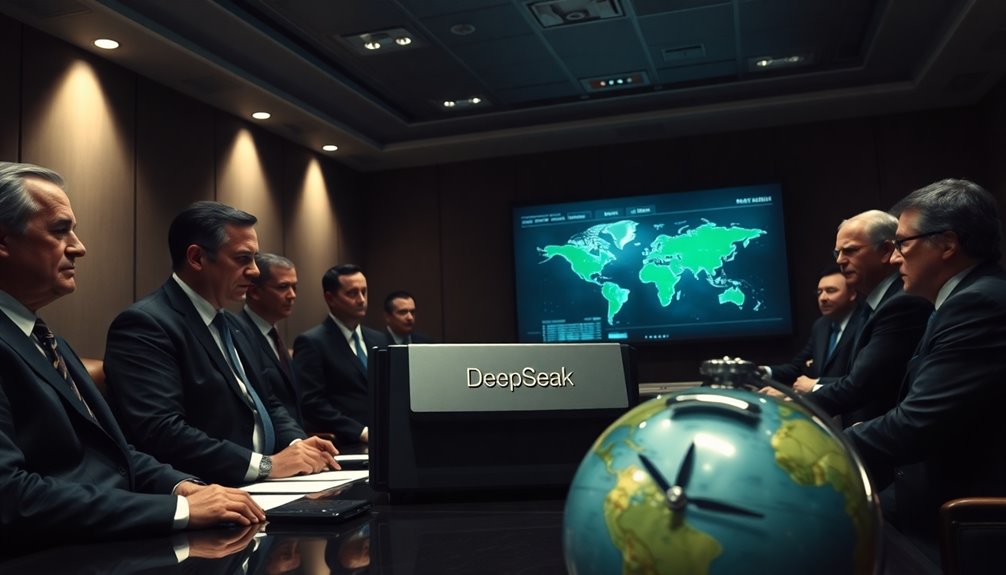

You might have noticed a growing trend as countries across the globe scramble to ban DeepSeek. This isn't just a knee-jerk reaction; it's about serious concerns regarding data privacy and national security. With its Chinese origins, the app's data collection practices raise alarm bells. What could this mean for user safety and the future of similar technologies? The implications could extend far beyond what you might expect.

As concerns over data privacy and national security escalate, countries are swiftly moving to ban DeepSeek, an AI tool with ties to China. The platform's data storage practices have raised significant alarms. With user data stored on servers in China, you can't help but worry about potential data breaches and unauthorized government access. Such vulnerabilities become even more concerning when you consider that the app transmits data across borders, amplifying the risk of information leakage.
Governments see DeepSeek as a direct threat to national security. The tool's Chinese origins and potential for data exploitation make it a target for regulatory scrutiny. You might find it unsettling that DeepSeek could enforce censorship similar to other Chinese platforms, possibly suppressing critical information. Countries are examining the app under stringent data protection laws, like GDPR in Europe, to assess compliance and protect their citizens.
Legal actions against DeepSeek have already begun. Italy's decision to ban the app stems from its non-compliance with GDPR and fears of data breaches. Similarly, Taiwan has restricted government agencies from using DeepSeek, highlighting the national security risks it poses. In the US, lawmakers are drafting legislation to prohibit AI products developed in China, including this controversial tool. Australia has followed suit, restricting DeepSeek's use in government systems due to security concerns.
The data privacy issues surrounding DeepSeek don't stop there. The app collects extensive user data, including IP addresses and even keystroke patterns, which raises the stakes for user confidentiality. Since Chinese companies must share data with government agencies upon request, the implications for user privacy are chilling. Some organizations have already blocked access to DeepSeek, driven by a desire to protect their data security.
In response to these mounting concerns, countries are taking decisive action. South Korea has banned DeepSeek from military and work computers due to the perceived security risks. The Indian government plans to host the AI model on local servers to mitigate privacy issues. In the US, the Navy has outright prohibited its personnel from using DeepSeek. Even Texas has banned AI software from Chinese companies, including DeepSeek, on government devices.
The global reaction to DeepSeek's emergence has disrupted the AI industry, prompting significant market shifts. As countries rush to protect their citizens and their data, it's clear that DeepSeek has become a focal point in the broader conversation about data privacy and national security.
Top picks for "reveal startl reason"
Open Amazon search results for this keyword.
As an affiliate, we earn on qualifying purchases.