
For remote check-ins around the home, I’d start with the Enabot EBO Air 2S if returning to a dock matters, or the EBO ROLA Mini 2K if local recording and a clearly stated 2K camera are higher priorities. Both move between rooms and let you communicate through a phone, but they are home camera robots rather than full workplace telepresence systems: neither listing specifies a display for the person at the robot, and the ROLA must be plugged in manually to recharge.

Get tech for your team delivered free — and shop member deals
- Fast, free delivery on millions of items
- Access to Prime Big Deal Days deals on October 6–7
- Prime Video, Amazon Music and more included
That distinction shapes my ranking. I put the Air 2S first because its automatic return to a charging dock reduces one recurring chore during remote use, while its two-way video is a closer fit for conversations than audio alone. The ROLA remains a useful alternative for buyers who value its stated local MP4 recording and motion sensing. The tradeoff is practical: convenience favors the Air 2S, while the ROLA’s documented recording features are more explicit.
Key Takeaways
Air 2S is the easiest to keep ready: it returns to its charging dock when its battery is low; ROLA charging is manual.
Video communication favors Air 2S: its listing specifies two-way video, while ROLA lists two-way audio.
ROLA is clearer on recording: local MP4 recording and motion sensing are specified, making it the more documented choice for capturing activity.
Both are indoor mobile camera robots: they can check different rooms, but the provided specifications do not describe a screen for face-to-face interaction at the robot.
Battery capacity alone is not runtime: both list a 5000 mAh battery, but neither supplied description gives a dependable operating duration.
| Enabot EBO Air 2S Mobile Robot Camera with Two-Way Video |  | Best Overall for Convenient Home Check-Ins | Camera: 2.5K HD | Communication: Two-way video | Night vision: Yes | VIEW ON AMAZON | See Our Full Breakdown |
| Enabot EBO ROLA Mini 2K Mobile Pet Camera Robot | 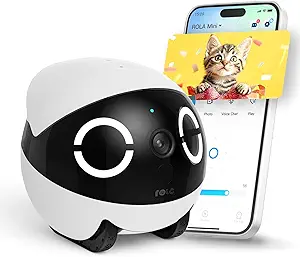 | Best for Local Recording and Motion Alerts | Camera: 2K QHD | Audio: Two-way audio | Night vision: Yes | VIEW ON AMAZON | See Our Full Breakdown |
| telepresence robot | Camera | Night vision | Battery | Charging |
|---|---|---|---|---|
| Enabot EBO Air 2S Mobile Robot | 2.5K HD | Yes | 5000 mAh; runtime not specified | Automatically returns to charging dock when low |
| Enabot EBO ROLA Mini 2K Mobile | 2K QHD | Yes | 5000 mAh; extended standby stated, runtime unspecified | Manual magnetic USB-C cable; no automatic recharge |
More Details on Our Top Picks
Enabot EBO Air 2S Mobile Robot Camera with Two-Way Video
The EBO Air 2S takes the top spot because it combines room-to-room mobility with two-way video and an automatic return to its charging dock. That last feature makes a real difference for telepresence: the robot can be more useful for spontaneous check-ins if it can head back to charge without someone carrying it to a cable. The ROLA Mini also moves through the home, but its manual charging requirement adds a regular task that the Air 2S is designed to avoid.
For conversations, the Air 2S has the stronger stated feature set. Its listing names two-way video, while the ROLA description promises two-way audio. That makes the Air 2S the more natural fit when a remote user wants a richer exchange with someone at home. Still, buyers should check the product’s communication setup carefully: the supplied specifications do not say whether the robot itself has a display, so I would not assume the person at home sees the remote caller’s face.
The 2.5K HD camera and night vision support checking in across different rooms and lighting conditions. Compared with the ROLA’s listed 2K camera, the Air 2S has the higher stated resolution, though resolution alone cannot confirm better real-world image quality. It also includes a charging dock, power adapter, and pre-installed 32GB microSD card. The listed accessories give buyers a more complete starting setup than the ROLA description, which does not specify included storage or a dock.
There are limits. Battery runtime is unspecified, despite the 5000 mAh capacity, so I cannot say how often it will need to recharge during active driving. Remote check-ins require home Wi-Fi, and the supplied details do not spell out connection reliability, app controls, or privacy settings. I’d choose it over the ROLA for lower charging effort and video-oriented communication, but choose the ROLA if documented local recording and motion sensing matter more than docking convenience.
Pros:- Returns to its charging dock when the battery is low.
- Lists two-way video for more conversational check-ins.
- 2.5K HD camera with night vision.
- Includes a dock and pre-installed 32GB microSD card.
Cons:- Battery runtime is not specified.
- Remote check-ins require home Wi-Fi.
- The provided details do not confirm a screen on the robot for showing the remote caller.
Best for: Households that want a mobile camera for remote check-ins and value automatic docking and two-way video.
Not ideal for: Buyers who need a specified battery runtime, a confirmed onboard display for face-to-face calls, or operation without home Wi-Fi.
- Camera:2.5K HD
- Communication:Two-way video
- Night vision:Yes
- Battery:5000 mAh; runtime not specified
- Charging:Automatically returns to charging dock when low
- Included storage:Pre-installed 32GB microSD card
- Network:Home Wi-Fi required for remote check-ins
Our verdict“I’d pick the Air 2S for the more hands-off charging routine and specified two-way video, provided home Wi-Fi is available.”
Enabot EBO ROLA Mini 2K Mobile Pet Camera Robot
The EBO ROLA Mini 2K suits buyers who want a mobile camera with specifically described local recording and motion sensing. It can be driven around the home from a smartphone, giving a remote user a way to look into different rooms rather than relying on a fixed camera’s field of view. Its 2K QHD video, night vision, and two-way audio cover the basics for checking on pets or family members, while local MP4 recording gives it a clearer role for reviewing captured activity than the Air 2S listing does.
Against the Air 2S, the ROLA’s strength is documentation around recording, not charging or richer communication. The Air 2S specifies two-way video and a dock return when its battery is low; the ROLA description specifies audio and says it must be recharged manually with a magnetic USB-C cable. That makes the ROLA less convenient for a household expecting to drive it often and leave it ready. A 5000 mAh battery supports extended standby according to the description, but no exact runtime is supplied, so active use remains hard to predict.
Connectivity is a small point in the ROLA’s favor on paper: its specs list both 2.4 GHz and 5 GHz Wi-Fi, along with Android and iOS smartphone compatibility. The Air 2S description says home Wi-Fi is required but does not give the same band or phone compatibility details. That does not establish which will connect more reliably in a particular home, but the ROLA’s stated compatibility details help set expectations before buying.
The main drawback is the manual charging routine. Unlike the Air 2S, it does not automatically find a dock, so someone needs to attach the magnetic cable after the battery runs down. I would favor this model for a buyer who values local recording and motion sensing and can manage charging. If the priority is keeping a mobile camera available for frequent conversations with minimal upkeep, the Air 2S is the better fit. Also, neither product’s provided description confirms a robot-mounted screen, so I would not treat either as a guaranteed video-call endpoint for the person at home.
Pros:- Local MP4 recording and motion sensing are specified.
- 2K QHD camera with night vision.
- Two-way audio supports live communication.
- Lists 2.4 GHz and 5 GHz Wi-Fi and Android/iOS compatibility.
Cons:- Requires manual charging with a magnetic USB-C cable.
- Does not automatically return to a charger.
- The description does not specify an exact battery runtime.
Best for: Pet owners or family members who want a drivable indoor camera with specified local MP4 recording and motion sensing.
Not ideal for: People who expect automatic recharging, need specified active-use runtime, or want confirmed face-to-face video at the robot.
- Camera:2K QHD
- Audio:Two-way audio
- Night vision:Yes
- Motion sensing:Yes
- Recording:Local recording; MP4
- Battery:5000 mAh; extended standby stated, runtime unspecified
- Charging:Manual magnetic USB-C cable; no automatic recharge
- Wi-Fi:2.4 GHz and 5 GHz
- Compatibility:Android and iOS smartphones
Our verdict“I’d choose the ROLA Mini for documented local recording and motion sensing, as long as manual charging is acceptable.”

How We Picked
I ranked these two products by how well their stated functions support remote presence inside a home: moving between rooms, seeing what is happening, communicating with someone nearby, and being ready for the next check-in. I gave extra weight to charging because a mobile camera that is out of power cannot help when a family member or pet needs attention. That is why the Air 2S leads: it is described as returning to its dock when the battery is low, while the ROLA requires a person to connect its magnetic USB-C cable.
I also compared the kind of interaction each model specifies. The Air 2S lists two-way video; the ROLA lists two-way audio. That wording makes the Air 2S the stronger match for a conversation-oriented purchase, although the provided details do not say whether the robot has an onboard screen that shows the remote caller. The ROLA earns a distinct place through specified local MP4 recording and motion sensing. These are meaningful capabilities for checking activity, but recording does not replace live interaction.
Camera figures are useful, but they do not settle the choice by themselves. The Air 2S is listed at 2.5K HD and the ROLA at 2K QHD; neither description supplies enough detail to compare image quality in different rooms or lighting conditions. Both list night vision and 5000 mAh batteries. I therefore treated those as shared basics, and avoided inferring battery runtime, app behavior, privacy controls, or compatibility beyond what the supplied descriptions state. My ranking reflects the product information provided and prioritizes distinct buyer needs rather than treating every feature as equally decisive.
| telepresence robot | Charging |
|---|---|
| Enabot EBO Air 2S Mobile Robot | Automatically returns to charging dock when low |
| Enabot EBO ROLA Mini 2K Mobile | Manual magnetic USB-C cable; no automatic recharge |
Factors to Consider When Choosing Telepresence Robots
I’d choose a home telepresence robot by starting with the job it needs to do. A mobile camera can help a remote person check rooms and communicate, but the phrase “telepresence robot” can also suggest a device built for face-to-face calls or workplace meetings. The listed features here describe mobile home cameras; confirm any missing interaction details that matter to your use.Decide whether you need a moving camera or a video-call endpoint
Both Enabot models are described as mobile cameras that can move around the home, which is useful when a fixed camera cannot see the room you want to check. The Air 2S specifies two-way video, and the ROLA specifies two-way audio. However, the supplied descriptions do not confirm an onboard screen on either robot. If the person at home needs to see the remote caller on the device, verify that capability before choosing; the available details do not establish it.
Treat charging as part of day-to-day usability
A robot that can move around still needs a way to recharge. The Air 2S is described as returning to its charging dock when the battery is low, while the ROLA uses a magnetic USB-C cable and needs manual charging. If you expect frequent check-ins, automatic docking may be a more important difference than the modest gap between their listed camera resolutions. Neither listing provides a precise active-use runtime, so the shared 5000 mAh capacity does not tell me how long either will operate away from a charger.
Match communication and recording to your use
For talking with someone at home, the Air 2S has the more expansive stated option with two-way video; the ROLA’s two-way audio may be enough for a quick check-in or speaking to a pet. For reviewing activity later, the ROLA has the clearer specification: local MP4 recording and motion sensing. The Air 2S includes a pre-installed 32GB microSD card, but its supplied description does not explicitly describe recording behavior. I would compare the details of the app and recording controls before relying on either for a particular monitoring routine.
Read camera resolution in context
The Air 2S lists a 2.5K HD camera; the ROLA lists 2K QHD. Both also specify night vision. Those figures give a basic point of comparison, but the supplied information does not describe lens coverage, image quality in motion, or performance in a specific room. If seeing fine detail matters, check sample footage and confirm how video is stored and accessed. For many buyers, charging behavior and the interaction type are more decisive than the resolution labels alone.
Check the home network and phone setup
The ROLA lists compatibility with Android and iOS smartphones and support for 2.4 GHz and 5 GHz Wi-Fi. The Air 2S description says a home Wi-Fi connection is required for remote check-ins. Network access is part of the setup for remote use, so confirm the intended room has reliable coverage and that the app supports the phones you plan to use. These products are presented for indoor use; I would not assume either is suited to outdoor driving or use beyond the home network conditions described.
Frequently Asked Questions
Which of these two telepresence robots is better for frequent check-ins?
I’d favor the EBO Air 2S for frequent check-ins because it automatically returns to its charging dock when the battery is low. That removes the ROLA Mini’s manual cable connection from the routine. The Air 2S also lists two-way video, while the ROLA lists two-way audio. Neither supplied description gives an exact battery runtime, so frequency and duration of use may still affect how often charging is needed.
Can either robot support face-to-face video calls?
The Air 2S listing specifies two-way video, but the provided product details do not confirm that the robot has an onboard display for showing the remote caller. The ROLA listing specifies two-way audio rather than two-way video. I would verify whether a screen is present and how calls appear to the person at home before treating either model as a face-to-face video-call device.
Which model is better suited to recording activity?
The ROLA Mini has the more explicit recording description: it supports local recording in MP4 format and lists motion sensing. The Air 2S includes a pre-installed 32GB microSD card, but its supplied description does not state how recording works. If saved footage is central to your choice, confirm recording controls, storage behavior, and playback access for the model you select.
Do the 5000 mAh batteries mean the robots run for the same amount of time?
No. Both list a 5000 mAh battery, but the supplied descriptions do not give an exact operating runtime, and battery capacity alone cannot establish how long a robot will run while being driven or streaming video. The Air 2S is described as returning to its dock when low; the ROLA needs manual charging. I would treat runtime as an open question for both products.
Do these robots need Wi-Fi?
The Air 2S description explicitly says a home Wi-Fi connection is required for remote check-ins. The ROLA lists support for 2.4 GHz and 5 GHz Wi-Fi and smartphone compatibility for Android and iOS. For either device, confirm the home network reaches the rooms where you plan to drive it and review the product’s setup requirements before relying on remote access.
Conclusion
I’d recommend the EBO Air 2S to households that want a mobile camera for regular conversations and prefer a robot that returns to its dock on its own. The ROLA Mini 2K makes more sense for buyers who value specified local MP4 recording, motion sensing, and listed Android/iOS support, and who are comfortable charging it manually. If your definition of telepresence requires a screen at the robot for face-to-face calls, verify that feature before buying: the supplied details do not confirm it for either model.
Halloween Picks
halloween
As an affiliate, we earn on qualifying purchases.