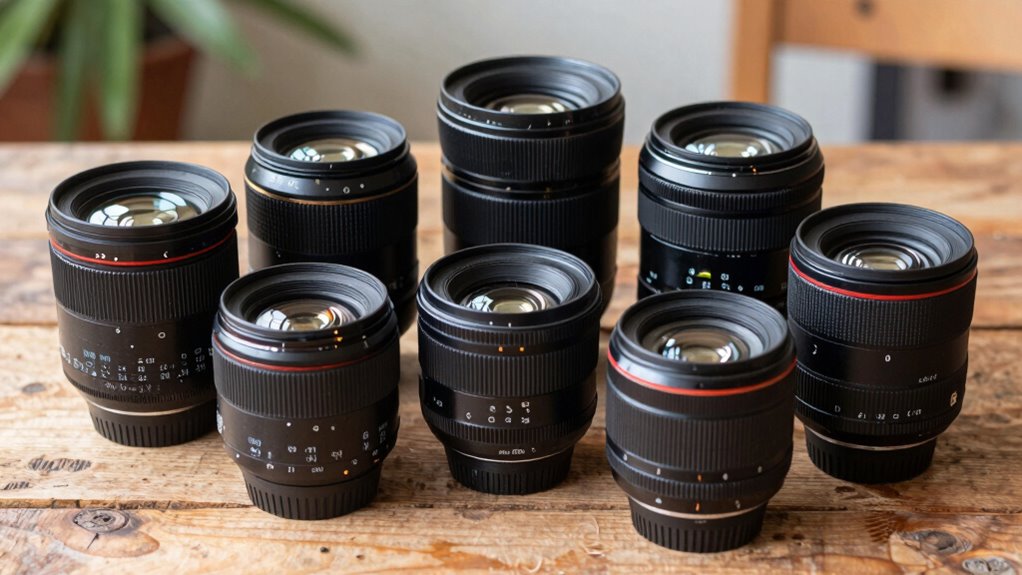

For most new Canon DSLR owners, the Canon EF-S 18-55mm f/3.5-5.6 II is the best overall starting point because its everyday zoom range covers many common subjects. The Canon EF 50mm f/1.8 STM is a standout for portraits and low-light practice, while the Canon EF 75-300mm f/4-5.6 III offers reach for distant subjects. The main tradeoff is choosing between an adaptable zoom, a bright fixed focal length, and a telephoto lens that is less versatile up close. This roundup also includes a manual-focus portrait lens and a filter kit, each with narrower uses. Read on for the full breakdown and help matching a lens to your camera and the photos you want to make.

Get business pricing on tech for your team
- Business-only prices and quantity discounts
- Tax-exempt purchasing
- Multiple users, one account, clear invoices
Key Takeaways
The 18-55mm standard zoom is the broadest first choice here: it can handle everyday scenes without requiring a beginner to commit to one focal length.
The 50mm f/1.8 STM is the clearest step toward portraits and low-light photography, but its fixed framing is less flexible than the standard zoom.
The 75-300mm telephoto makes sense when distant subjects are the priority; it is a poor substitute for an everyday lens because its long reach limits close and wide scenes.
The Lightdow 85mm asks beginners to focus manually, which can slow portraits and make moving subjects harder than with the autofocus Canon options.
The 58mm accessory kit adds filters and accessories rather than replacing the lens; check the lens’s filter-thread size before buying, since 58mm compatibility is not universal.
| Canon EF-S 18-55mm f/3.5-5.6 II SLR Lens |  | Best Overall Starter Zoom | Focal length: 18-55mm | Maximum aperture: f/3.5-5.6 | Mount: Canon EF-S | VIEW ON AMAZON | See Our Full Breakdown |
| Ultra Deluxe 58mm Lens Kit for Canon EF-S 18-55mm IS II Lens |  | Best Accessory Bundle | Filter size: 58mm | Wide-angle magnification: 0.43x | Telephoto magnification: 2.2x | VIEW ON AMAZON | See Our Full Breakdown |
| Canon EF 50mm f/1.8 STM Lens, Black, Compatible with Canon EOS DSLR Cameras |  | Best for Portraits and Low Light | Focal length: 50mm; 80mm equivalent on APS-C | Maximum aperture: f/1.8 | Focus motor: STM stepping motor | VIEW ON AMAZON | See Our Full Breakdown |
| Canon EF 75-300mm f/4-5.6 III Telephoto Zoom Lens |  | Best for Learning Telephoto Framing | Focal length: 75-300mm | Maximum aperture: f/4-5.6 | Mount: Canon EF | VIEW ON AMAZON | See Our Full Breakdown |
| Canon EF 75-300mm f/4-5.6 III Telephoto Zoom Lens |  | Best Basic EF Telephoto | Focal length: 75-300mm | Maximum aperture: f/4-5.6 | Mount: Canon EF | VIEW ON AMAZON | See Our Full Breakdown |
| Canon EF 75-300mm f/4-5.6 III Telephoto Zoom Lens (Renewed) |  | Best for Learning Telephoto Photography | Mount: Canon EF | Focal length: 75-300mm | Aperture range: f/4-5.6 | VIEW ON AMAZON | See Our Full Breakdown |
| Lightdow 85mm f/1.8 Manual Focus Portrait Lens for Canon EOS DSLR Cameras |  | Best for Manual Portrait Practice | Mount: Canon EF/EF-S | Focal length: 85mm | Maximum aperture: f/1.8 | VIEW ON AMAZON | See Our Full Breakdown |
| camera lenses for beginner | Focal length | Mount | Maximum aperture | Lens construction |
|---|---|---|---|---|
| Canon EF-S 18-55mm f/3.5-5.6 I | 18-55mm | Canon EF-S | f/3.5-5.6 | 16 elements in 12 groups |
| Ultra Deluxe 58mm Lens Kit for | — | — | — | — |
| Canon EF 50mm f/1.8 STM Lens | 50mm; 80mm equivalent on APS-C | Canon EF | f/1.8 | 6 elements in 5 groups |
| Canon EF 75-300mm f/4-5.6 III | 75-300mm | Canon EF | f/4-5.6 | 13 elements in 9 groups |
| Canon EF 75-300mm f/4-5.6 III | 75-300mm | Canon EF | f/4-5.6 | 13 elements in 9 groups |
| Canon EF 75-300mm f/4-5.6 III | 75-300mm | Canon EF | — | — |
| Lightdow 85mm f/1.8 Manual Foc | 85mm | Canon EF/EF-S | f/1.8 | — |
More Details on Our Top Picks
Canon EF-S 18-55mm f/3.5-5.6 II SLR Lens
For a beginner who wants one lens for everyday scenes, the 18-55mm range makes this the most flexible starting point in the group. Its wide end suits landscapes and indoor snapshots, while the longer end helps frame portraits without changing lenses. Compared with the Canon EF 50mm f/1.8 STM, it offers zoom convenience but gives up the prime’s much brighter aperture and stronger low-light potential. The UD glass and aspherical elements are intended to support sharpness across the range, while the gear-driven focus allows manual adjustment. The tradeoff is the modest f/3.5-5.6 aperture, which can make dim rooms and blurred backgrounds harder to manage. It also fits APS-C Canon EF-S bodies only, so it is not a general-purpose choice for every Canon camera.
Pros:- 18-55mm range covers wide everyday scenes through short portrait framing.
- UD glass and aspherical elements support image sharpness.
- A zoom lets beginners change framing without swapping lenses.
- Gear-driven focus provides a manual focusing option.
Cons:- The f/3.5-5.6 maximum aperture is limiting in low light.
- Background blur is harder to achieve than with the EF 50mm f/1.8 STM.
- EF-S mount limits compatibility to APS-C Canon DSLR bodies.
Best for: New Canon APS-C DSLR owners who want a versatile lens for family photos, travel, and everyday practice.
Not ideal for: Photographers who often shoot indoors without flash, want strong background blur, or use a full-frame Canon body.
- Focal length:18-55mm
- Maximum aperture:f/3.5-5.6
- Mount:Canon EF-S
- Sensor compatibility:APS-C
- Lens construction:16 elements in 12 groups
- Special elements:UD glass and aspherical lenses
- Diagonal angle of view:74°-7.5°
- Focus type:Gear-driven
Our verdict“Choose this as a practical first lens if you own a Canon APS-C DSLR and value framing flexibility over low-light performance.”
Ultra Deluxe 58mm Lens Kit for Canon EF-S 18-55mm IS II Lens
This kit is for beginners who want to experiment with add-on effects rather than buy another dedicated lens. It bundles a 0.43x wide-angle attachment, a 2.2x telephoto attachment, filters, hoods, and caps for compatible 58mm threads. That gives it broader experimentation value than the straightforward Canon EF-S 18-55mm f/3.5-5.6 II, but it does not replace the reliable, native zoom range of that lens. Add-on optics also bring extra handling steps; the wide-angle unit must be assembled from two parts, and the result depends on a matching filter thread. Multi-coated glass and steel barrels add a sturdier feel, though this bundle’s appeal is breadth, not simplicity. I’d pick it for learning what different accessories do, not for a cleaner or faster upgrade in image quality.
Pros:- Includes wide-angle and telephoto attachments plus filter and close-up sets.
- Hoods and protective caps add useful handling and storage accessories.
- Steel barrels and multi-coated glass are specified for the attachments.
- Offers several ways to experiment without buying separate accessory kits.
Cons:- Compatibility depends on a 58mm filter thread, which excludes many lenses.
- The wide-angle attachment requires manual assembly from two parts.
- Add-on optics add setup complexity rather than offering the simplicity of a native zoom lens.
Best for: Canon kit-lens owners with a 58mm filter thread who want to try wide-angle, telephoto, close-up, and filter effects in one bundle.
Not ideal for: Beginners seeking a simple, dependable lens upgrade or anyone whose lens does not accept 58mm accessories.
- Filter size:58mm
- Wide-angle magnification:0.43x
- Telephoto magnification:2.2x
- Materials:Steel barrel and multi-coated anti-reflection glass
- Included optics:Wide-angle and telephoto attachments
- Included accessories:3-piece filter kit, 4-piece close-up filters, tulip lens hood, soft lens hood, lens cap, cap keeper
- Primary compatibility:Canon EF-S 18-55mm f/4-5.6 and f/3.5-5.6 IS STM
Our verdict“Choose this bundle if your compatible Canon lens has a 58mm thread and you want to experiment with multiple optical effects.”
Canon EF 50mm f/1.8 STM Lens, Black, Compatible with Canon EOS DSLR Cameras
The f/1.8 maximum aperture makes this prime the clearest step up for beginners who want to shoot in dimmer light or separate a subject from the background. Its STM autofocus is designed for smooth, quiet operation, a useful contrast with the more basic focus systems on the Canon EF 75-300mm f/4-5.6 III lenses. On APS-C bodies, the 50mm view is equivalent to 80mm, which suits portraits but feels tight for rooms, group photos, and casual wide scenes. Unlike the Canon EF-S 18-55mm, there is no zoom, so changing composition means moving yourself or changing lenses. It also lacks optical stabilization, meaning the bright aperture does not prevent blur from shaky hands. This is a focused creative tool, not the most flexible single-lens starter choice.
Pros:- f/1.8 aperture supports low-light shooting and shallow depth of field.
- STM autofocus is designed for smooth, quiet operation in stills and video.
- Compact prime format gives beginners a simple way to practice deliberate framing.
- 0.35m minimum focusing distance supports close everyday subjects.
Cons:- Fixed focal length lacks the framing flexibility of the EF-S 18-55mm zoom.
- The 80mm-equivalent view on APS-C can be restrictive indoors.
- No optical image stabilization is specified.
Best for: Beginners using Canon EF DSLR bodies who prioritize portraits, subject separation, or available-light photography over zoom convenience.
Not ideal for: Travel and family photographers who need wide framing, quick composition changes, or stabilization for handheld shooting.
- Focal length:50mm; 80mm equivalent on APS-C
- Maximum aperture:f/1.8
- Focus motor:STM stepping motor
- Minimum focusing distance:0.35m (1.15ft)
- Maximum magnification:0.21x
- Lens construction:6 elements in 5 groups
- Angle of view:40° horizontal, 27° vertical, 46° diagonal
- Mount:Canon EF
Our verdict“Pick this prime if portraits and low-light scenes matter more to you than zoom flexibility.”
Canon EF 75-300mm f/4-5.6 III Telephoto Zoom Lens
If distant subjects are the reason you want another lens, this 75-300mm zoom reaches much farther than the EF-S 18-55mm and can bring wildlife, field sports, or candid portraits closer in the frame. That reach is its distinct beginner lesson: you can explore telephoto composition without committing to a more specialized lens. The tradeoff is that this model has no image stabilization, and its f/4-5.6 aperture calls for good light or careful support, especially at the long end. Autofocus uses a DC motor rather than the smoother, quieter STM system in the Canon EF 50mm f/1.8 STM. At 16.8 ounces, it remains fairly manageable, but the 4.9-foot minimum focusing distance means it is not a close-up lens. I’d choose it for outdoor reach, not as an all-purpose first lens.
Pros:- 75-300mm range brings distant subjects closer than the 18-55mm starter zoom can.
- Relatively light 16.8-ounce design is easier to carry than many long telephoto lenses.
- 4.9-foot closest focusing distance gives some flexibility for larger nearby subjects.
- Compatible with Canon EF mount cameras.
Cons:- No image stabilization, making handheld shots at long focal lengths harder to keep steady.
- f/4-5.6 aperture limits use in dim light and may require faster shutter compromises.
- DC motor autofocus is less suited to quiet, smooth focusing than the 50mm STM.
Best for: Canon EF DSLR beginners who photograph wildlife, outdoor sports, or distant subjects in reasonably bright conditions.
Not ideal for: People who mainly shoot indoors, need stabilization for handheld telephoto work, or want one lens for both wide scenes and close subjects.
- Focal length:75-300mm
- Maximum aperture:f/4-5.6
- Mount:Canon EF
- Lens construction:13 elements in 9 groups
- Diagonal angle of view:32°-8°
- Closest focusing distance:1.5m (4.9ft)
- Filter size:58mm
- Weight:16.8 ounces
- Autofocus and stabilization:DC motor; no image stabilization
Our verdict“Choose this when outdoor reach matters more than low-light performance, stabilization, or wide-angle coverage.”
Canon EF 75-300mm f/4-5.6 III Telephoto Zoom Lens
This listing offers the same core 75-300mm range and 13-element, 9-group construction as the other Canon EF 75-300mm III in this lineup, so I would not treat it as a different optical class. Its role is a basic way for an EF DSLR beginner to try telephoto framing; compared with the Canon EF-S 18-55mm, it trades wide everyday coverage for reach that suits distant subjects. The micromotor-driven, front-group extension focusing system is straightforward, but the provided details do not describe the smoother STM autofocus found on the 50mm f/1.8 STM. Its f/4-5.6 variable aperture and lack of stated stabilization also make long-range handheld shooting less forgiving, particularly as light fades. Choose it for straightforward outdoor reach, and compare the listing details carefully if weighing it against the other 75-300mm option.
Pros:- 75-300mm focal range is suited to framing distant subjects.
- Canon EF mount matches compatible Canon DSLR bodies.
- 13-element, 9-group construction provides a clearly stated optical specification.
- 1.5m closest focusing distance allows framing larger subjects from a moderate distance.
Cons:- f/4-5.6 variable aperture limits performance as light levels drop.
- Image stabilization is not specified, leaving long handheld shots less forgiving.
- Micromotor-driven front-group focusing is a basic system compared with the 50mm STM’s stepping motor.
Best for: Canon EF DSLR beginners who want a basic telephoto zoom for outdoor wildlife, field sports, or distant subjects.
Not ideal for: Buyers who need low-light performance, image stabilization, quiet autofocus, or a clearly differentiated alternative to the other 75-300mm III listing.
- Focal length:75-300mm
- Maximum aperture:f/4-5.6
- Mount:Canon EF
- Lens construction:13 elements in 9 groups
- Diagonal angle of view:32°11′-8°15′
- Focus adjustment:Front-group rotating extension system with micromotor
- Closest focusing distance:1.5m (4.9ft)
Our verdict“Pick this lens if you want an entry-level EF telephoto for bright outdoor shooting and do not need stabilization or low-light versatility.”
Canon EF 75-300mm f/4-5.6 III Telephoto Zoom Lens (Renewed)
For a beginner with a Canon EF-mount DSLR who wants to photograph distant subjects, this renewed zoom offers a straightforward reach-focused option: 75-300mm focal length lets you frame wildlife, outdoor sports, or details without moving closer. It extends well beyond the everyday range of the Canon EF-S 18-55mm f/3.5-5.6 II, while its 1.05-pound weight keeps it manageable to carry. The tradeoff is that this lens lacks optical image stabilization, so camera shake is more apparent at long focal lengths; its f/4-5.6 aperture also makes dim conditions harder than they are with the Canon EF 50mm f/1.8 STM. Its plastic construction and renewed condition are further reasons to handle it carefully. I’d choose it to explore telephoto framing, not as an all-purpose or low-light lens.
Pros:- 75-300mm range reaches subjects well beyond the Canon EF-S 18-55mm kit zoom
- Relatively light, compact body for a telephoto zoom
- DC autofocus motor supports automatic focusing
- Super Spectra coating helps reduce flare and ghosting
Cons:- No optical image stabilization, making steady technique or faster shutter speeds important at long focal lengths
- Variable f/4-5.6 aperture limits performance in low light
- Plastic construction and renewed condition may concern buyers seeking a more robust new lens
Best for: Canon EF DSLR beginners who mainly shoot wildlife, outdoor events, or distant subjects in good light and want an affordable way to learn telephoto framing.
Not ideal for: Beginners who shoot indoors, need stabilization for handheld long-zoom shots, or want one lens for everyday scenes and portraits.
- Mount:Canon EF
- Focal length:75-300mm
- Aperture range:f/4-5.6
- Minimum focus distance:4.9 ft (1.5 m)
- Filter thread:58mm
- Weight:16.8 oz (1.05 lbs)
- Dimensions:2.8 in diameter x 4.8 in length
- Focus motor:DC autofocus motor
- Condition and warranty:Renewed; 90-day warranty
Our verdict“Choose this renewed zoom if your beginner priority is reaching distant subjects in daylight, but look elsewhere for stabilization or stronger low-light performance.”
Lightdow 85mm f/1.8 Manual Focus Portrait Lens for Canon EOS DSLR Cameras
The Lightdow takes a more hands-on route than the Canon EF 50mm f/1.8 STM: its 85mm focal length and f/1.8 aperture suit portraits with softened backgrounds, but focusing is entirely manual. That makes it a deliberate learning tool for beginners willing to slow down and check focus, rather than an easy choice for moving people or spontaneous family photos. The lens has no electronic contacts, so the camera may show a no-lens warning; the supplied guidance calls for M mode and enabling “Release shutter without lens.” Its six rounded aperture blades and hybrid aspherical elements are intended to support smooth bokeh and control aberrations, but they do not replace autofocus convenience. Compared with the Canon EF 75-300mm f/4-5.6 III, this is built for close portrait framing and background separation, not reaching distant subjects.
Pros:- f/1.8 aperture supports portrait shooting with a softer background
- 85mm focal length provides a dedicated portrait perspective
- Large focus ring gives manual focusing direct control
- Compatible with Canon EOS Rebel, EOS, and EOS-1D series DSLRs
Cons:- No autofocus, so every shot requires manual focus adjustment
- No electronic contacts; setup may require M mode and “Release shutter without lens”
- Less versatile for everyday framing than the Canon EF 50mm f/1.8 STM
Best for: Canon EOS DSLR beginners who want to practice manual focusing and make portraits with a shallow depth of field, and are comfortable changing camera settings.
Not ideal for: New photographers who need autofocus for children, pets, action, or quick candid shots, or who prefer a lens that communicates electronically with the camera.
- Mount:Canon EF/EF-S
- Focal length:85mm
- Maximum aperture:f/1.8
- Focus type:Manual focus
- Aperture blades:6 rounded
- Lens elements:Hybrid aspherical (H-ASP)
- Coating:Ultra Multi-Coating (UMC)
- Compatibility:Canon EOS Rebel, EOS, and EOS-1D series DSLRs
Our verdict“Pick the Lightdow if portrait practice and manual control matter more to you than autofocus ease and all-purpose flexibility.”

How We Picked
I ranked these choices by how well they serve a beginner’s actual first-lens needs: useful framing range, focusing ease, low-light and portrait potential, and how much practice or extra gear each option demands. I also weighed compatibility and practical limitations, including filter size, fixed focal length, manual focus, and the older EF/EF-S DSLR mount context. Those factors matter more for a new photographer than a long feature list.
The 18-55mm zoom ranks first for its everyday versatility, followed by the 50mm STM as a strong specialty lens that can teach composition and shallow-depth-of-field work. The telephoto entries serve a distinct need rather than competing as general-purpose picks; repeated listings of the same 75-300mm model do not represent meaningfully different optical choices, and the renewed listing adds condition uncertainty. The accessory kit and manual-focus 85mm rank lower because they depend on a compatible lens or a more deliberate shooting style.
| camera lenses for beginner | Maximum aperture | Mount |
|---|---|---|
| Canon EF-S 18-55mm f/3.5-5.6 I | f/3.5-5.6 | Canon EF-S |
| Ultra Deluxe 58mm Lens Kit for | — | — |
| Canon EF 50mm f/1.8 STM Lens | f/1.8 | Canon EF |
| Canon EF 75-300mm f/4-5.6 III | f/4-5.6 | Canon EF |
| Canon EF 75-300mm f/4-5.6 III | f/4-5.6 | Canon EF |
| Canon EF 75-300mm f/4-5.6 III | — | Canon EF |
| Lightdow 85mm f/1.8 Manual Foc | f/1.8 | Canon EF/EF-S |
Factors to Consider When Choosing Camera Lenses For Beginners
Before choosing among these lenses, I would start with the camera body and the kinds of photos you take most often. The right first lens should let you practice without making every outing a gear puzzle. These broader checks can prevent a common beginner mistake: buying a lens for one impressive specification and only later discovering it does not fit your camera or routine.
Check the Mount and Sensor Format
Canon EF and EF-S lenses are made for compatible Canon DSLR bodies, but they are not interchangeable with every Canon camera system. EF-S lenses are designed for APS-C DSLR bodies, while EF lenses can be used on compatible full-frame and APS-C DSLRs. Mirrorless bodies may need an adapter, and compatibility can vary by body and lens, so check the camera manual before ordering. A lens that physically fits is not automatically the best match for the sensor format or intended use. I would confirm the exact camera model first, especially when considering a lens bought secondhand or as a kit.
Choose a Focal-Length Range That Fits Your Subjects
A standard zoom gives beginners room to frame wide scenes and tighter subjects without changing lenses. A prime lens has one focal length, so the photographer must move or accept a different composition; that constraint can help build framing skills but can frustrate in tight spaces. Telephoto lenses bring distant subjects closer, yet their narrow view makes them harder to use for rooms, landscapes, and group photos. Think about the subjects you photograph repeatedly rather than the most dramatic use you can imagine. A first lens should suit ordinary outings, not only occasional special shots.
Treat Aperture as a Practical Tradeoff
A wider maximum aperture can help in dim light and make backgrounds look softer, which is why a bright prime can be appealing for portraits. It does not make every photo better: shallow focus can leave an eye or part of a face soft if focus is misplaced. Zoom lenses with smaller maximum apertures may need more light, a slower shutter, or higher ISO settings as conditions darken. Beginners often benefit from learning exposure with a versatile zoom before adding a lens chosen mainly for background blur. Match aperture to the light and subjects you shoot, not just a desire for a blurred background.
Decide Whether Autofocus Matters for Your Practice
Autofocus can make it easier to photograph children, pets, events, and other moving subjects while learning composition and exposure. Manual focus can be rewarding for still portraits or careful, deliberate work, but it adds another task at the moment of capture. Viewfinder magnification and focus-assist features vary across camera bodies, so manual focusing may feel easier on some cameras than others. Beginners who mainly shoot moving subjects should give autofocus a high priority. A manual lens is a more sensible choice when the slower pace is part of the goal, not an inconvenience to work around.
Check Filter Size Before Buying Accessories
Filter diameter is a lens-specific measurement, not a universal Canon standard. A 58mm filter or accessory kit will not fit a lens with a different thread size unless an appropriate step-up or step-down ring is used, and those rings can complicate stacking filters or using a lens hood. Some kits bundle items that a new photographer may rarely use, so compare the included accessories with actual shooting plans. I would buy a filter only after checking the marking on the lens or its specifications. This simple check can prevent paying for accessories that sit unused.
Think Beyond the Initial Lens Purchase
A useful lens is one that stays on the camera and helps build skill, not simply one with the most specialized range. An everyday zoom can cover many situations, while a portrait prime or telephoto makes more sense once a recurring need becomes clear. For used and renewed lenses, inspect the seller’s condition terms, return window, glass, autofocus operation, and included caps or hood. Repeated listings of the same lens model may differ in condition or seller support rather than image-making capability. I would spend time confirming fit and condition before adding accessories or a second lens.
Frequently Asked Questions
Which lens should I buy first for a Canon DSLR?
If you do not yet know which focal lengths you prefer, an everyday standard zoom such as the 18-55mm option is the most flexible starting point in this roundup. It lets you try wider scenes and tighter framing without changing lenses. Choose the 50mm prime first only if portraits, available-light photos, or learning to compose around one focal length are your clear priorities. Before buying, confirm the lens mount and whether the lens suits your camera’s sensor format. The best first lens is the one that fits both your body and the photos you expect to take most often.
Are the three Canon 75-300mm listings different lenses?
Two entries are listed as the Canon EF 75-300mm f/4-5.6 III, and one is the same model marked renewed. The titles do not indicate a different focal range or optical design for the repeated standard listings. The renewed version may differ in condition, included items, or seller terms, so check those details rather than assuming it offers a distinct feature set. This telephoto range is most useful for distant subjects, not as a replacement for a standard everyday zoom. Compare the individual listing’s condition and return policy before choosing among them.
Can I use the 58mm lens kit with every lens in this roundup?
No. The kit is described for a Canon EF-S 18-55mm IS II lens, and its 58mm fit should not be assumed to match every lens listed here. Check the filter-thread marking on the front of the lens or in its specifications before ordering. A step ring may connect different sizes, but it can make accessory stacking and hood use less convenient. The kit also does not replace a lens; it adds accessories for a compatible lens. If you do not know which filters you need, start by confirming fit and buying only for a specific shooting purpose.
Is a manual-focus 85mm lens a good first portrait lens?
It can suit a beginner who photographs still subjects and wants to practice deliberate focusing and portrait composition. Manual focus makes it harder to react quickly when a person moves, and it can slow sessions compared with an autofocus lens. An 85mm view can also feel tight indoors or on an APS-C DSLR, where the framing is narrower than many beginners expect. If you want a simpler portrait lens for everyday use, an autofocus option such as the 50mm STM may be easier to learn with. Choose the manual 85mm when its slower, hands-on approach is a feature for you rather than a barrier.
Should I choose a telephoto zoom or a 50mm prime for portraits?
The 50mm f/1.8 STM is the more straightforward choice for portraits at closer working distances and gives you a wider maximum aperture for dimmer settings and background separation. The 75-300mm zoom is better when you cannot get close to the subject, such as at some outdoor events, but its smaller maximum aperture can make low-light shooting more demanding. On an APS-C DSLR, both lenses frame more tightly than their focal-length labels might suggest compared with a full-frame camera. Consider how much space you have and whether your subjects stay still. For a first portrait lens, autofocus and comfortable working distance often matter as much as focal length.
Conclusion
For the best overall beginner choice, I would pick the Canon EF-S 18-55mm f/3.5-5.6 II because its broad everyday range leaves room to learn what subjects you prefer. The best value in practical versatility is also the standard zoom, provided it fits your DSLR and you do not need a brighter portrait lens. For the best beginner portrait option, choose the Canon EF 50mm f/1.8 STM if you are comfortable with fixed framing and want autofocus. There is no distinct premium optical pick among these listings; the renewed telephoto is a condition-based alternative, not an upgrade in lens design. Choose the 75-300mm for distant subjects, the Lightdow 85mm for deliberate manual-focus portraits, or the 58mm kit only when your lens’s filter thread matches.
Columbus Day / Indigenous Peoples' Day Picks
long weekend sales
As an affiliate, we earn on qualifying purchases.