

The best AI automation resource for small businesses overall is The No-Code AI Automation Handbook, because it skips theory and walks you through reclaiming ten hours a week with tools you can set up without coding. Two other standouts: n8n for Business Automation for owners who want a free, powerful workflow platform, and ChatGPT for Business: The 10X Playbook for its library of 100 ready-to-run workflows. The main tradeoff in this category is between ready-made playbooks that deliver quick wins and foundational guides that take longer to pay off but build skills you own forever. Price ranges from a few dollars to premium bundles, and depth varies just as widely. Keep reading for the full breakdown of how all twelve compare.

Get business pricing on tech for your team
- Business-only prices and quantity discounts
- Tax-exempt purchasing
- Multiple users, one account, clear invoices
Key Takeaways
- Workflow-first guides ranked highest across the board because small business owners see results from copy-paste automation templates within days, not months.
- n8n for Business Automation offers the best pure value: it teaches a genuinely free, self-hostable platform, unlike guides built around subscription tools that add monthly costs.
- Motivational and big-picture titles (Operational AI Profit Wave, Upskill or Out) ranked lowest for practical buyers — they explain why AI matters but rarely show how to implement anything.
- The 100-workflow playbook format is powerful but overwhelming for beginners; narrower, single-outcome guides convert reading into action faster.
- Two guides target earning income from AI rather than running a business with it — useful only if you want to sell automation services, not if you want to automate your own operations.


| AI automation software for small businesse | Format | Audience | Skill level |
|---|---|---|---|
| AI-Powered Automation and Work | Kindle eBook | Small business owners | — |
| AI Business Automation System | Kindle eBook | Non-technical beginners | — |
| ChatGPT for Business: The 10X | Kindle eBook | Business owners and managers | — |
| AI Automation for Small Busine | Kindle eBook | Small business owners | — |
| Operational AI Profit Wave: Ma | Kindle eBook | Business leaders and entrepreneurs | — |
| n8n for Business Automation: H | Kindle eBook | — | Intermediate |
| The No-Code AI Automation Hand | Kindle eBook | — | Beginner |
| ChatGPT for Entrepreneurs and | Kindle eBook | — | Beginner to intermediate |
| Upskill or Out: AI | Kindle eBook | — | All levels |
| AI Automation for Small Busine | Kindle eBook | — | Beginner to intermediate |
| AI for Small Business: From Ma | Kindle eBook / Paperback | Small-business owners and managers | Unspecified — general business audience |
| The One-Person AI Automation A | Kindle eBook / Paperback | Solo entrepreneurs and freelancers with baseline AI knowledge | — |
More Details on Our Top Picks
AI-Powered Automation and Workflows for Small Business Owners (AI Productivity for Small Business Owners Book 5)
This entry in the AI Productivity series takes the broadest view of the bunch, walking through how automation reshapes small business workflows rather than drilling into any single tool. That framing makes it a natural starting point before tackling tool-specific titles like n8n for Business Automation, which assumes you already know what you want to build. Where ChatGPT for Business: The 10X Playbook throws 100 workflows at you, this book explains which processes are worth automating in the first place — arguably the more useful question for a first-time buyer. The tradeoff is depth: there is little hands-on instruction here, and readers who already grasp AI basics may find the early chapters slow. This pick makes the most sense for owners who want a conceptual roadmap before investing time in any platform.
Pros:- Frames automation decisions around real small-business workflows
- Practical strategy-first approach that travels well across any tool you later choose
- Part of a broader series, so it scales with your learning
- Well suited to owners who don’t know where to start automating
Cons:- No detailed technical content or tool walkthroughs
- Assumes some prior familiarity with AI concepts
- Light on specifics compared to workflow-driven titles
Best for: Small business owners new to automation who want a strategic overview before committing to a specific tool or platform
Not ideal for: Hands-on operators who need step-by-step build instructions — this stays at the strategy level and skips technical detail
- Format:Kindle eBook
- Series:AI Productivity for Small Business Owners, Book 5
- Focus:AI automation strategy and workflows
- Audience:Small business owners
- Technical depth:Strategic overview, non-technical
- Tool coverage:General, not tool-specific
Our verdict“Buy this first if you need to understand what to automate before learning how.”
AI Business Automation System (2026 Guide): How Ordinary People Are Using AI to Automate Repetitive Work, Streamline Business Operations, Save Time
What separates this guide from the pack is its audience: people with zero technical background. Compared with AI-Powered Automation and Workflows for Small Business Owners, which still leans on business-management vocabulary, this one writes for the novice and leans on real-world, repetitive-task examples anyone can recognize — inbox triage, scheduling, data entry. It also lacks the revenue-hype angle of ChatGPT for Business: The 10X Playbook, which some readers will find honest and others will find limiting. The drawback is a real one: beyond orientation, there is little step-by-step instruction, so you will finish motivated but still needing a hands-on companion like The No-Code AI Automation Handbook to actually build anything. This option stands out as an on-ramp, not a destination.
Pros:- Genuinely beginner-friendly language with no jargon assumed
- Grounds abstract AI ideas in familiar repetitive tasks
- Current 2026 framing keeps examples relevant
- Good confidence-builder before tackling technical guides
Cons:- No detailed technical instructions — it orients but doesn’t equip
- Scope is strictly business automation, with nothing on marketing or creative uses
Best for: Solo operators and non-technical staff who have never touched AI tools and need plain-language encouragement before anything else
Not ideal for: Readers who already use ChatGPT or Zapier-style tools — the early material will feel redundant
- Format:Kindle eBook
- Edition:2026 Guide
- Focus:Automating repetitive business work
- Audience:Non-technical beginners
- Technical depth:Low — conceptual guidance
- Primary promise:Time savings through task automation
Our verdict“The right first book if AI intimidates you — just plan to follow it with something hands-on.”
ChatGPT for Business: The 10X Playbook: 100 AI Workflows to Save Time, Grow Revenue, Automate Operations, and Build a Smarter Company
This is the most action-dense book in the lineup: 100 ready-to-adapt ChatGPT workflows spanning operations, revenue, and admin. If AI Business Automation System (2026 Guide) tells you why automation matters, this playbook hands you the prompts and processes on day one — that immediacy is its whole value proposition. The breadth comes at a cost, though. Because everything runs through ChatGPT, it skips workflow platforms entirely; readers who want system-to-system automation (forms feeding CRMs, auto-reporting) will get more from n8n for Business Automation. And with 100 workflows, coverage of any single one is inevitably shallow — expect to adapt rather than copy. Compared with ChatGPT for Entrepreneurs and Small Business, which is broader but lighter, this pick is better for buyers who want a pick-and-choose reference they return to weekly.
Pros:- 100 concrete workflows you can apply immediately
- Spans operations, revenue, and time savings across departments
- Reference-style structure suits dipping in and out
- Deepest action-to-page ratio in this roundup
Cons:- Each workflow gets limited depth given the sheer count
- Tool-locked to ChatGPT; no coverage of integration platforms
- Oriented to owners and managers, not technical implementers
Best for: Busy owners and managers who want a browse-on-demand catalog of specific AI workflows rather than theory
Not ideal for: Teams needing multi-app integrations — this is ChatGPT-centric and doesn’t cover automation platforms like n8n or Zapier
- Format:Kindle eBook
- Workflows included:100
- Primary tool:ChatGPT
- Coverage areas:Time savings, revenue growth, operations automation
- Audience:Business owners and managers
- Structure:Playbook / workflow catalog
Our verdict“The best pick if you want quantity of usable workflows over depth on any single process.”
AI Automation for Small Businesses: The Practical 2026 Guide to Saving Time, Reducing Costs & Growing Your Business
This guide earns its spot by pairing a tight cost-and-time focus with small-business framing — every chapter ties back to saving money or hours, which is exactly the lens most buyers shopping this category actually care about. It sits between two neighbors in the roundup: more concrete than Operational AI Profit Wave, which stays at the strategy altitude, yet less immediately actionable than the 100-workflow catalog in ChatGPT for Business: The 10X Playbook. That middle position is the tradeoff — you get a balanced path from reasoning to implementation, but not a full walk down either end. The absence of bundled templates or tools also means the practical burden stays on you. This model is better suited to budget-conscious owners who want one affordable, current guide covering the whole automation journey in a single sitting.
Pros:- Directly ties automation to cost reduction and time savings
- Balanced coverage from strategy through practical implementation
- Small-business-specific rather than enterprise-flavored
- Current 2026 guidance at an accessible price point
Cons:- No supplementary tools, templates, or resources
- Less actionable than workflow-driven competitors
- Generalist scope means little depth on any single function
Best for: Cost-sensitive small business owners who want one affordable guide connecting automation to measurable savings
Not ideal for: Readers who want templates, tools, or done-for-you resources — this is guidance only with no extras
- Format:Kindle eBook
- Edition:2026 Guide
- Focus:Time savings, cost reduction, business growth
- Audience:Small business owners
- Technical depth:Practical but non-technical
- Extras:None — guide content only
Our verdict“A sensible single-buy for owners who want the full automation picture without paying for specialized depth.”
Operational AI Profit Wave: Mastering AI for Sustainable Growth and Business Success
Positioned at the executive end of this roundup, this book is less about automating tasks and more about building AI into a long-term growth model. Where AI Automation for Small Businesses: The Practical 2026 Guide optimizes for quick time savings, this one asks how operational AI compounds into durable profitability — a question for founders thinking in years, not weeks. That strategic altitude is also its weakest point: there is virtually no technical instruction, and compared with ChatGPT for Business: The 10X Playbook it will feel abstract to anyone wanting prompts they can run tonight. The absence of reader reviews also makes it harder to validate against peers. This pick makes the most sense for business leaders and entrepreneurs who already have automation running and want a framework for where it goes next.
Pros:- Elevates the conversation from tasks to sustainable growth strategy
- Covers profitability and operational integration, not just efficiency
- Well matched to leaders planning multi-year AI adoption
- Pairs naturally with hands-on guides as the ‘why’ companion
Cons:- Little to no technical instruction or implementation detail
- No customer reviews yet to gauge real-world reception
- Assumes prior AI familiarity, unlike the beginner guides here
Best for: Founders and business leaders who already automate the basics and want a long-horizon strategy for scaling AI profitably
Not ideal for: Task-level doers seeking immediate automation recipes — the abstract strategy focus will frustrate them
- Format:Kindle eBook
- Focus:Sustainable growth and profitability via AI
- Audience:Business leaders and entrepreneurs
- Technical depth:Strategic, non-technical
- Time horizon:Long-term growth planning
- Reader feedback:No reviews available yet
Our verdict“Read this after you’ve automated the busywork — it’s the strategy layer, not the how-to.”
n8n for Business Automation: How to Build AI-Powered Workflows That Save Time, Reduce Costs, and Generate Income
This pick makes the most sense for owners who want to go beyond tool tips and actually architect workflows on a real platform. Where The No-Code AI Automation Handbook stays deliberately tool-agnostic, this guide anchors everything to n8n, which means the lessons transfer into a system you can run the same day. Compared with AI Automation for Small Businesses: Build Semi-Passive Income Systems, it skews toward efficiency and cost reduction rather than income speculation. The tradeoff is real: it lacks detailed beginner hand-holding, so readers new to workflow logic may stall in the early chapters. But for anyone comfortable tinkering, this option stands out for connecting AI steps into repeatable pipelines instead of one-off prompts.
Pros:- Anchored to a specific, powerful platform (n8n) rather than vague concepts
- Strong focus on measurable outcomes: time saved and operating costs cut
- Covers income-generating automation use cases, not just efficiency
- Workflow thinking scales with a growing business
Cons:- Thin on step-by-step instruction for newcomers to automation platforms
- Assumes readers bring their own tooling context; no bundled templates or deep tool walkthroughs
Best for: Hands-on owners and solo technical staff who want to build real, connected AI workflows on n8n rather than collect generic tips
Not ideal for: Complete beginners with no technical appetite — the workflow-building focus assumes comfort with tools and logic the book doesn’t fully teach
- Format:Kindle eBook
- Primary platform covered:n8n
- Focus areas:AI-powered workflows, cost reduction, income generation
- Skill level:Intermediate
- Coding required:Some technical comfort recommended
- Best use case:Business process automation and workflow design
Our verdict“Choose this if you want to build durable AI workflows on n8n yourself; skip it if you need a beginner’s guided path.”
The No-Code AI Automation Handbook: Reclaim 10 Hours a Week by Automating the Busywork Your Small Business Does by Hand
This is the gentlest on-ramp in the lineup, built around a concrete promise: reclaiming 10 hours a week from manual busywork. Its step-by-step, no-code approach contrasts sharply with the n8n guide, which assumes far more technical confidence — here, every strategy is reachable without writing a line of code. Compared with ChatGPT for Entrepreneurs and Small Business, the scope is narrower but sharper: it targets routine tasks specifically rather than spreading across marketing, service, and content. The flip side is depth. Experienced operators will find the material too elementary, and anyone wanting advanced multi-tool orchestration should look elsewhere in this roundup. For a first automation book, though, the clarity and small-business framing are hard to beat.
Pros:- Step-by-step guidance requires zero coding or technical background
- Concrete time-saving goal (10 hours/week) makes progress measurable
- Written specifically for small business contexts, not enterprises
- Beginner-friendly tone with immediately applicable routines
Cons:- Too basic for readers already running automations
- No deep treatment of advanced or multi-platform automation
Best for: Overwhelmed solo owners and micro-business teams who do everything by hand and want simple, no-code wins fast
Not ideal for: Experienced automators or readers wanting advanced technical depth — the content stays deliberately basic
- Format:Kindle eBook
- Approach:No-code, step-by-step
- Core promise:Reclaim ~10 hours per week
- Skill level:Beginner
- Coding required:No
- Target audience:Small business owners and small teams
- Focus areas:Routine task automation, productivity
Our verdict“The right first book if manual busywork is drowning your business; experienced users should jump to a more technical pick.”
ChatGPT for Entrepreneurs and Small Business: Master AI for Marketing, Customer Service, Content Creation, and Productivity
This option stands out for breadth across four functional areas — marketing, customer service, content creation, and general productivity — making it the most versatile single-tool guide here. While The No-Code AI Automation Handbook teaches workflow thinking across many tools, this book goes deep on one AI workhorse, which pays off if ChatGPT is already central to your daily operations. Compared with Upskill or Out, it skips the big-picture economic commentary and stays tactical: prompts, playbooks, and processes you can deploy this week. The main tradeoff is focus on a single model’s ecosystem, so readers wanting multi-platform automation should pair it with a broader pick. Sparse detail on structure and edition also means you’re buying on faith in the framework.
Pros:- Covers four high-impact business functions in one framework
- Tactical strategies usable immediately without technical setup
- Strong angle on scaling operations for lean teams
- Pairs well as a companion to broader automation guides
Cons:- Locked to a single AI tool rather than a flexible toolkit
- Limited published detail on contents, structure, or editions
Best for: Founder-operators who handle their own marketing, support, and content and want to squeeze more from ChatGPT specifically
Not ideal for: Readers seeking platform-agnostic automation systems — this book lives inside the ChatGPT ecosystem, not across tools
- Format:Kindle eBook
- Primary tool covered:ChatGPT
- Focus areas:Marketing, customer service, content creation, productivity
- Skill level:Beginner to intermediate
- Coding required:No
- Target audience:Entrepreneurs and small business owners
Our verdict“Pick this to master ChatGPT across your marketing and support workload; choose a broader guide if you want multi-tool automation.”
Upskill or Out: AI, Small Business, and the New American Dream
Every roundup needs one book that explains why before how, and this is it. Unlike AI Automation for Small Businesses: Build Semi-Passive Income Systems, which jumps straight into tactics, this read frames AI as a economic shift reshaping entrepreneurship — who survives it and how. The adaptation strategies here are strategic rather than tutorial-style, making it a better companion than standalone manual: pair it with The No-Code AI Automation Handbook for execution. The honest tradeoff is that it lacks detailed case studies, so readers expecting proof-heavy narratives or named examples will be left wanting. This model is better suited to owners making two-year decisions about skills and positioning than to anyone automating an inbox this afternoon.
Pros:- Frames AI adoption as a strategic imperative, not just a tool choice
- Directly relevant to small business owners and independent entrepreneurs
- Useful mental model for deciding which skills to build next
Cons:- Short on concrete case studies and real-world examples
- No hands-on implementation guidance
- Limited publication details make currency of content hard to verify
Best for: Owners and aspiring entrepreneurs thinking about long-term positioning and skill investment in an AI-driven economy
Not ideal for: Readers who want immediate, tactical automation steps — this book prioritizes mindset and strategy over how-to instruction
- Format:Kindle eBook
- Genre:Business strategy / AI commentary
- Focus areas:AI’s impact on small business, upskilling, economic adaptation
- Skill level:All levels
- Hands-on instruction:Minimal — strategic focus
- Target audience:Entrepreneurs and small business planners
Our verdict“Read this to understand where small business is heading; don’t expect it to automate anything for you tomorrow.”
AI Automation for Small Businesses: Build Semi-Passive Income Systems Without Hiring or Coding
This pick carves out the most entrepreneurial angle in the batch: using AI automation to build semi-passive income streams as a one-person operation. Where the n8n guide optimizes existing business processes, this book asks a different question — how a solo operator can generate revenue systems without hiring or coding. Compared with Upskill or Out, it’s far more tactical, trading economic commentary for money-making frameworks. The tradeoff is credibility of depth: like several entries here, it lacks detailed technical instructions, and readers pursuing advanced implementations will hit a ceiling quickly. Realistic expectations matter, too — ‘semi-passive’ still means upfront setup work. Still, for lean operators who want automation tied directly to revenue rather than cost savings, this focus is hard to find elsewhere in the lineup.
Pros:- Unique revenue-focused angle in a roundup full of cost-saving guides
- Genuinely accessible — no coding or hiring required
- Designed for one-person operations with limited resources
- Frameworks map automation directly to income rather than efficiency
Cons:- Light on technical detail for actually building the systems
- ‘Semi-passive’ income claims require realistic expectations and real setup effort
Best for: Solo entrepreneurs and side-business builders who want AI systems that generate income without staff or technical skills
Not ideal for: Established businesses optimizing internal operations, or readers wanting advanced technical implementation — this is income-focused and instruction-light
- Format:Kindle eBook
- Focus areas:Semi-passive income systems, AI automation
- Skill level:Beginner to intermediate
- Coding required:No
- Hiring required:No — designed for solo operators
- Target audience:Solo entrepreneurs and small business owners
Our verdict“Choose this if you’re a solo builder chasing income-generating automations; skip it if your goal is streamlining an existing operation.”
AI for Small Business: From Marketing and Sales to HR and Operations, How to Employ the Power of Artificial Intelligence for Small Business Success
This pick makes the most sense for owners who want breadth over depth. Where AI Automation for Small Businesses: The Practical 2026 Guide zooms in on saving time and cutting costs, this title walks across four functions at once — marketing, sales, HR, and operations — which is rare in a category dominated by single-topic titles. The payoff is perspective: a reader finishes with a map of where AI fits across an entire company rather than one workflow. The tradeoff is real, though. Compared with n8n for Business Automation, which teaches concrete tools, this book stays at the strategy level and offers little hands-on technical guidance. It is also vague about whether it is written for AI novices or intermediate readers, so total beginners may want a companion title beside it.
Pros:- Covers four business functions — marketing, sales, HR, and operations — in one volume
- Frames AI as a company-wide strategy rather than a single-department trick
- Practical implementation guidance that translates concepts into business decisions
- Useful as a first read before diving into tool-specific books
Cons:- No specific tools, walkthroughs, or technical detail for actual implementation
- Unclear audience level — neither explicitly beginner nor advanced
- May feel too general for readers who already know where they want to apply AI
Best for: Small-business owners and general managers who want a strategic, cross-functional understanding of AI before committing to any single tool or workflow
Not ideal for: Hands-on implementers who need step-by-step software instructions — this stays conceptual where titles like the n8n guide get technical
- Format:Kindle eBook / Paperback
- Topic Focus:AI strategy across marketing, sales, HR, and operations
- Audience:Small-business owners and managers
- Skill Level:Unspecified — general business audience
- Hands-On Content:Strategy and implementation frameworks; minimal tool tutorials
- Coverage Style:Broad, multi-function overview
Our verdict“Choose this if you want the strategic lay of the land across your whole business before picking a specialized how-to guide.”
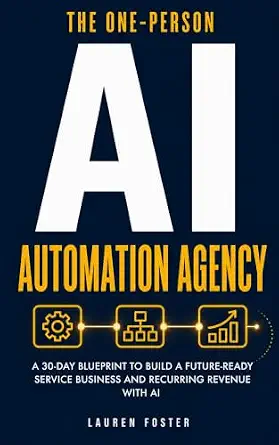
The One-Person AI Automation Agency: A Practical 30-Day Blueprint to Build a Future-Ready Service Business, Win Small-Business Clients, and Create Recurring Revenue with Artificial Intelligence
Every other title in this roundup teaches you to automate your own business; this one teaches you to sell automation to others. That shift in audience is what earns it a slot. The 30-day blueprint structure gives it a pace and accountability that AI Automation for Small Businesses: Build Semi-Passive Income Systems lacks, and its focus on recurring-revenue client work is a genuinely different business model rather than a repackaged productivity guide. The catch: compared with The No-Code AI Automation Handbook, which assumes no prior knowledge, this book leans on the reader already understanding AI and automation basics. It also stays light on technical build instructions — you will deliver the service using skills learned elsewhere. As a business-launch plan, though, it stands alone in this lineup.
Pros:- Concrete 30-day timeline that turns a vague idea into a launch schedule
- Focused specifically on winning small-business clients, not generic marketing advice
- Built around recurring revenue rather than one-off projects
- Tailored to solo operators with no team or budget required
Cons:- Skips detailed technical instruction — you must source AI skills elsewhere
- Assumes prior familiarity with AI and automation concepts
- The 30-day pace may be unrealistic for complete newcomers
Best for: Freelancers and solo entrepreneurs who already know some AI basics and want a structured plan to launch a client-services business with recurring revenue
Not ideal for: Small-business owners automating their own operations — this is about selling automation services, not running your company with them
- Format:Kindle eBook / Paperback
- Topic Focus:Starting a one-person AI automation agency
- Structure:30-day step-by-step blueprint
- Revenue Model:Client services with recurring revenue
- Audience:Solo entrepreneurs and freelancers with baseline AI knowledge
- Technical Depth:Business-building focus; limited implementation detail
Our verdict“Pick this only if your goal is building an AI services agency for other small businesses — everyone else should choose an internal-automation guide.”

How We Picked
I judged every guide on four factors that matter to a small business owner with limited time and budget. Actionability came first: does the book give specific workflows, prompts, or step-by-step builds you can implement this week, or does it stay at the strategy level? Tool accessibility was second — guides built around free or low-cost tools scored higher than ones assuming enterprise budgets. Time-to-value measured how quickly a reader could realistically see results, and audience fit checked whether the book actually addresses small business constraints like solo teams and thin margins rather than corporate scenarios.
The ranking order reflects a simple philosophy: for a small business owner, a guide that automates one real process this month beats one that theorizes about transformation for a year. That is why hands-on workflow handbooks cluster at the top, broad tool-mastery guides sit in the middle, and motivational or income-pitch titles land at the bottom — not because they are badly written, but because they answer a different question than the one most buyers are asking.
| AI automation software for small businesse | Format | Audience | Skill level |
|---|---|---|---|
| AI-Powered Automation and Work | Kindle eBook | Small business owners | — |
| AI Business Automation System | Kindle eBook | Non-technical beginners | — |
| ChatGPT for Business: The 10X | Kindle eBook | Business owners and managers | — |
| AI Automation for Small Busine | Kindle eBook | Small business owners | — |
| Operational AI Profit Wave: Ma | Kindle eBook | Business leaders and entrepreneurs | — |
| n8n for Business Automation: H | Kindle eBook | — | Intermediate |
| The No-Code AI Automation Hand | Kindle eBook | — | Beginner |
| ChatGPT for Entrepreneurs and | Kindle eBook | — | Beginner to intermediate |
| Upskill or Out: AI | Kindle eBook | — | All levels |
| AI Automation for Small Busine | Kindle eBook | — | Beginner to intermediate |
| AI for Small Business: From Ma | Kindle eBook / Paperback | Small-business owners and managers | Unspecified — general business audience |
| The One-Person AI Automation A | Kindle eBook / Paperback | Solo entrepreneurs and freelancers with baseline AI knowledge | — |
Factors to Consider When Choosing AI Automation Software For Small Businesses
Before picking any guide in this category, it helps to understand what actually separates a useful AI automation resource from an expensive motivational lecture. These are the factors I would weigh before clicking buy.Know Whether You Want Strategy or Execution
The single biggest mistake buyers make is grabbing a book that promises “transformation” when what they need is a checklist for automating invoice follow-ups. Strategy books explain why AI matters, what the landscape looks like, and how to think about adoption — valuable if you are still skeptical or pitching AI adoption to partners. Execution books assume you are already convinced and jump straight into building. If you cannot name three repetitive tasks you want to eliminate, start with a strategy-leaning guide. If you can, skip the persuasion entirely and buy the most tactical book you can find. Mixing up these two needs is why so many business books get abandoned a third of the way through.
Check Which Tools the Guide Teaches
Every practical AI automation guide is built around specific tools — n8n, Zapier, Make, ChatGPT, or others — and that choice has real cost consequences. Guides teaching free or self-hosted tools like n8n keep your ongoing costs near zero but demand more setup effort. Guides built on Zapier or paid AI subscriptions can be faster to launch but quietly add $30–200 per month as your usage grows. Before buying, check the book’s description or table of contents for tool names, and confirm those tools fit your budget at the volume you will actually run. A brilliant guide for the wrong platform is a shelf decoration.
Match the Guide to Your Technical Comfort Level
Be honest about whether “no-code” means no-code for you. Some books labeled beginner-friendly still expect you to understand APIs, webhooks, or spreadsheet formulas. Others genuinely hold your hand through every click. If the sight of a settings panel makes you anxious, prioritize guides organized around a single tool with screenshots, not ones covering a dozen platforms in survey fashion. The opposite mistake is just as costly: technically confident owners often outgrow hand-holding books within a week and regret not buying the deeper n8n or workflow-engineering guide from the start. Skimming a free sample chapter before buying is the cheapest way to calibrate this.
Watch for Hidden Agendas
A noticeable share of AI books in 2026 are lead magnets — the book is cheap, but the real product is an upsold course, community, or consulting package. That does not automatically make them bad; some of the best workflow content lives in these funnels. But it does mean you should read reviews looking for complaints about constant upselling or “the real content is behind the paywall.” Similarly, be wary of guides that promise semi-passive income or agency riches. Those are legitimate topics, but they solve the problem of building a new business, not running the one you already have. Know which problem you are buying for.
Factor In How Fast AI Advice Goes Stale
AI tools change interfaces, pricing, and capabilities every few months, which means screenshot-heavy guides can age badly. Books focused on durable principles — how to map a process, how to structure a prompt, how to identify automation candidates — hold their value far longer than ones tied to a specific version of a specific dashboard. The best guides acknowledge this by teaching frameworks first and tool steps second. When comparing two similar titles, check the publication date and whether the author has committed to updates. A slightly older book with evergreen frameworks often beats a newer one that is already drifting out of date.
Consider Whether You Need One Book or Two
A common pattern among owners who succeed with automation is buying a tactical guide plus a reference guide, not hunting for one book that does everything. The tactical guide gets you started this week; the reference guide (like a 100-workflow playbook) becomes something you return to as new bottlenecks appear. Given that most of these titles cost less than a single hour of a consultant’s time, buying two well-matched books is usually smarter than agonizing over one. The exception is beginners, who are better served by finishing one focused book completely before adding a second. Half-read automation guides automate nothing.
Frequently Asked Questions
Do I need coding skills to use AI automation as a small business owner?
No, and that is exactly why the no-code category exists. Modern platforms like n8n, Zapier, and Make let you connect tools through visual drag-and-drop builders, and most beginner-oriented guides assume zero programming background. That said, comfort with logic matters more than code: if you can describe a process as “when this happens, do that,” you can automate it. Where coding knowledge helps is with edge cases — custom API calls, unusual data formats, or heavy data processing. If you hit those walls later, a freelancer can handle the technical piece for a one-time fee while you keep the strategy in-house.
Is it better to learn a free tool like n8n or start with something like Zapier?
It depends on volume and appetite for learning. n8n is free when self-hosted and has no per-task billing, which makes it dramatically cheaper once you run more than a handful of automations — but the initial learning curve is steeper and self-hosting requires some technical comfort or a small hosting fee. Zapier and similar platforms are faster to set up and friendlier for non-technical users, yet costs climb quickly as task counts grow. A reasonable rule: if you plan fewer than five simple automations, either works; if you expect to automate heavily or want to scale, investing a weekend in n8n pays for itself within a month or two.
How much time do I realistically need before AI automation saves me time?
Expect your first genuinely useful automation to be running within a few days of focused effort — not hours, and not months. The initial time investment goes into mapping your processes honestly, which most owners find is the real bottleneck, not the tools. A realistic first-month target is automating two or three repetitive tasks that eat 30–60 minutes each per week, which means the work pays back within weeks. The mistake to avoid is trying to automate everything at once; guides that push a single quick win first consistently produce better outcomes than ones that outline a sprawling 90-day overhaul.
Are the income-focused AI books worth it if I just want to run my own business better?
Usually not, and this is a common purchase mismatch. Books about building an AI automation agency or generating semi-passive income are written for people who want to sell automation as a service. Their workflows center on client acquisition, pricing, and deliverables — not on streamlining an existing operation. That said, there is a middle path: some owners pick up a second income stream by automating their own business first, then selling the same setups to peers in their industry. If that appeals to you, one income-focused book can serve double duty. If it does not, spend your money on an operations-focused guide.
Will an AI automation guide written in 2024 or 2025 still be useful in 2026?
Partially — it depends on what the book teaches. Frameworks for identifying automation opportunities, structuring prompts, and mapping workflows stay relevant because they are tool-agnostic. What ages poorly is anything tied to specific screens, menus, or pricing, since AI platforms redesign interfaces and shift plans multiple times a year. When evaluating an older title, check whether reviewers complain about outdated instructions, and favor authors who publish updates or maintain a companion website. A good strategy is to buy the most recent edition available and treat any step-by-step instructions as roughly right rather than exactly right, expecting minor adjustments as you follow along.
Conclusion
For most small business owners, The No-Code AI Automation Handbook is the best overall choice — it is built around a concrete outcome, assumes no technical background, and gets automations live in days. The best value pick is n8n for Business Automation, which pairs a modest cover price with a genuinely free platform, making it the smartest long-term bet for cost-conscious owners willing to climb a slightly steeper curve. For beginners, ChatGPT for Entrepreneurs and Small Business is the gentlest on-ramp, covering marketing, customer service, and content in familiar terms before you touch a workflow builder. As a premium-style reference, ChatGPT for Business: The 10X Playbook earns its keep through sheer volume — 100 workflows you will return to for a year. And for a specific need, The One-Person AI Automation Agency stands alone as the right buy if your goal is selling automation services rather than automating your own shop. Whichever route you take, pick one book, finish it, and automate one real process before buying anything else.
Fall Picks
fall essentials
As an affiliate, we earn on qualifying purchases.