
To use neuromorphic computing boards for machine learning experiments, start by understanding their core principles like spike-based, event-driven processing and how they mimic biological neurons. Configure the hardware by setting neuron parameters and encoding your data into spike trains using techniques like rate or temporal coding. Leverage the platform’s parallel processing capabilities and utilize visualization tools to monitor network activity. Keep experimenting with parameters to optimize performance, and if you continue exploring, you’ll uncover even more ways to maximize these systems.
Key Takeaways
- Load and encode datasets into spike trains using appropriate coding schemes compatible with neuromorphic hardware.
- Configure network parameters, including neuron thresholds and synaptic weights, leveraging hardware SDKs or software tools.
- Deploy the spiking neural network onto the neuromorphic board and utilize its parallel processing capabilities for training and inference.
- Monitor spike activity and network responses with visualization tools, adjusting parameters to optimize performance.
- Exploit hardware acceleration features and on-chip learning rules to enhance experiment efficiency and machine learning outcomes.
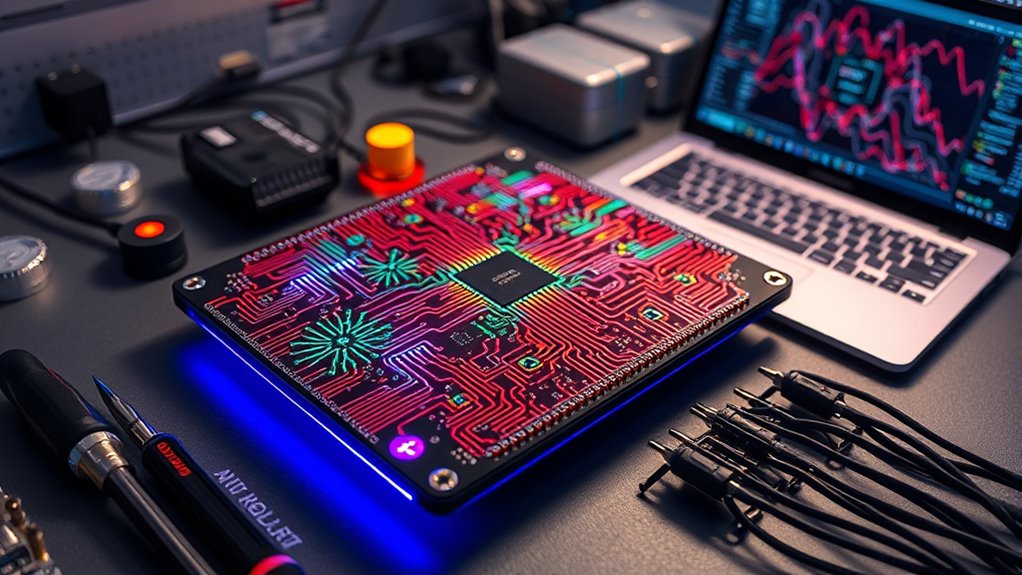
Neuromorphic computing boards are transforming machine learning by mimicking the neural structures of the human brain to process information more efficiently. These boards leverage spiking neural networks (SNNs), which closely resemble biological neurons by transmitting discrete spikes of activity rather than continuous signals. This architecture enables faster, more energy-efficient processing, making neuromorphic hardware ideal for real-time applications. As you set out to perform machine learning experiments, understanding how to harness these features is essential.
First, you’ll want to familiarize yourself with the core principles behind spiking neural networks. Unlike traditional neural networks, SNNs operate asynchronously, with neurons firing only when a specific threshold is reached, much like biological neurons. This spike-based communication allows for sparse and event-driven computation, reducing power consumption and increasing processing speed. When deploying SNNs on neuromorphic hardware, you’ll typically use specialized software frameworks or SDKs designed for these architectures. These tools help you configure neuron parameters, synaptic weights, and spike timing, giving you control over how your network learns and responds.
Hardware acceleration is a key advantage of neuromorphic boards. They are built to execute neural computations at hardware level, drastically reducing latency compared to software simulations on traditional computers. When working with neuromorphic hardware, you should focus on optimizing your network architecture for the platform’s capabilities. For example, many neuromorphic boards support parallel processing of multiple neurons and synapses, so designing your network to leverage this parallelism can markedly boost efficiency. Additionally, hardware acceleration enables rapid training and inference cycles, so you can iterate quickly during experimentation.
To get started, load your dataset into the development environment compatible with your neuromorphic board. Prepare your data by encoding it into spike trains, which can be achieved through various encoding schemes like rate coding or temporal coding. Once encoded, you can load your spike data into the hardware, configure your network parameters, and run your experiments. Keep an eye on the spike activity and network responses, adjusting your parameters as needed to improve accuracy or efficiency. Many neuromorphic platforms include visualization tools that help you monitor spike patterns and synaptic changes in real time.
Finally, take advantage of hardware acceleration by tuning your network to exploit the board’s architecture fully. Use parallel processing capabilities, optimize your synaptic weight initialization, and leverage on-chip learning rules if available. This approach not only accelerates your experiments but also provides insights into how neuromorphic systems can outperform traditional hardware in specific machine learning tasks. Understanding the importance of contrast ratio and other image quality factors can be crucial when applying neuromorphic techniques to visual data processing, as they impact the clarity and detail of the outputs. By mastering these techniques, you’ll activate the full potential of neuromorphic computing boards for your machine learning experiments, pushing the boundaries of efficient, brain-inspired artificial intelligence.

Canlarriz Digital Menu Board 18.5 inch Desktop Digital Signage Display Advertising Screen for Stores Restaurants and Commercial Display 700 nits Ultra-High Brightness Free Web Content Editor Android
【Remote Management】: The electronic menu board supports cross-platform remote control via smartphones, computers, and tablets, and can intelligently...
As an affiliate, we earn on qualifying purchases.
Frequently Asked Questions
What Are the Main Advantages of Neuromorphic Boards Over Traditional Hardware?
You benefit from neuromorphic boards’ brain-inspired architecture, which mimics neural processes for more efficient computation. They excel at real-time processing, enabling faster responses with lower power consumption compared to traditional hardware. This makes them ideal for applications like sensory data analysis and robotics. Their adaptive, parallel nature allows for more natural learning and inference, giving you a significant edge in developing intelligent, energy-efficient systems.
How Do Neuromorphic Boards Handle Large-Scale Data Processing?
Ever wondered how neuromorphic boards handle large-scale data processing? They excel by efficiently integrating sensors and encoding data in a way that mimics biological neural networks. You can connect multiple sensors to gather diverse data streams, then use specialized encoding techniques to convert this information into neural signals. This approach allows the boards to process vast amounts of data in real-time, enabling scalable, energy-efficient machine learning experiments without overwhelming traditional hardware limits.
Are Neuromorphic Boards Compatible With Existing Machine Learning Frameworks?
Yes, neuromorphic boards are compatible with existing machine learning frameworks through software integration. You can connect them using APIs and SDKs designed for hardware compatibility, allowing you to adapt traditional models for neuromorphic architectures. While some adjustments may be necessary, most frameworks support this integration, enabling you to leverage neuromorphic computing’s efficiency and speed for your machine learning experiments seamlessly.
What Are the Power Consumption Differences Between Neuromorphic and Conventional Systems?
Imagine your system running smoothly like a well-oiled machine, with neuromorphic boards using markedly less energy than conventional systems. You’ll notice notable power savings because neuromorphic architectures mimic the brain’s energy-efficient processes, consuming far less power during operation. This enhanced energy efficiency means you can run complex machine learning experiments longer without overheating or draining resources, making neuromorphic boards a smart choice for sustainable, low-power AI applications.
How Can I Troubleshoot Hardware Issues With Neuromorphic Computing Boards?
To troubleshoot hardware issues with neuromorphic computing boards, start with hardware diagnostics to identify faulty components. Check connections, power supplies, and make certain proper cooling. If you find damaged parts, perform component replacement carefully, following manufacturer instructions. Keep your system updated with the latest firmware, and consult the troubleshooting guide for specific error codes. Regular maintenance and thorough diagnostics will help you quickly resolve hardware problems.

QIXZOCV MWE 32 Inch Digital Signage Display, Portable LCD Digital Kiosk, Advertising Display Poster, Android Kiosk with Auto Media Player, HDMI/USB
【High-Quality Display】This MWE-QIXZOCV digital signage kiosk features an IPS display screen with FHD image and video quality, offering...
As an affiliate, we earn on qualifying purchases.
Conclusion
As you explore neuromorphic computing boards, you’ll find yourself stepping into a world where brain-like efficiency meets cutting-edge innovation. Imagine your experiments sparking to life like neurons firing in perfect harmony, coincidence aligning to open new possibilities. With each connection made and data processed, you’re not just running tests—you’re shaping the future of machine learning. Embrace this synergy, and watch your ideas ignite like sparks in a neural network, transforming possibilities into reality.

PWR4GTR 15.6" Digital Signage Capacitive Touchscreen Advertising Display with Adjustable Stand, 10000mAh Battery, Android 11 Commercial LCD Monitor with Auto Play, Wireless Screen Mirroring, 4+64GB
10-Point Capacitive Touch Screen: The 15.6" LCD monitor features a 2K FHD touch panel for a high-definition visual...
As an affiliate, we earn on qualifying purchases.

Canlarriz Digital Signage Display 50 inch Wall Mount Digital Menu Board for Restaurants and Stores Advertising Screen 1000 nits Ultra-High Brightness 4K UHD Free Web Content Editor Android 4GB + 32GB
【Ultra-thin ultra-narrow bezels】Digital signage with a 6.8mm ultra-narrow bezel delivers a seamless visual experience. Paired with a 3.5cm...
As an affiliate, we earn on qualifying purchases.