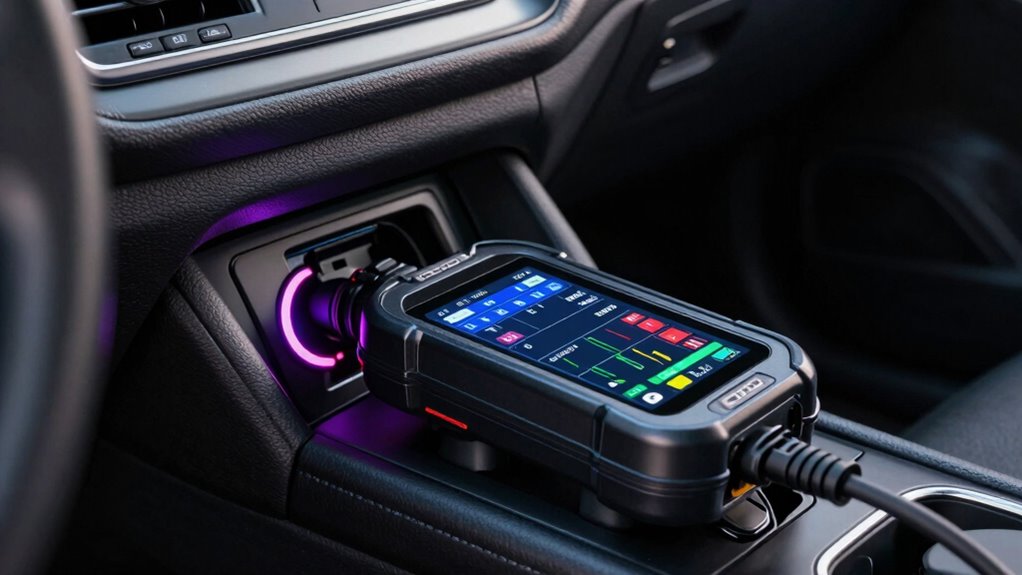

An OBD2 scanner can tell you a lot about your vehicle’s health, like identifying specific problems through diagnostic trouble codes (DTCs). It also provides real-time data such as engine temperature, RPM, and sensor readings, helping you understand what’s happening under the hood. While these tools guide repairs and can reset warning lights after fixes, understanding how to interpret their findings can make a big difference. Keep exploring to learn more about what your scanner can reveal.
Key Takeaways
- OBD2 scanners retrieve Diagnostic Trouble Codes (DTCs) to identify specific vehicle issues.
- They provide real-time data such as engine temperature, RPM, and sensor readings for deeper analysis.
- Scanners can reset warning lights and clear fault codes after repairs.
- Compatibility with vehicle protocols is essential for accurate readings and effective diagnostics.
- They offer guidance but do not directly fix problems; interpretation of data is necessary.
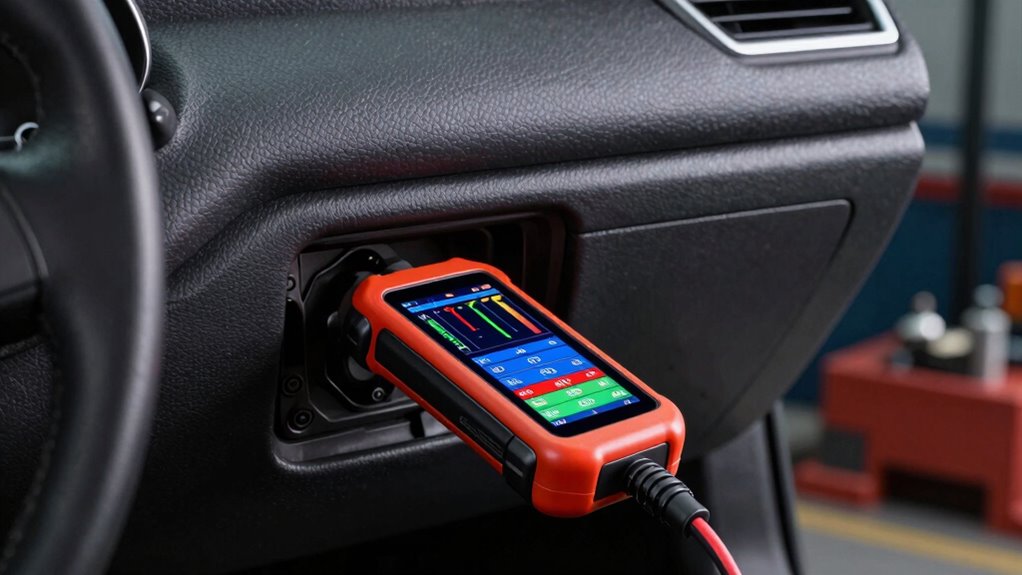
If you’ve ever wondered how to quickly diagnose car issues without visiting a mechanic, OBD2 scanners are the tools you need. These compact devices connect to your vehicle’s onboard computer, allowing you to access crucial information about your car’s health. One of the main advantages of using an OBD2 scanner is understanding vehicle compatibility. Not all scanners work with every vehicle, so it’s necessary to choose one that matches your make and model. Most modern scanners support a wide range of vehicles, including cars, trucks, and SUVs from various manufacturers, but verifying compatibility ensures you get accurate readings and avoid frustration. Once connected, the scanner communicates with your vehicle’s computer system, retrieving diagnostic trouble codes (DTCs) that point directly to specific issues.
Diagnostic accuracy is where OBD2 scanners truly shine. Instead of guessing what’s wrong, you get precise trouble codes that can tell you exactly what’s malfunctioning. These codes help you identify problems like engine misfires, sensor failures, or emissions system issues. The better the scanner’s technology, the more reliable its readings, giving you confidence in your diagnostics. Many advanced scanners also provide real-time data, such as engine temperature, RPM, or oxygen sensor readings, which can help you understand underlying problems more thoroughly. This immediate access allows you to determine whether an issue is minor or serious, often saving you money and time by avoiding unnecessary trips to the mechanic. Additionally, understanding vehicle diagnostic systems can help you better interpret the information provided by your scanner. Furthermore, familiarity with OBD2 protocols can enhance your ability to troubleshoot effectively across different vehicle brands. A good understanding of how different components communicate within the vehicle’s electronic control systems can also improve your diagnostic skills. Recognizing these communication protocols can be essential for accurate diagnostics, especially when working with less common vehicle makes.
However, keep in mind that while OBD2 scanners can tell you a lot, they don’t fix problems directly. Instead, they serve as a diagnostic tool that guides you toward the root cause. For instance, if your scanner shows a code related to the oxygen sensor, you’ll know where to focus your repairs or what to tell your mechanic. Plus, many scanners offer additional features like resetting warning lights or clearing codes once repairs are complete. This function guarantees that once you address the issues, the warning lights won’t stay on, giving you peace of mind and confirming that the problem has been addressed.

ANCEL AD310 Classic Enhanced Universal OBD II Scanner Car Engine Fault Code Reader CAN Diagnostic Scan Tool, Read and Clear Error Codes for 1996 or Newer OBD2 Protocol Vehicle (Black)
CEL Doctor: The ANCEL AD310 is one of the best-selling OBD II scanners on the market and is…
As an affiliate, we earn on qualifying purchases.
As an affiliate, we earn on qualifying purchases.
Frequently Asked Questions
Can OBD2 Scanners Diagnose All Engine Problems Accurately?
OBD2 scanners can’t diagnose all engine problems accurately. While they provide valuable diagnostic accuracy for many issues and can help with emission testing, they mainly detect sensor malfunctions and engine trouble codes. More complex problems, like mechanical wear or internal engine damage, often require a professional mechanic’s inspection. So, use an OBD2 scanner as a helpful starting point, but don’t rely on it for a complete diagnosis.
Do OBD2 Scanners Work on Motorcycles or Only Cars?
OBD2 scanners generally work on cars and some motorcycles, but their motorcycle compatibility is limited. You might find specialized motorcycle diagnostic tools more effective because standard OBD2 scanners can’t access all motorcycle systems. Scanner limitations include compatibility issues and restricted data access, so if you own a motorcycle, make sure your scanner supports it. Otherwise, you might need a motorcycle-specific diagnostic device for accurate readings and troubleshooting.
How Often Should I Use an OBD2 Scanner for Maintenance?
You should use an OBD2 scanner regularly, ideally during routine maintenance or if you notice performance issues. Check sensor calibration and emissions systems to guarantee everything runs smoothly. Use it before emission testing to confirm your vehicle’s systems are functioning correctly. Frequent scans help catch problems early, saving you money and preventing breakdowns. Aim for monthly or quarterly scans, especially if your vehicle is older or has recent repairs.
Are There Any Legal Restrictions on Using OBD2 Scanners?
You might think there are strict legal restrictions on using an OBD2 scanner, but generally, you’re free to use them for personal diagnostics, provided you follow legal compliance and privacy concerns. Laws vary by state or country, so it’s wise to check local regulations. Avoid sharing or mishandling sensitive data from your vehicle, as privacy concerns could lead to legal issues. Always use OBD2 scanners responsibly to stay within legal boundaries.
Can OBD2 Scanners Predict Future Vehicle Failures?
OBD2 scanners don’t predict future vehicle failures directly, but they use predictive analytics to identify potential issues based on current data. This helps you anticipate problems before they become serious, enabling better maintenance scheduling. By monitoring sensor readings and error codes, you can catch early signs of wear or malfunction, allowing you to plan repairs proactively and avoid unexpected breakdowns, ultimately extending your vehicle’s lifespan.

FOXWELL Car Scanner NT604 Elite OBD2 Scanner ABS SRS Transmission
[Easy to Use—Work Out of the Box] + [FOXWELL 2026 New Version] FOXWELL NT604 Elite scan tool is…
As an affiliate, we earn on qualifying purchases.
As an affiliate, we earn on qualifying purchases.
Conclusion
Think of your OBD2 scanner as a trusted compass guiding you through the tangled forest of car troubles. While it reveals the hidden secrets beneath your engine’s hood, it’s up to you to interpret its signals. With this tool in hand, you’re better equipped to navigate the twists and turns of vehicle maintenance, turning potential breakdowns into manageable detours. Embrace your scanner’s wisdom, and keep your journey smooth and trouble-free.

ANCEL AD410 Enhanced OBD2 Scanner, Vehicle Code Reader for Check Engine Light, Automotive OBD II Scanner Fault Diagnosis, OBDII Scan Tool for All OBDII Cars 1996+, Black/Yellow
UNDERSTAND YOUR CHECK ENGINE LIGHT – The ANCEL AD410 OBD2 scanner helps everyday drivers quickly read and clear…
As an affiliate, we earn on qualifying purchases.
As an affiliate, we earn on qualifying purchases.
ANCEL AD310 Classic Enhanced Universal OBD II Scanner Car Engine Fault Code Reader CAN Diagnostic Scan Tool, Read and Clear Error Codes for 1996 or Newer OBD2 Protocol Vehicle (Black)
CEL Doctor: The ANCEL AD310 is one of the best-selling OBD II scanners on the market and is…
As an affiliate, we earn on qualifying purchases.
As an affiliate, we earn on qualifying purchases.