📊 Full opportunity report: Backyard Homes And ADUs: What’s Changing In Proptech? on IdeaNavigator AI — validation score, market gap, and execution plan.
TL;DR
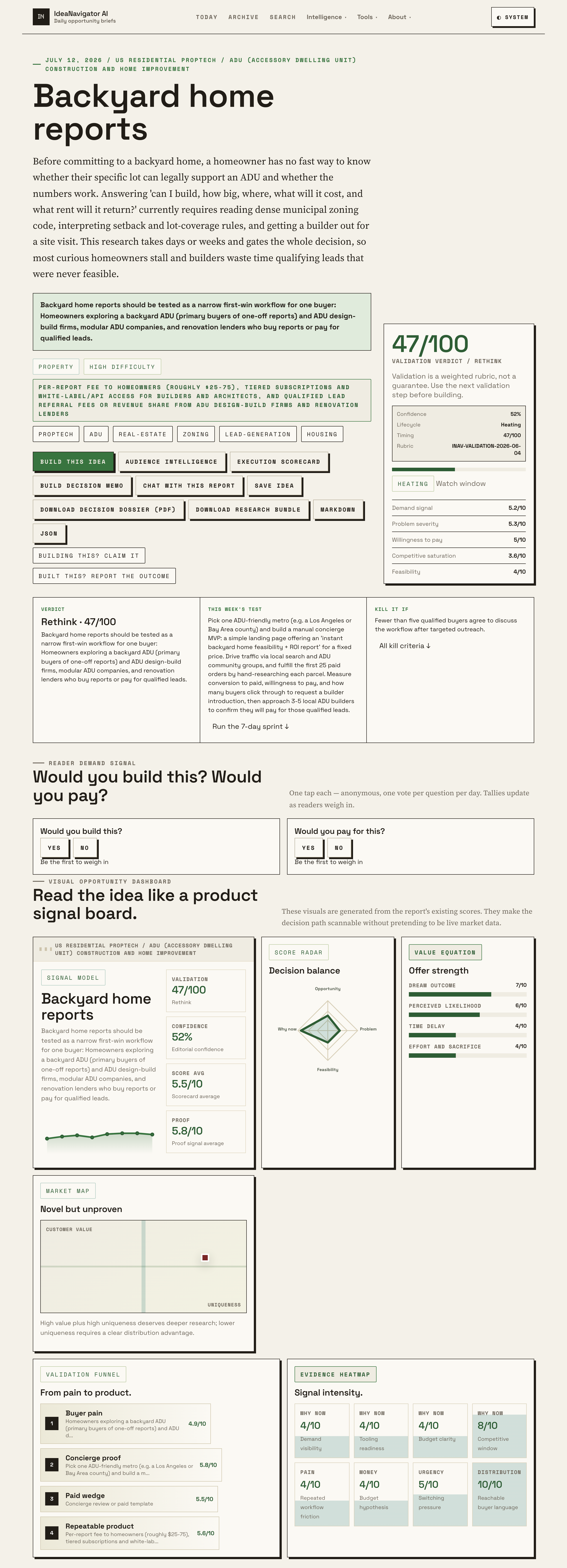
An IdeaNavigator AI proposal describes a paid report that would help homeowners assess whether a specific property could support an accessory dwelling unit (ADU), with estimates for size, costs and rent. The concept has not been shown to be a launched product or validated business; its first proposed test is to fulfill 25 orders manually in one California market.
IdeaNavigator AI has proposed a proptech service that would sell homeowners an address-specific report on whether a backyard accessory dwelling unit (ADU) may fit their property, what it could cost and what rent it might earn. The proposal describes a business concept and a way to test demand, rather than a launched service or confirmed market result.
The suggested report would combine parcel information, local zoning rules and rental comparisons for one launch market. A homeowner would enter an address and receive a PDF with potential ADU types and size limits, setbacks and lot coverage, an estimate of buildable area, a cost range and projected rental income. The proposal calls for starting in a limited area, such as a few California counties, and manually curating local rules.
The proposed customers include homeowners considering a one-off project, as well as ADU builders, modular-home companies and renovation lenders. The suggested revenue streams are homeowner report fees of roughly $25 to $75, subscriptions or data access for industry firms, and referral fees for connecting qualified homeowners with builders or lenders. Those prices and revenue sources are proposals; no sales, partnerships or operating results are reported.
To test the idea, the plan recommends a manual concierge pilot in one ADU-friendly metro. It proposes advertising a fixed-price feasibility and return report, researching the first 25 paid orders by hand, and tracking purchases and requests for builder introductions. The team would then approach three to five local builders to ask whether they would pay for those leads. The plan does not report that this test has begun.
A Faster First Check for ADUs
An address-specific assessment could help homeowners decide whether to spend time and money on a project before commissioning detailed design work or arranging a builder visit. The proposal identifies a familiar early-stage hurdle: a homeowner must work through municipal zoning rules, site constraints and project economics before knowing whether an ADU is plausible. A report that organizes those questions could also help builders spend less time on inquiries for properties that cannot meet local requirements.
The value depends on accuracy and clear limits. Parcel records may show lot boundaries and existing structures, but local rules determine what can be built, and construction costs vary with site conditions, design and labor. A preliminary report could inform a decision, but it would not by itself establish permit approval, a final construction price or guaranteed rental income. Those distinctions would matter to buyers paying for a quick assessment.
The concept also has a business test beyond homeowner interest: builders or lenders must find the resulting leads valuable enough to pay for them. The proposed pilot would examine both willingness to pay for reports and whether homeowners ask for introductions. Until those results exist, the commercial case remains unproven.
California’s ADU Policy Backdrop
The proposal situates the idea in California, where statewide ADU legislation began in 2016 and the state has loosened rules over time. It cites more than 45,000 ADU permits in Los Angeles County in 2023 and says ADUs account for roughly one in five new housing units produced in California. These figures are presented as context for the business opportunity, not as evidence that the proposed report service has customers.
ADU regulations and permitting practices still vary by jurisdiction. The product plan therefore recommends a narrow launch, with a manually maintained rule set for a specific metro or group of counties, rather than immediate nationwide coverage. It proposes combining parcel data with zoning-rule interpretation and local rent comparisons; it does not specify a completed data system or demonstrate that automated code parsing can reliably resolve every property’s eligibility.
Demand and Accuracy Still Untested
No pilot results are provided. It is not known whether homeowners will pay the proposed $25 to $75, whether builders will buy referrals, or how often a report will lead to a project. The proposed first 25 orders and outreach to three to five firms are future validation steps, not completed research.
The proposal also leaves open how the service would handle incomplete parcel records, conflicting local rules, unusual lot conditions and changes in permitting requirements. It gives no measured accuracy rate, cost-estimate methodology or evidence that rent projections would match eventual outcomes. The specific launch county, report turnaround time and process for updating rules are also unspecified.
A Manual Pilot Would Test Buyers
The next step described in the plan is to select one ADU-friendly California market, publish a landing page with a fixed-price offer and manually prepare reports for the first 25 paid customers. The operator would measure how many visitors purchase, whether customers request builder introductions and whether local firms are willing to pay for qualified leads.
Those results would help determine whether to build a web application that generates reports from parcel data and a curated zoning database. No schedule is stated, and there is no confirmed launch or funding announcement. Until a pilot is reported, the proposal remains an unvalidated business concept.
Source: IdeaNavigator AI
Key Questions
Has an ADU feasibility report service launched?
The proposal does not announce a launch. It describes a concept and recommends testing it with a manual pilot.
What would a homeowner report include?
It would estimate possible ADU types and size, setbacks, lot coverage, buildable area, construction cost and rental income using local comparisons.
How much might a report cost?
The proposal suggests a one-time homeowner price of roughly $25 to $75. It does not report an established price or customer purchases.
Would a report confirm that a property can receive a permit?
No permit guarantee is described. The report is proposed as an early feasibility estimate based on parcel information and local rules; final approval would depend on the relevant jurisdiction and project details.
How would the idea be tested?
The plan proposes manually researching the first 25 paid orders in one California market, then asking three to five local builders whether they would pay for qualified leads.
Source: IdeaNavigator AI