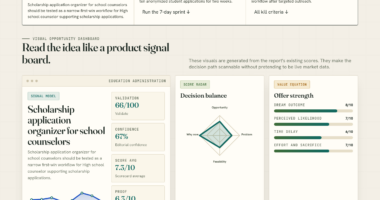
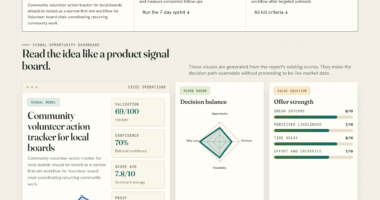
📊 Full opportunity report: Should Your Nonprofit Consider Open-source Tools? on IdeaNavigator AI — validation score, market gap, and execution plan.

Get business pricing on tech for your team
- Business-only prices and quantity discounts
- Tax-exempt purchasing
- Multiple users, one account, clear invoices
TL;DR

An IdeaNavigator AI business proposal suggests helping small nonprofits audit SaaS spending and migrate selected tools to managed open-source alternatives. The concept has not been validated by reported customer results: it proposes testing the service with 20 nonprofits and seeking five paid migrations.
IdeaNavigator AI has proposed a service that would help small nonprofits identify software subscriptions they could replace with managed open-source tools, then handle migration, training and ongoing support. The proposal frames the idea as a way to address the expertise and switching costs that can keep nonprofits paying for multiple SaaS products, but it provides no completed audit results, confirmed savings or customer outcomes.
According to the IdeaNavigator AI proposal, the service would start with a software-stack audit to estimate which subscriptions could be replaced and how much spending might be avoidable. It would then offer a fixed-fee migration to a managed bundle covering areas such as customer relationship management, forms, email and document tools. Training and an ongoing support subscription are part of the proposed offer.
The proposal says the business model would combine one-time migration fees with recurring managed-hosting and support revenue. It identifies small nonprofit executive directors as the target buyers, particularly organizations spending grant money on several SaaS subscriptions without staff who can evaluate alternatives, move data and maintain replacement systems.
To test demand, IdeaNavigator AI recommends auditing 20 nonprofits, publishing average savings and converting five organizations into paid migrations. The proposal also calls for tracking customer retention over a year. Those figures are suggested validation targets, not reported results; the proposal does not say that the audits or migrations have taken place.
The Cost of Switching Software
The IdeaNavigator AI proposal focuses on a practical barrier to software savings: the work required to switch. A nonprofit may find a lower-cost or open-source alternative, but evaluating whether it fits, moving data, training staff and maintaining the new setup all require time and technical skill. Without those resources, keeping existing subscriptions can be the less disruptive choice even when budgets are tight.
A managed service could make alternatives more accessible by bundling the technical work and ongoing help. But lower software-license costs do not, by themselves, establish that a migration will save money overall. Hosting, implementation, support and staff time also affect the total cost. The proposal’s suggested audit and year-long retention tracking would need to show whether savings persist and whether organizations can use the new systems reliably.
For nonprofit leaders, the idea points to a decision that depends on fit as much as price. Replacing tools used for fundraising, communications or internal records can affect daily operations. A credible assessment would need to compare the proposed replacement with each organization’s requirements and account for the cost and disruption of changing systems.
open source CRM software for nonprofits
As an affiliate, we earn on qualifying purchases.
As an affiliate, we earn on qualifying purchases.
A Proposed Nonprofit IT Service
IdeaNavigator AI describes the opportunity within nonprofit IT services. Its proposal says budgets are under pressure as grants tighten and SaaS prices climb, while mature open-source options and managed hosting may have reduced some usability barriers. These are the proposal’s market rationale; it does not provide price data, grant trends or product comparisons to quantify them.
The suggested offer is not simply a list of free software. As described in the proposal, it combines assessment, migration, training and continuing technical support. That distinction matters because open-source software can reduce or avoid some licensing charges, but organizations still need someone to configure, host, secure and maintain the tools. The proposal treats that expertise gap as the service opportunity.
The recommended pilot is deliberately limited: examine a group of nonprofit software stacks, publish the resulting average savings, and seek a small number of paid migrations. That approach would produce more useful evidence than assuming that every organization can use the same bundle. Nonprofits differ in their existing systems, data needs, staff capacity and tolerance for operational change.
As an affiliate, we earn on qualifying purchases.
Savings and Demand Remain Untested
The IdeaNavigator AI proposal supplies no verified savings figures and no evidence that nonprofits have completed migrations or agreed to pay for the service. It also does not identify specific software products, hosting arrangements, migration timelines or support terms. Those details would be needed to compare the proposed bundle with the tools an organization already uses.
The proposal leaves open how an audit would calculate savings, including whether it would count migration costs, hosting, training, support and staff time. It also does not describe how data security, privacy, backups, accessibility, integrations or service outages would be handled. These issues can vary by organization and by software combination; the proposal does not establish that one bundle will meet every nonprofit’s needs.
The suggested target of five paid migrations from 20 audits is a validation goal, not a measured conversion rate. The proposal reports no figures for customer retention, satisfaction or longer-term costs. Until a pilot reports those outcomes, claims that the approach will reliably reduce spending remain unconfirmed.
free document collaboration tools for nonprofits
As an affiliate, we earn on qualifying purchases.
As an affiliate, we earn on qualifying purchases.
Evidence Needed From a Pilot
The next step described in the IdeaNavigator AI proposal is to conduct 20 nonprofit stack audits, make the average potential savings public and try to convert five organizations into paid migrations. A useful report would show how savings were calculated, which costs were included, and how results differed across organizations rather than presenting an average without detail.
After migration, the proposed year-long retention measure could help establish whether customers continue using the service. Further reporting would need to distinguish subscription savings from the full cost of hosting and support, while documenting any service interruptions, staff training needs and ongoing maintenance. The proposal does not give a schedule for the pilot or report that it has begun, so whether and when these results will emerge remains unknown.
For a nonprofit considering a switch now, the proposal supports a cautious first step: review one workflow or group of tools, compare the complete cost of the current and replacement setups, and assess support and operational requirements before expanding a migration. That is a practical implication of the proposal, not a reported outcome from a completed program.
Source: IdeaNavigator AI proposal
managed open-source software migration services
As an affiliate, we earn on qualifying purchases.
As an affiliate, we earn on qualifying purchases.
Key Questions
What service is being proposed?
A service that would audit a nonprofit’s software subscriptions, identify possible open-source replacements, and manage migration, training, hosting and ongoing support.
Does the proposal show that nonprofits have already saved money?
No. It gives no completed audit results or confirmed savings. Publishing average savings is part of the proposed validation plan.
How would the service make money?
The proposed model combines fixed-fee migration projects with recurring managed-hosting and support subscriptions.
What would the proposed pilot test?
It would audit 20 nonprofits’ software stacks, publish average potential savings, seek five paid migrations and track retention for a year. These are targets, not results already achieved.
What should a nonprofit check before switching?
It should compare total costs—including hosting, migration, support and staff time—and review data handling, integrations, accessibility, security and the effect of a change on daily operations.
Source: IdeaNavigator AI
Fall Picks
fall essentials
As an affiliate, we earn on qualifying purchases.