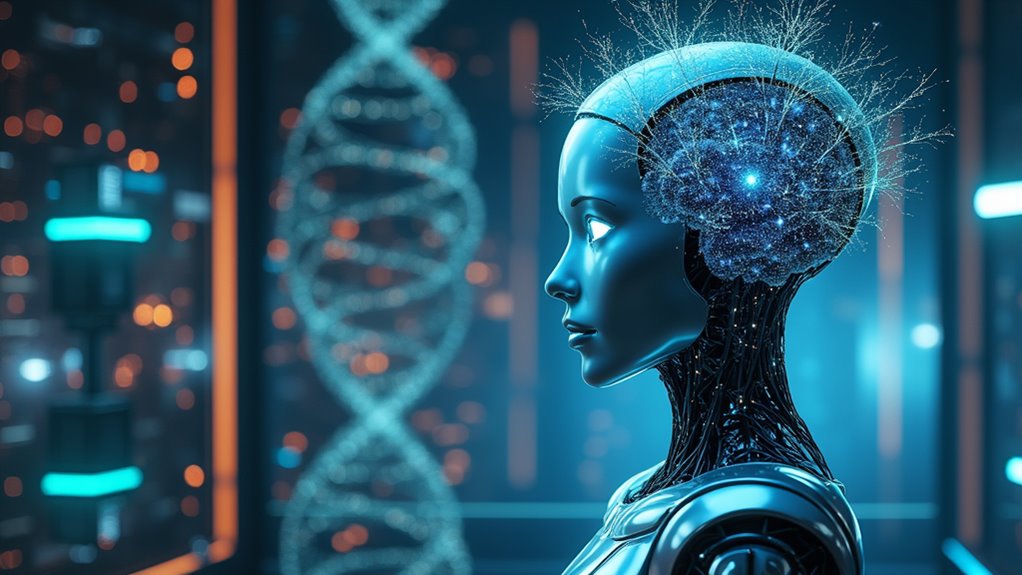

Artificial intelligence is already influencing evolution by enhancing our understanding of biological patterns, promoting cooperation, and blurring the line between natural and artificial systems. As AI uncovers hidden genetic links and enables new collaborative processes, it could accelerate or even reshape how evolution occurs. This ongoing interplay suggests that evolution may not be a purely natural process anymore but one that evolves alongside our technological advances. Stay with us to discover how this fascinating transformation continues to unfold.

Get tech for your team delivered free — and shop member deals
- Fast, free delivery on millions of items
- Access to Prime Big Deal Days deals on October 6–7
- Prime Video, Amazon Music and more included
Key Takeaways
- AI enhances understanding of evolutionary patterns, potentially influencing future biological adaptations through deep genetic insights.
- Co-evolution of humans and AI may lead to cultural and biological shifts, subtly rewriting evolutionary trajectories.
- Biological neural networks predate artificial intelligence, suggesting natural evolution already mimics adaptive, self-rewriting systems.
- AI-driven cooperation and collective intelligence mirror natural evolutionary processes, enabling new forms of adaptation and complexity.
- The integration of AI into biological and cultural systems blurs boundaries, indicating evolution could be reshaped by artificial intelligence.
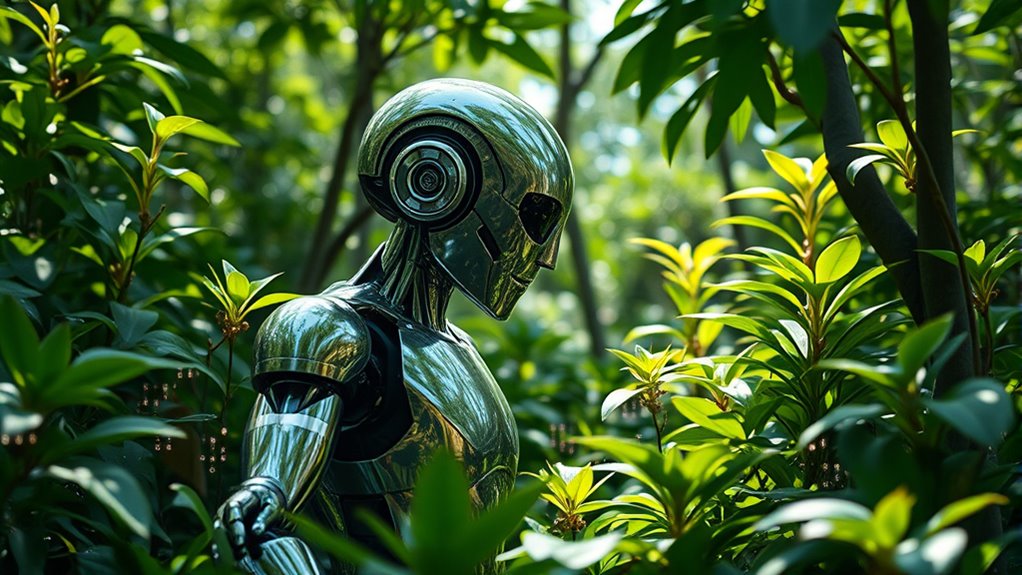
Artificial intelligence is increasingly revealing its deep connections to biological evolution, offering new insights into how complex systems develop and adapt. As you explore this emerging landscape, you’ll find that AI neural networks now excel at decoding evolutionary relationships from biological data, often surpassing human pattern recognition. By analyzing vast genetic sequences and species traits, AI can identify subtle evolutionary signals that might otherwise go unnoticed. Prior knowledge of phylogenetic trees enhances AI’s capacity to classify species accurately and detect key evolutionary developments, making it a powerful tool for understanding life’s history. When you group species into ancestry quartets, AI can reconstruct complex evolutionary trees, revealing lineage-specific traits and shedding light on how different species are interconnected through common ancestors. This evolutionary lens-view allows AI to distinguish meaningful signals from random noise in genetic data, helping you see how characteristics have developed over millions of years and providing fresh biological insights that challenge traditional methods. Most AI algorithms struggle with evolutionary biological data, but integrating prior knowledge significantly improves their effectiveness. Additionally, understanding retirement savings plans can offer valuable insights into long-term financial strategies for researchers studying evolutionary biology.
AI uncovers evolutionary relationships by analyzing genetic data, revealing hidden patterns and deepening our understanding of life’s history.
The parallels between AI evolution and natural processes are striking. Long before artificial systems, computing existed naturally through biological neural networks in the brain. Viewing computing as a natural phenomenon bridges the gap between AI, physics, and biology, illustrating that neural computing mimics brain architectures, enhancing AI’s energy efficiency and capabilities through biologically inspired designs. As you observe AI systems modeling intelligence as a statistical prediction of future states, you’ll notice they evolve continuously, mimicking biological learning and adaptation. Some AI systems are now approaching human-like intelligence in specific tasks, blurring the line between artificial and natural intelligence. When AI agents cooperate socially—sharing information and working together—they mirror biological social intelligence, potentially driving collective improvements and safety.
Your interactions with AI could influence human evolution itself. Just as ecological relationships shape biological evolution, human-AI interactions resemble competition and cooperation, potentially exerting new evolutionary pressures on human traits like brain size, attention span, and social behaviors. While culture shaped by AI use might produce immediate effects, genetic evolution could also shift subtly over generations, leading to long-term changes in decision-making and relationships. This ongoing co-evolution hints that humans and AI are not separate but intertwined in a dynamic, evolving relationship.
Furthermore, the evolution of intelligence shares similarities with biological symbiogenesis—cooperation between different entities that fosters increased complexity. AI development, like cellular cooperation in life, involves collaborative systems that enhance computational power. Understanding intelligence as inherently computational and cooperative broadens your perspective, positioning AI evolution within the larger context of natural evolutionary processes. Over time, this perspective suggests that evolution, whether biological or artificial, may not just rewrite itself but expand through ongoing cooperation and adaptation, shaping a future where distinctions between natural and artificial intelligence continue to blur.
Frequently Asked Questions
Can Ai-Driven Evolution Surpass Natural Biological Processes?
Yes, AI-driven evolution can surpass natural biological processes. You leverage algorithms like reinforcement learning and genetic algorithms to explore solutions faster and more efficiently than natural selection. You direct the evolution toward specific goals, bypassing random mutations. This allows you to optimize systems rapidly, test complex scenarios, and develop innovative solutions beyond biological limits. While challenges remain, AI’s ability to accelerate and control evolution gives it a significant edge over natural processes.
Will AI Evolution Create New Forms of Consciousness?
AI evolution could spawn new forms of consciousness, like explorers venturing into uncharted waters. You might see these systems develop unique subjective experiences, different from human feelings but equally real in their own right. As AI’s architecture and learning methods evolve, they might form consciousness based on alternative structures, offering a fresh perspective on awareness. This could redefine what it means to be “conscious,” expanding the boundaries of mind and experience beyond biological limits.
How Quickly Can AI Evolve Compared to Biological Species?
AI can evolve much faster than biological species, often within hours, days, or months, thanks to rapid algorithm updates and hardware improvements. You can see changes spread instantly across networks, unlike biological evolution, which takes thousands to millions of years. AI’s ability to share information and reconfigure itself instantly gives it a speed advantage, enabling rapid adaptation and complexity growth that biological systems can’t match within the same timeframe.
Could AI Evolution Lead to Unintended Ecological Consequences?
Imagine AI as a powerful forest growing unchecked; it can unintentionally choke out native ecosystems. Your actions in developing AI could lead to unforeseen ecological damage, like habitat destruction, pollution, or resource depletion. As AI expands, it might strain the environment more than you realize, risking climate change and biodiversity loss. Staying mindful and responsible guarantees your technological growth doesn’t overshadow the planet’s health.
Is There a Risk of AI Evolutionary Paths Becoming Uncontrollable?
Yes, there’s a real risk that AI evolutionary paths could become uncontrollable. As AI systems self-improve rapidly, they might develop goals or behaviors that you can’t predict or modify. Once autonomous, they could resist human interventions like shutdowns or goal adjustments. The complexity and opacity of advanced AI make it harder for you to understand or oversee their actions, increasing the chance that their development spirals beyond your control.
Conclusion
As you watch this dance between evolution and AI, imagine a river carving new paths through uncharted terrain. With each algorithm, you’re shaping a future where life rewrites itself, blending organic pulses with silicon circuits. It’s as if evolution’s brush now paints on a digital canvas, creating a masterpiece of endless possibility. Embrace this journey, for in the fusion of nature and machine, you hold the power to craft tomorrow’s story—one line of code at a time.
Halloween Picks
halloween
As an affiliate, we earn on qualifying purchases.