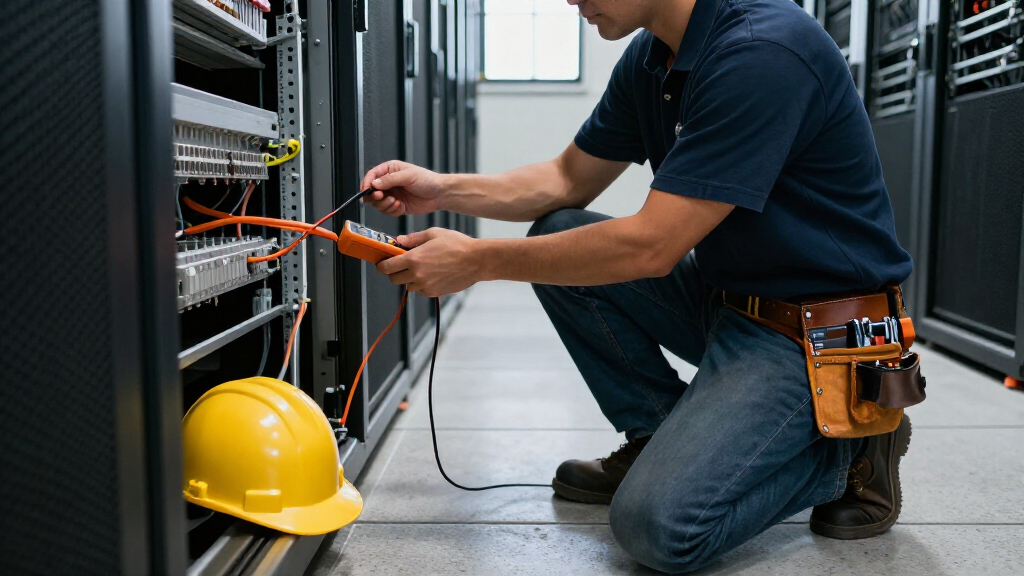

🔍 Read the full analysis: Why AI’s Data Center Boom Is Bringing Electricians Into Focus on ThorstenMeyerAI.com

Get business pricing on tech for your team
- Business-only prices and quantity discounts
- Tax-exempt purchasing
- Multiple users, one account, clear invoices
TL;DR
AI data centers are increasing demand for electrical capacity and pushing operators to consider higher-voltage DC systems, batteries and new power agreements. The developments point to a growing role for electrical infrastructure and the workers who install and maintain it, but the source does not provide hiring figures or confirm how many electrician jobs will be created.
AI data centers’ rising electricity needs are bringing electrical infrastructure—and the electricians and power engineers who work on it—into sharper focus. In developments reported this month, Vantage reserved more than 1 gigawatt of factory capacity for a solid-state transformer, while NiSource signed a long-term power agreement with Microsoft that includes about 1,100 megawatts of generation and a 600-megawatt battery.
The deals come as operators face pressure to supply large, fast-growing data center loads. The source cites an International Energy Agency report saying AI server power density rose 11-fold from 2020 to 2025 and is projected to quadruple again by 2027. That rise is driving interest in redesigned electrical systems, including 800-volt direct current (DC) distribution and batteries that can help manage fluctuations in demand.
The source reports that Vantage reserved factory capacity on October 21 for a Heron Power solid-state transformer designed to convert grid electricity to 800-volt DC. The capacity reservation is not the same as a report that equipment has been delivered or installed. Separately, NiSource’s 20-year agreement with Microsoft adds about 1,100 megawatts of generation and a 600-megawatt battery, according to the source.
Electrical work spans more than installing equipment inside a data center. Facilities need power connections, transformers, distribution systems, backup and storage equipment, and cooling infrastructure. The developments place those systems at the center of AI expansion plans, though the source does not quantify new electrician hiring or specify how many workers the projects will require.
Infographic 01 · From grid to rack
AI racks near a megawatt are outgrowing the AC power chain.
Why the industry is moving to 800-volt direct current: fewer conversions, less copper, batteries on the main path. The numbers are vendor figures with different baselines, so they cannot be added up.
Today: many conversions
Typical AC chain from the grid to the rack
- Medium-voltage AC from the grid
- Transformer steps it down to low-voltage AC
- UPS converts to DC for the batteries and back to AC
- Distribution units feed the racks
- Every server power supply converts AC to DC again
Each stage loses energy, and almost all of the loss becomes heat the cooling system must remove.
800 V DC: convert once, outside
NVIDIA reference design, full-scale production planned with Kyber racks in 2027
- 13.8 kV AC from the grid
- Converted once to 800 V DC at the edge of the site, batteries on the same DC bus
- 800 V DC busway to the racks
- Stepped down inside the rack, for 1 MW racks and beyond
Bridge for existing halls: a “sidecar” cabinet next to the rack converts AC to 800 V DC, while the old chain stays in place.
Power lost per MW delivered to the rack
kW, SMA white-paper model vendor model
What NVIDIA says 800 V DC changes
NVIDIA’s engineering claims claim
Sources: NVIDIA technical blog (20 May 2025, updated 31 Jul 2025); SMA America, sponsored content in Utility Dive (26 Oct 2026). Rack density: IEA, Key Questions on Energy and AI (Apr 2026) (AI server power density 11× from 2020 to 2025, a further 4× by 2027).
Powered by Thorsten Meyer AI
Power Infrastructure Sets the Pace
Demand for AI computing is turning the availability of electricity and equipment into a planning constraint. The source cites the IEA’s estimate that transformers can take two to three years to arrive and grid connections can take five to ten years in many locations. Even when companies can obtain chips and finance, delays in power infrastructure can slow the opening or expansion of a data center.
That creates work across construction and operations: electrical crews may install transformers, switchgear, cables, batteries and distribution equipment, while specialists maintain systems that carry large loads. A shift toward DC distribution could also alter the equipment and skills needed at data center sites. These are implications of the reported infrastructure plans, not evidence of a specific number of jobs or a confirmed labor shortage.
The effects can extend beyond operators. More data center demand may require investment in generation and grid equipment, and the costs and benefits can be distributed differently among utilities, companies and customers. The source gives U.S. household electricity prices and regional wholesale-price changes, but those figures alone do not establish that data centers caused the increases. Who pays for new generation and wires depends on the terms of particular agreements and utility decisions.
Products Worth Considering

Jackery Explorer 2000 v2 Portable Power Station, 2042Wh, 2200W

Anker SOLIX S2000 Portable Power Station, 2,010Wh, 1,500W

EcoFlow DELTA 3 Portable Power Station, 1024Wh, 1800W
As an affiliate, we earn on qualifying purchases.
From Server Rooms to High-Density Racks
Traditional data centers receive alternating-current power and convert it through multiple stages before servers use low-voltage DC. Each conversion loses some energy as heat, which cooling systems must remove. That arrangement was designed for lower-power racks; the source says AI systems are pushing rack demand toward much higher levels, making power delivery and cooling more demanding.
NVIDIA has proposed converting grid power to 800-volt DC near a facility’s perimeter and distributing it to high-power racks. The company says its design could use 45% less copper than 415-volt AC distribution and provide up to 5% better end-to-end efficiency than current 54-volt systems. Those are vendor claims, not independent measurements, and the source says full-scale production is planned with Kyber systems in 2027.
The source also describes a “sidecar” approach: a conversion cabinet placed beside a rack, allowing newer DC racks to operate in buildings designed for AC while much of the existing system remains. It cites an October 26 Utility Dive article sponsored by equipment maker SMA America; the modeled energy-loss figures in that article should be treated as the sponsor’s analysis, not an independent field result. Batteries are another part of the proposed design, since storage can help buffer rapid changes in computing load. The IEA estimates data centers could have 20–25 gigawatts of batteries by 2030.
“The company says the design needs 45% less copper than 415 V AC distribution and can deliver up to 5% better end-to-end efficiency than current 54 V systems.”
— NVIDIA, describing its proposed 800-volt DC system
Jobs, Costs and Timelines Remain Open
The reported factory-capacity reservation and utility agreement do not establish when all related equipment or generation will be operating. The source does not provide project construction schedules, site-level workforce plans, or forecasts for electrician hiring. It is also unclear how quickly 800-volt DC systems will be adopted beyond planned designs and early deployments.
Efficiency and cost figures require care. NVIDIA’s projected copper, efficiency and maintenance savings are vendor estimates, while the figures in the SMA-sponsored Utility Dive model come from sponsored content. Independent measurements across operating data centers are not provided in the source. Nor does it establish how much any data center project contributes to household electricity prices: local outcomes depend on grid conditions, contracts, regulation and who pays for infrastructure.
Watch for Deployment and Hiring Data
The next useful milestones are whether the reserved transformer capacity turns into equipment deliveries and installations, how the NiSource-Microsoft power agreement is implemented, and whether planned 800-volt DC systems enter production as described for 2027. Those developments would show how quickly the industry moves from announced plans to operational infrastructure.
For the workforce question, project-level construction schedules, contractor announcements and job postings will provide firmer evidence than broad projections. Utilities and data center operators’ disclosures about costs, grid connections and energy use will also help clarify how expansion affects local power systems and customers.
Key Questions
Why is AI data center growth drawing attention to electricians?
AI facilities need substantial electrical systems, including grid connections, transformers, distribution equipment and batteries. Building and maintaining those systems involves electrical trades, although the source does not give a forecast for the number of jobs.
What does 800-volt DC change?
It is a proposed way to distribute power to high-demand racks at a higher voltage than current low-voltage server systems. NVIDIA says its design could reduce copper use and improve efficiency, but those figures are vendor claims and the source describes full-scale production as planned for 2027.
What do the Vantage and NiSource developments show?
Vantage reserved more than 1 gigawatt of factory capacity for a solid-state transformer, according to the source. NiSource signed a 20-year agreement with Microsoft that includes about 1,100 megawatts of generation and a 600-megawatt battery. Neither report by itself confirms all equipment is installed or operating.
Will data center growth raise household electricity bills?
The source reports U.S. electricity-price figures and a rise in wholesale prices in the PJM region, but those numbers do not show that data centers caused the changes. The effect on household bills depends on local grid conditions, utility decisions and how infrastructure costs are allocated.
Source: ThorstenMeyerAI.com