TL;DR
President Donald Trump said on November 20 that US companies should not build data centres abroad and threatened a “tremendous tax” if they do. As of the following morning, no order or rule implementing the threat had been published; existing chip export controls remain in force.
President Donald Trump said on November 20 that the United States would not allow American companies to build data centres abroad and threatened a “tremendous tax” on firms that do. As of the next morning, however, no executive order, regulation or tax proposal implementing the threat had been published, leaving companies with overseas projects without a new announced rule to follow.

Get business pricing on tech for your team
- Business-only prices and quantity discounts
- Tax-exempt purchasing
- Multiple users, one account, clear invoices
At a White House news conference after his trip to Asia, Trump said, “We’re not going to allow our companies to build data centers outside of our country.” He then added that companies could build abroad but would face a “tremendous tax.” He also referred to “tremendous penalties,” according to accounts of the remarks. The shift between saying construction would not be allowed and saying it could proceed with a penalty leaves the proposed policy unclear.
Trump gave no tax rate, start date, legal basis or list of affected countries. He mentioned China and Finland, but did not set out how either country would be treated. He said his staff had not heard the proposal from him before the news conference. The White House referred Newsweek to the remarks when asked for details.
A review of the official record described in the source material found no relevant presidential action or Federal Register rule as of the morning of November 21. That means the comments had not themselves changed the rules governing overseas data centre construction. They do not establish whether existing projects, leasing arrangements or purchases of cloud capacity would be covered if a policy were later proposed.
How Overseas Projects Could Be Affected
The threat raises questions for US cloud and AI companies planning where to place computing capacity. Data centres outside the United States can serve customers in other markets, and restrictions or additional costs could affect investment decisions and the delivery of AI services. The remarks do not show that any project has been halted or that firms must relocate existing capacity.
The practical effect depends on what policy, if any, follows. A tax could change project economics; restrictions on building would raise a different set of legal and operational questions. Without a published proposal defining the firms, facilities and activities covered, companies cannot calculate a specific exposure from the announcement alone.
The comments also sit alongside existing US controls on advanced AI chips. Those controls can affect the hardware available to some overseas facilities, but they are separate from a general ban or tax on building data centres abroad. The distinction matters: current chip licensing requirements should not be read as proof that the new threat is already in force.
Products Worth Considering

Samsung Galaxy Tab A11+ Kids Edition, 128GB, Royal Blue

DJI Mic 3 Wireless Microphone (2 Transmitters, 1 Receiver, Charging Case)

Apple AirPods Pro
As an affiliate, we earn on qualifying purchases.
Existing Rules and Legal Routes
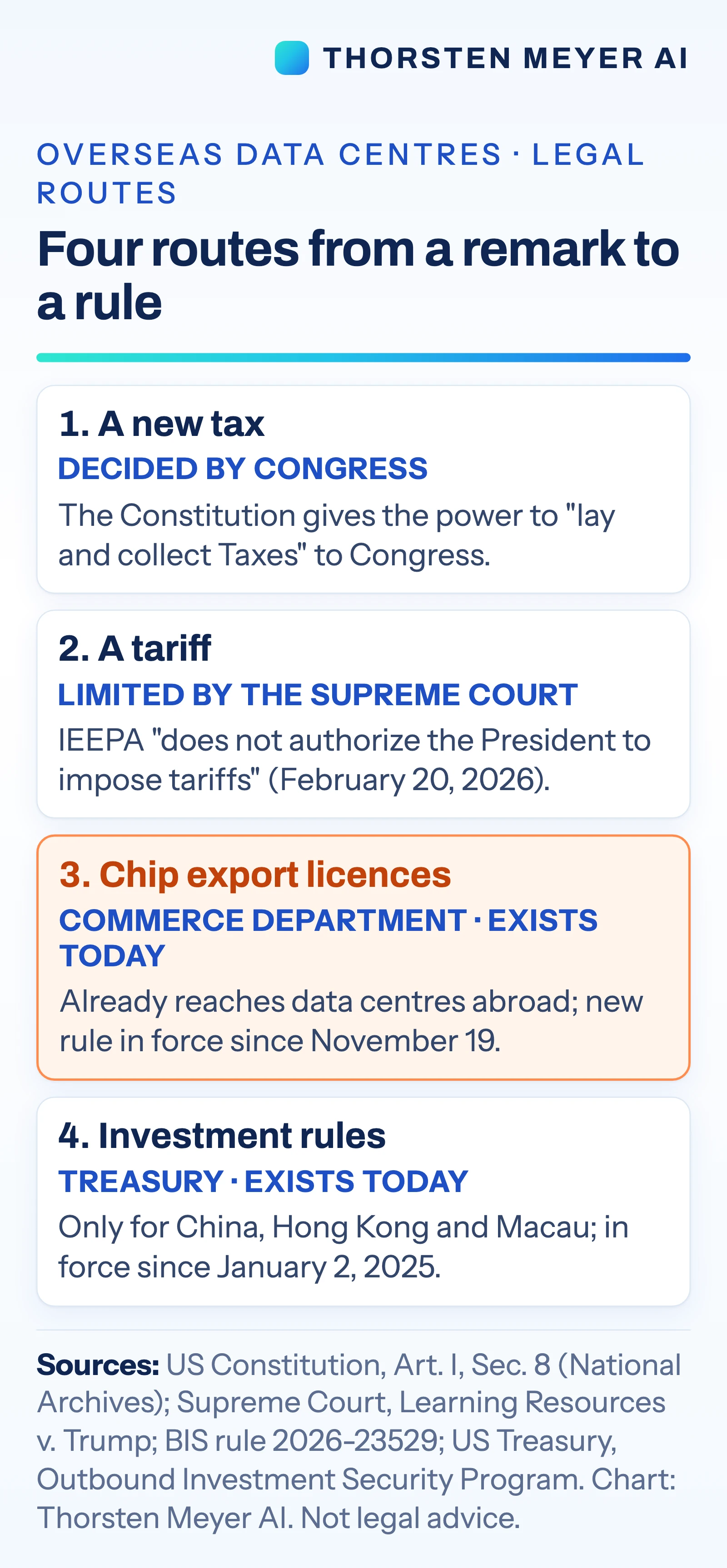
The source material describes a Commerce Department rule effective November 19 that requires licences for advanced AI chips in five countries and applies to data centres serving China-headquartered companies at scale. It also describes a reporting process for US-headquartered companies. These are existing chip-related requirements, not a rule prohibiting US firms from constructing data centres overseas.
A July 2025 executive order, as summarized in the source, set US policy to support the global deployment of US-origin AI technologies, including data centres. Trump’s new remarks point in a different direction, but do not by themselves amend that order or explain how the administration would reconcile the two positions.
The source cites the Constitution’s assignment of federal taxing authority to Congress and a February 20, 2026 Supreme Court ruling that the emergency powers law IEEPA does not authorize the president to impose tariffs. Those points narrow the suggested routes: a new tax would require congressional action, while the cited ruling rules out using IEEPA tariffs as the basis. Export controls on chips are already available as a separate policy tool.
Scope and Legal Basis Remain Open
It remains unclear which companies or countries Trump intended to cover, and whether the remarks referred only to new construction. The comments did not address existing facilities, projects already under way, leased data centre space, or overseas cloud capacity bought from another provider. They also did not identify the “tremendous tax” or penalties, who would administer them, or when they might begin.
The source says the White House had published no implementing action by the morning of November 21 and that the Federal Register contained no rule on the matter. That is a snapshot of the record at that time; it does not establish what the administration may propose later. It is also not clear whether Congress would take up a tax proposal or whether the administration would pursue another legal route.
Watch for a Written Proposal
The next concrete sign of a policy would be published government action: for example, a bill, executive action, agency proposal or formal guidance specifying its authority and scope. Until such details appear, the remarks provide no new compliance deadline or stated tax rate for US firms with overseas data centre plans.
Companies and customers will also be watching for clarification from the White House and relevant agencies about how the threat relates to the existing chip licensing and reporting requirements. The status described here is based on records checked on November 21; any later announcement could change the picture.
Key Questions
Has the United States banned its companies from building data centres abroad?
No ban had been published as of November 21, 2026. Trump said the United States would not allow such construction, but no implementing order or rule was identified in the source material.
Did Trump specify the threatened tax?
No. He called it a “tremendous tax” but gave no rate, start date or details about which companies or projects it would cover.
Do current AI chip controls prohibit overseas data centres?
The source describes existing licensing requirements for advanced AI chips in certain cases, including facilities serving some China-headquartered companies at scale. Those controls are distinct from a general prohibition on building data centres overseas.
What legal authority could support a new tax?
The source notes that the Constitution gives Congress the power to levy taxes and cites a Supreme Court ruling that IEEPA does not authorize presidential tariffs. No legal basis for Trump’s proposed tax was specified in his remarks.
Source: Thorsten Meyer AI