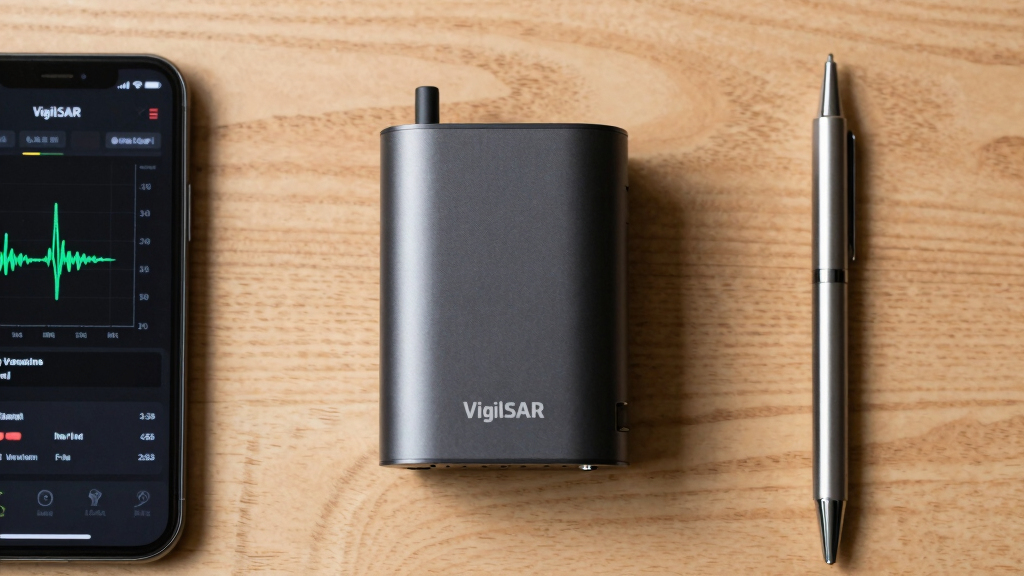

📊 Full opportunity report: VigilSAR: The Object That Isn’t Transmitting on ThorstenMeyerAI.com — validation score, market gap, and execution plan.

Get business pricing on tech for your team
- Business-only prices and quantity discounts
- Tax-exempt purchasing
- Multiple users, one account, clear invoices
TL;DR
VigilSAR is a radar-based platform that detects objects visible on SAR imagery without transponder signals. Its ability to identify ‘dark’ vessels improves maritime security, safety, and law enforcement. The system is based on publicly available data and is targeted at defense and civilian agencies.
VigilSAR has confirmed its ability to detect objects in radar imagery that are not transmitting transponder signals, a capability that enhances maritime situational awareness in all weather conditions. This development matters because it addresses a key gap in identifying vessels engaged in illegal activities or in distress, regardless of weather or darkness.
The platform leverages Synthetic Aperture Radar (SAR) imagery, which can operate day and night through cloud cover, unlike optical satellites. VigilSAR combines detection algorithms with AI classifiers to identify objects and then fuses this data with signals from AIS and ADS-B transponders, as well as open-source information. The core confirmed capability is its ability to flag radar-detected vessels that do not broadcast transponder signals, indicating ‘dark’ objects that could be involved in illegal fishing, sanctions evasion, or distress situations.
This capability is built on the European Space Agency’s Sentinel-1 SAR data, which is publicly accessible. The platform’s broader reach, including commercial satellite constellations and deployment in secure environments, remains in development and is not yet independently verified at scale. VigilSAR’s market approach involves private briefings rather than open pricing, consistent with defense and intelligence sector norms.
VigilSAR — the object that isn’t transmitting
Radar sees through cloud and darkness, when cameras can’t. Fuse it with transponder data and the signal is the one detection no transponder explains.
Independent commentary on public positioning, produced with AI assistance under human editorial oversight. The views are the author’s own and may change. This does not verify or endorse VigilSAR’s capabilities, contracts, or performance. Capabilities on Sentinel-1 / Copernicus reflect a free, public data foundation; commercial-constellation and air-gapped-deployment references reflect stated positioning, not independently demonstrated fact. ISR and related technologies may be subject to export controls and dual-use regulations — lawful, ethical use is solely the operator’s responsibility. Nothing here is an offer, pricing, or operational/safety/legal advice. AI detection and classification can err and require human verification. Product and company names are trademarks of their respective owners; mention does not imply endorsement.
Maritime Security and Rule-of-Law Enhancement
This development is significant because it provides a reliable method for identifying vessels that are intentionally hiding or disabling transponders, which is a common tactic used in illegal fishing, smuggling, and sanctions evasion. It also improves search-and-rescue efforts by detecting distressed vessels in adverse conditions. The ability to detect ‘dark’ objects enhances maritime safety, law enforcement, and sovereignty enforcement, making VigilSAR a valuable tool across multiple sectors.
Products Worth Considering

LG UltraGear 32GX850A-B 32-Inch 4K UHD Glossy OLED Gaming Monitor

Sony WH-1000XM6 Wireless Noise-Canceling Over-Ear Headphones, Blue, Bundle

Apple iPad Air 13-inch (M4), 128GB, Wi-Fi 7, Space Gray
As an affiliate, we earn on qualifying purchases.
Advances in SAR and Maritime Surveillance
Traditional optical satellite imagery is limited by weather, darkness, and smoke, creating gaps in situational awareness. SAR technology overcomes these limitations by providing all-weather, day-and-night imaging capabilities. The detection and classification pipeline, involving AI, is well-established, but VigilSAR’s innovation lies in its data fusion and focus on unaccounted-for radar detections. This approach addresses longstanding challenges in maritime domain awareness, particularly in monitoring vessels that go ‘dark.’
“VigilSAR’s ability to identify objects that appear on radar but lack transponder signals fills a critical gap in maritime security, especially for law enforcement and rescue operations.”
— Thorsten Meyer, remote sensing expert
Unverified Scale and Commercial Readiness
While VigilSAR has demonstrated the core detection capability using publicly available Sentinel-1 data, its performance across commercial satellite constellations, large-scale deployment, and operational integration remains unconfirmed. Details about pricing, full system validation, and real-world operational effectiveness are still emerging and have not been publicly verified.
Next Steps for Validation and Deployment
VigilSAR plans to conduct further demonstrations with private and government partners, aiming to validate its detection and fusion capabilities in operational environments. The company is also preparing for broader commercial and defense sector engagement, with potential pilot programs and integration into existing maritime surveillance systems expected in the coming months.
Key Questions
How does VigilSAR detect vessels that are not transmitting transponder signals?
It uses Synthetic Aperture Radar (SAR) imagery to identify objects based on radar reflections, then fuses this data with transponder signals to highlight vessels that appear on radar but lack transponder broadcasts.
Is VigilSAR available for commercial or civilian use?
Currently, VigilSAR is positioned as a defense and intelligence product, with deployment through private briefings rather than open-market sales. Broader civilian availability is not yet confirmed.
What are the main applications of VigilSAR?
The system is primarily aimed at maritime security, law enforcement, search-and-rescue, and rule-of-law enforcement, especially for detecting illegal fishing, sanctions evasion, and distressed vessels.
How reliable is VigilSAR’s detection capability?
The core detection capability has been demonstrated using publicly available Sentinel-1 SAR data, but full operational reliability across different satellite constellations and environments is still under validation.
What are the limitations of SAR technology in this context?
SAR images are signals rather than visual photos, requiring AI interpretation to identify objects. Weather conditions, signal noise, and false positives remain challenges until further validation.
Source: ThorstenMeyerAI.com