
TL;DR

Get business pricing on tech for your team
- Business-only prices and quantity discounts
- Tax-exempt purchasing
- Multiple users, one account, clear invoices
Google announced TPU 8tx, a system aimed at confidential inference, and TPU 8i Max, designed for AI workloads with very large context windows. The company says the systems add new configurations to its eighth-generation TPU lineup, but the supplied announcement does not include complete specifications or availability details.
Google announced TPU 8tx and TPU 8i Max on Nov. 9, expanding its eighth-generation AI accelerator portfolio to four systems. The company describes 8tx as a system for secure, confidential inference and 8i Max as a configuration for large context windows and high compute density, targeting different needs among enterprise and cloud AI users.
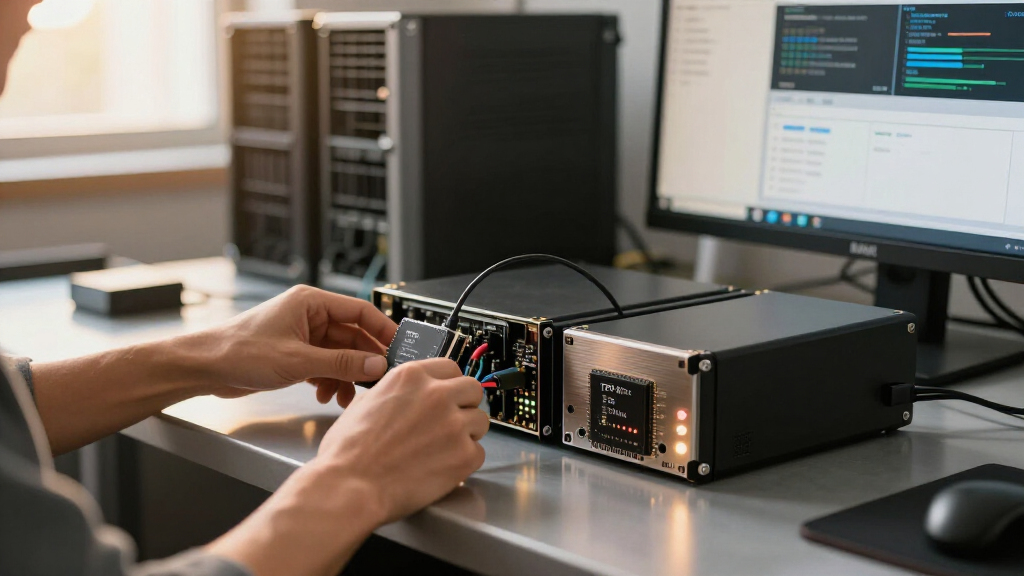
Google says TPU 8tx uses the same silicon as TPU 8t, paired with fifth-generation AMD EPYC CPU hosts and a low-latency network the company calls Boardfly. It is intended for organizations running proprietary models and autonomous agents alongside sensitive information. Google says the system protects data and model weights while they are in active use, rather than only when stored or transferred. Those security and performance descriptions are company claims; the announcement does not provide independent test results.
The company says 8tx can support inference as well as small-scale training, including fine-tuning models on private data, distilling larger models and reinforcement-learning work on agents. Google claims it can deliver up to two times lower latency than TPU 8t, with a near-zero performance penalty. The stated comparison is against TPU 8t, but the announcement excerpt does not give the test conditions or workload details behind that figure.
TPU 8i Max addresses memory capacity and bandwidth for workloads that must keep extensive information available, such as groups of AI agents working across software codebases or processing long video. Google says it combines two low-latency TPU 8i chips in one package. The supplied report ends before giving the system’s full architecture, memory capacity, performance numbers or deployment details, so those specifications cannot be assessed from the available material.
Two Systems for Enterprise AI
The announcement reflects a shift from offering a small number of general-purpose accelerators toward configuring systems for distinct stages and constraints in AI work. Confidential inference matters to businesses and government agencies that want to use models with sensitive data, while large-context processing is relevant to agents that must draw on extensive documents, code or media in a single task.
For cloud customers, the practical question is whether these systems can make workloads easier to run without sacrificing performance, security or cost. Google’s claims about encryption during processing and lower latency could be relevant to regulated organizations, but buyers will need implementation details and evaluations to judge the protection and performance. The 8i Max pitch similarly depends on memory and scaling specifications that are not present in the supplied announcement.
The additions also matter to the competitive market for AI infrastructure. Google says its TPU business now serves nearly 100 customers, spanning sectors such as research, retail and finance. The company did not provide customer names or revenue figures in the material supplied, so the scale and commercial impact of these systems remain difficult to measure.
Products Worth Considering

Apple MacBook Air 13.6-inch Laptop with M5 Chip, 16GB Memory, 512GB SSD, Midnight

DJI Mini 4K Drone with 4K UHD Camera

Amazon Kindle Scribe (3rd Generation), 64GB, 11-inch Display, Graphite, with Premium Pen
As an affiliate, we earn on qualifying purchases.
Google’s Eighth-Generation Lineup
Google introduced TPU 8t and TPU 8i at its Cloud Next event in April 2026. The company positioned 8t for large-scale model training and 8i for real-time reasoning. In its Nov. 9 announcement, Google said the earlier systems offer up to 2.7 times better training performance and 80% better inference price performance, respectively, compared with its previous TPU generation. These are Google’s comparisons; the supplied material does not detail the benchmarks or test conditions.
The new systems are presented as configurations built around existing TPU designs, rather than as wholly new chips. Google distinguishes a chip’s silicon design from a system’s combination of compute, networking, storage, packaging and security. It says this modular approach can let it adapt systems more quickly to customer requirements. With 8tx based on 8t silicon and 8i Max combining two 8i chips in one package, the announcement emphasizes system-level specialization.
Google says the portfolio reflects feedback from external organizations as well as its work with Google DeepMind. It also points to recent PyTorch announcements as part of an effort to make TPUs more accessible to developers and Cloud customers. The four systems now named are TPU 8t, TPU 8i, TPU 8tx and TPU 8i Max.
““Today, we’re taking that a step further, expanding our eighth-generation TPU portfolio with two additional systems.””
Specifications and Access Still Pending
The announcement material provided does not state when either system will be available, which Cloud regions or configurations will support them, or whether customers can deploy them directly in their own data centers. It also omits pricing, capacity limits and complete technical specifications. Those details are needed to compare the systems with other accelerators or determine which workloads can use them.
Google’s performance and security statements are not accompanied here by benchmark methodology, independent verification or a detailed account of the threat model. In particular, the claim of up to two times lower latency for 8tx depends on an unspecified workload and comparison setup. The source material also cuts off during its description of 8i Max, leaving its memory capacity and other technical details unconfirmed.
Availability and Benchmarks to Watch
Customers and developers will need further Google Cloud documentation to learn when the systems can be ordered, what configurations will be offered and how they can access them. More complete specifications for 8i Max and details on 8tx’s confidential-computing protections would help organizations evaluate fit for regulated or memory-intensive workloads.
Independent performance tests, security documentation and customer deployments would provide evidence beyond Google’s announcement claims. Until those details are available, the confirmed development is the addition of two named systems to the eighth-generation TPU portfolio, not a fully documented account of their real-world results.
Key Questions
What did Google announce?
Google announced TPU 8tx and TPU 8i Max on Nov. 9, 2026, bringing its eighth-generation TPU lineup to four systems alongside TPU 8t and TPU 8i.
What is TPU 8tx designed to do?
Google says 8tx is optimized for confidential inference and can also support small-scale training. It is aimed at sensitive enterprise and government workloads, though the supplied announcement does not include independent security evaluations.
What is TPU 8i Max for?
Google describes 8i Max as a system for workloads requiring very large context windows. The company says it combines two TPU 8i chips in one package, but full memory and performance specifications were not included in the source material.
When will the systems be available?
The supplied announcement does not specify availability dates, pricing or supported regions. Google Cloud customers will need further company information to determine when they can access either system.
Are Google’s performance claims independently verified?
Not in the supplied material. Google claims up to two times lower latency for 8tx than TPU 8t, but does not provide the workload conditions or independent test results needed to assess that comparison.
Source: blog.google