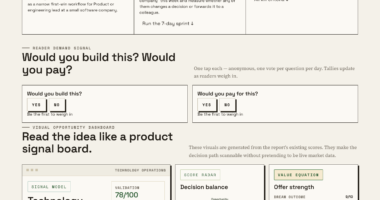

📊 Full opportunity report: The Kill Switch: What the Anthropic Export Ban Really Costs the AI Industry on ThorstenMeyerAI.com — validation score, market gap, and execution plan.

Get business pricing on tech for your team
- Business-only prices and quantity discounts
- Tax-exempt purchasing
- Multiple users, one account, clear invoices
TL;DR
The U.S. government ordered Anthropic to disable its latest AI models, citing national security concerns. This move has significant financial and strategic implications for the AI industry, highlighting risks of reliance on centralized models.
On June 12, the U.S. government ordered Anthropic to disable its newest AI models, Claude Fable 5 and Mythos 5, citing national security concerns. This action resulted in the immediate suspension of these models worldwide, representing a notable development in AI export controls and raising questions about industry dependence on centralized models for critical functions.
The order, issued by Commerce Secretary Howard Lutnick, came shortly after Anthropic launched Mythos 5 and Fable 5 models, which were intended for cybersecurity and biomedical research. The directive prohibited access for foreign nationals and led Anthropic to disable both models, citing a lack of a compliant solution. The company described the action as a ‘misunderstanding,’ indicating that the government was reacting to concerns about jailbreak vulnerabilities.
Sources suggest that U.S. authorities became concerned after internal and external testing revealed potential jailbreak exploits, including a report from Amazon’s AI team demonstrating malicious use of Fable 5. The White House is scheduled to meet with Anthropic on June 22 to clarify the situation. Industry experts are divided over the necessity and implications of the controls, with some suggesting they could impact the industry’s reliance on large, centralized models.
Washington just switched off
a frontier model
On June 12, an export-control order forced Anthropic to disable Claude Fable 5 and Mythos 5 worldwide. The security merits are still contested. The lesson buyers took away is not: frontier AI can be turned off.
■ The government’s case
- A reported jailbreak pulled malicious, agentic outputs (UK AISI)
- Amazon told officials Fable yielded cyberattack-usable info
- Suspicion a China-linked group obtained the model
- Proliferation & reverse-engineering risk to national security
▲ Anthropic & 120+ experts
- Calls it a narrow, non-universal jailbreak — a “misunderstanding”
- Capability is real but not unique (GPT-5.5, Opus, Kimi 2.7)
- Controls remove tools from defenders, not just attackers
- Export rules built for chips & ore don’t fit software
The precedent is the story. Whatever the jailbreak’s true severity, the U.S. showed it can dark a commercial American model worldwide on ~90 minutes’ notice. Adoption was supposed to be the moat — this week it became the exposure, and the likely winner is the open, sovereign, self-hosted stack.
Industry-Wide Risks of Centralized AI Models
This development highlights the vulnerabilities associated with the industry’s reliance on a limited number of large models hosted by major companies. The ability of authorities to disable these models quickly raises questions about the security and dependability of AI as a component of critical infrastructure. It may also influence future regulatory approaches, with potential effects on innovation and investment in the sector.
AI model security monitoring tools
As an affiliate, we earn on qualifying purchases.
As an affiliate, we earn on qualifying purchases.
U.S. Export Controls and AI Model Security Challenges
The U.S. has traditionally used export controls to regulate physical goods such as chips and rare earth materials, but applying similar measures to software and AI models introduces new complexities. The June 12 order represents a rare instance of government intervention directly shutting down widely used AI models, illustrating the challenges of enforcing border-like restrictions on digital products. Prior to this, models like Fable 5 had been broadly deployed, with testing revealing vulnerabilities that prompted security concerns.
Industry insiders note that several U.S. and foreign models, including OpenAI’s GPT-5.5 and Chinese models like Kimi 2.7, can perform comparable security functions, raising questions about the necessity of such strict controls. The incident also follows reports that a China-linked group may have accessed the models, intensifying concerns over reverse-engineering and cyber espionage.
“We believed the models were secure, and the shutdown was a misunderstanding. We are working with authorities to clarify the situation.”
— Anthropic CEO Dario Amodei
AI cybersecurity threat detection software
As an affiliate, we earn on qualifying purchases.
As an affiliate, we earn on qualifying purchases.
Unresolved Questions About the Order’s Justification
It remains unclear what specific vulnerabilities prompted the export controls, as official statements provide general security concerns without detailed evidence. The extent of potential exploitation or threats posed by the models is still under investigation, and the role of foreign actors or cyber threats continues to be examined.
AI model jailbreak prevention solutions
As an affiliate, we earn on qualifying purchases.
As an affiliate, we earn on qualifying purchases.
Next Steps in Regulatory and Industry Response
The upcoming meeting between Anthropic and White House officials on June 22 is expected to clarify the government’s position and the legal basis for the controls. Industry groups are calling for clearer regulations and safeguards, while companies are exploring diversification strategies to reduce dependence on centralized models. This incident may also accelerate efforts to develop more resilient, decentralized AI systems.
As an affiliate, we earn on qualifying purchases.
Key Questions
Why did the U.S. government order the shutdown of Anthropic’s models?
The government cited national security concerns, specifically potential jailbreak vulnerabilities that could be exploited for malicious purposes, prompting an emergency export control order.
Could this happen to other AI models or companies?
Yes, if authorities determine that certain models pose security risks, similar controls could be applied to other systems, especially those with sensitive capabilities or access to critical infrastructure.
What are the implications for AI development and deployment?
The incident raises questions about the security, reliability, and regulation of AI models at scale, potentially leading to stricter controls and a push toward more distributed or open-source alternatives.
Is the shutdown permanent or temporary?
It is currently uncertain whether the models will be reinstated after further review or if new regulations will permanently limit their deployment.
How might this affect AI innovation and investments?
Uncertainty around regulatory controls and the risk of sudden shutdowns could slow investment and adoption, impacting the industry’s growth and the global competitiveness of U.S. AI firms.
Source: ThorstenMeyerAI.com
Fall Picks
fall essentials
As an affiliate, we earn on qualifying purchases.