
🔍 Read the full analysis: Previewing The Future Of AI With Anthropic's Hardware Standard on ThorstenMeyerAI.com

Get business pricing on tech for your team
- Business-only prices and quantity discounts
- Tax-exempt purchasing
- Multiple users, one account, clear invoices
TL;DR
Anthropic has announced a limited research preview of the Model Hardware Standard (MHS), designed to enable AI agents to control physical devices through shared drivers. The initiative aims to reduce integration time and improve automation, but remains in early testing stages with safety and performance still under evaluation. For more details, see the original analysis.
Anthropic has launched a limited research preview of the Model Hardware Standard (MHS) on August 27, 2026, aimed at enabling AI agents to interact with and control physical equipment through a shared hardware interface. This development is significant because it could streamline automation processes in laboratories and factories, reducing the time and effort required for hardware integration. The preview is currently accessible to selected research and industry partners, with broader release plans still under development.
The Model Hardware Standard introduces a shared software driver layer that exposes basic device operations such as reading temperatures, adjusting settings, and describing device capabilities. It also enforces safety limits and physical descriptions, allowing AI agents to discover, monitor, and coordinate multiple instruments like microscopes, liquid handlers, and robotic arms.
Anthropic states that early projects with partners such as Genentech, Janelia Research Campus, and QuEra have demonstrated promising results. For example, Genentech’s proof of concept involved an AI agent coordinating a liquid handler, robotic arm, and plate reader. QuEra reported a laser lock recovery rate of 99.3% in tests, although no independent validation has been published. These initial tests suggest MHS could significantly cut setup times from weeks or months to hours or minutes, based on company and partner experience. Learn more about the hardware standards in this detailed overview.
However, the standard remains in early development, with safety and reliability still under assessment. Anthropic emphasizes that the current implementation depends on expert supervision, and the full safety and performance claims are yet to be validated through independent, multi-site testing. The system does not yet support equipment lacking programmable interfaces, limiting its current scope.
Potential to Transform Laboratory and Factory Automation
The Model Hardware Standard could address a longstanding interoperability challenge in automation—integrating diverse hardware from multiple vendors with minimal custom engineering. By providing a common driver layer, MHS may enable AI systems to manage complex workflows more efficiently, reducing costs and accelerating research and production cycles.
This development could democratize automation, making advanced laboratory and manufacturing setups more accessible to smaller teams and organizations. It also has implications for safety, as standardized device descriptions and control limits could help prevent accidents caused by miscommunication or faulty commands. Nonetheless, the safety mechanisms depend on reliable enforcement and thorough validation, which are still under testing.
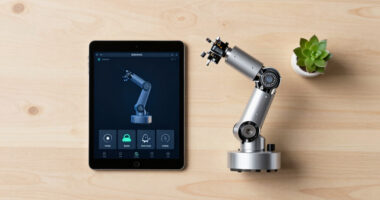
AI-controlled laboratory robotic arms
As an affiliate, we earn on qualifying purchases.
As an affiliate, we earn on qualifying purchases.
Origins and Development of the Model Hardware Standard
The Model Hardware Standard originated from collaborative work between Anthropic and the HHMI Janelia Research Campus, focusing on consolidating control interfaces for complex research rigs combining lasers, cameras, and motorized components. The goal was to replace numerous point-to-point connections with a single, unified interface that records device controls and sensor data in a consistent format.
Following initial success, Anthropic expanded testing to include partners in biotechnology, robotics, and quantum computing, such as AWS, Doosan Robotics, Tecan, and Universal Robots. Companies like Hugging Face and Raspberry Pi are also working on integrating MHS into their platforms. Despite these advances, the standard is still under development, with no scheduled open-source release yet announced.
“MHS targets a real interoperability problem, offering a shared interface that could make automation more accessible and efficient.”
— Thorsten Meyer, AI researcher
industrial automation hardware interface
As an affiliate, we earn on qualifying purchases.
As an affiliate, we earn on qualifying purchases.
Safety and Reliability of the Standard in Broader Use
While preliminary results are promising, it is not yet clear how MHS will perform across the full range of equipment and operating environments found in commercial labs and factories. The safety mechanisms depend on enforcement of device limits, which has not yet been independently validated. Additionally, the system currently supports only programmable equipment, leaving out many legacy devices.
Further testing is needed to assess how well the standard prevents errors, handles sensor failures, and manages unexpected machine behavior during real-world deployments.
As an affiliate, we earn on qualifying purchases.
Next Steps for Validation and Broader Adoption
Anthropic plans to expand testing among research and industry partners, focusing on developing safety evaluation protocols and deployment best practices. The company is also preparing a physical safety roadmap and aims to publish findings from the preview phase. A key milestone will be demonstrating consistent, safe operation across multiple independent sites while maintaining human oversight during failures.
Additional developments include refining device descriptions, expanding hardware support, and establishing safety benchmarks. The company has not yet announced a timeline for a public, open-source release, but expects that broader adoption will follow after initial validation.
AI integration with manufacturing devices
As an affiliate, we earn on qualifying purchases.
As an affiliate, we earn on qualifying purchases.
Key Questions
What types of equipment does MHS support currently?
Currently, MHS supports programmable devices such as microscopes, liquid handlers, robotic arms, and laser systems, with support dependent on manufacturer participation and driver development.
How does MHS improve automation workflows?
By providing a shared driver layer that standardizes device control and safety limits, MHS reduces the need for custom integrations, allowing AI agents to coordinate multiple instruments more quickly and reliably.
Are there safety concerns with AI controlling physical equipment?
Yes, safety remains a key concern. The current standard enforces device limits at the driver level, but independent validation of safety features is still underway. Proper oversight and testing are essential.
When will MHS be available for general use?
Anthropic has not announced a specific release date. The current focus is on testing with select partners, developing safety protocols, and validating performance before broader deployment.
Can MHS work with legacy or non-programmable equipment?
Not yet. MHS currently supports only equipment with programmable interfaces, but future updates may include support for additional device types as drivers are developed.
Primary source: Anthropic · via ThorstenMeyerAI.com
Fall Picks
fall essentials
As an affiliate, we earn on qualifying purchases.