
TL;DR
Nvidia announced Rubin HPC at SC26 on Nov. 16, describing it as a GPU for simulation and data processing in science, engineering and analytics. The company says it will have more than 50,000 CUDA cores and seventh-generation NVLink, with availability expected in 2028. Nvidia has not released performance benchmarks or several specifications needed to assess the chip.
Nvidia announced Rubin HPC at the SC26 supercomputing conference in Chicago on Nov. 16, saying the GPU is designed for science, engineering and analytics workloads. Nvidia says one chip will contain more than 50,000 CUDA cores and that the product is expected to be available in 2028; the company has not yet provided independent performance results or several specifications needed to assess its capabilities.

Get business pricing on tech for your team
- Business-only prices and quantity discounts
- Tax-exempt purchasing
- Multiple users, one account, clear invoices
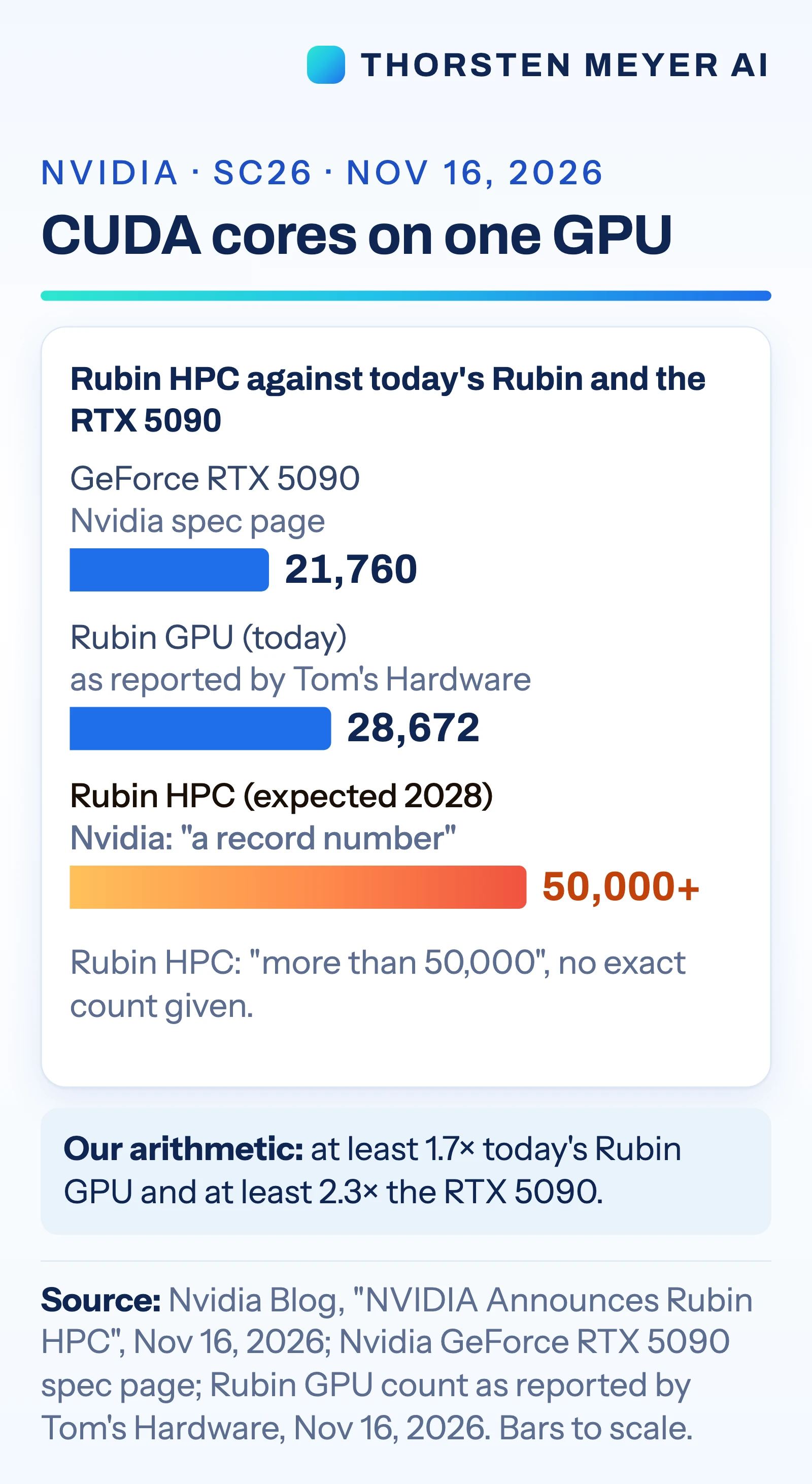
In a Nov. 16 blog post, Nvidia described Rubin HPC as a new GPU in its Vera Rubin platform, intended to accelerate simulation and data processing. The company says the chip will include “a record number of CUDA cores — more than 50,000 on a single GPU.” It did not give an exact core count or publish a benchmark showing how the chip performs on a scientific workload.
Nvidia also says Rubin HPC will use seventh-generation NVLink to connect GPUs and include what it calls a “sparse data acceleration capability.” The company describes the design as balancing data movement with computing capacity, but did not explain how the sparse-data feature works. The announcement does not specify the chip’s memory capacity or bandwidth, power use, price, or the systems that will contain it.
The post was written by Dan Ernst, Nvidia’s senior director of supercomputing products. Ian Buck, the company’s vice president of hyperscale and high-performance computing, said: “For agents tackling science and engineering, faster simulation means faster discovery.” That describes Nvidia’s intended use case and rationale; the announcement supplied no benchmark results to quantify the expected speedup.
Why Faster Simulations Matter
Scientific and engineering simulations let researchers test candidate materials, molecules, designs or other ideas on a computer before committing time and money to laboratory work or physical prototypes. Nvidia is positioning Rubin HPC for the computational step in that process. Its proposed workflow pairs AI agents that suggest candidates with simulations that test them, then uses the results to guide further work.
If Rubin HPC improves performance on relevant simulations, researchers and engineering teams could test more candidates or get results sooner. That could matter in fields such as climate modeling, engineering, genomic analysis and financial risk, which Nvidia identifies as areas that rely on demanding computation. The practical effect will depend on measured performance for particular workloads, as well as memory, power and system costs. Those figures are not available yet.
The core count is a prominent headline figure, but it cannot establish how quickly a chip will complete a given simulation. Workloads also depend on factors such as memory access, software and the type of calculations involved. Nvidia’s claims about keeping cores supplied with data and speeding up the research loop remain unquantified in the announcement.
Products Worth Considering

Apple AirPods Pro 3 Wireless Earbuds with Active Noise Cancellation

Bose QuietComfort Wireless Noise-Cancelling Headphones, Sandstone

Kindle Paperwhite Signature Edition 32GB (2024 Model) – Metallic Black
As an affiliate, we earn on qualifying purchases.
How Rubin HPC Fits the Platform
Nvidia announced Rubin HPC during SC26, the supercomputing conference running in Chicago from Nov. 15 to 20, 2026. Its blog post places the GPU within the Vera Rubin platform and says it is intended for simulation and data-processing tasks. The post does not identify a specific computer system or customer that will use Rubin HPC.
The announcement says Rubin HPC will have at least 50,000 CUDA cores. For comparison, Nvidia lists 21,760 CUDA cores for its GeForce RTX 5090. Tom’s Hardware reports that the current Rubin GPU has 28,672 CUDA cores, a figure consistent with Nvidia’s reported 224 streaming multiprocessors. Using the lower bound in Nvidia’s announcement, those figures imply at least about 2.3 times the RTX 5090’s core count and about 1.7 times the reported count for the current Rubin GPU. These are arithmetic comparisons of core counts, not measurements of computing performance.
Tom’s Hardware suggested that the announced count might indicate a configuration similar to Rubin Ultra’s four-die design, while also reporting that Nvidia had not disclosed Rubin HPC’s physical layout. That is the outlet’s inference, not a confirmed description from Nvidia. Nvidia’s post says the GPU will use seventh-generation NVLink; its Vera Rubin NVL72 product page describes sixth-generation NVLink for that platform.
““A record number of CUDA cores — more than 50,000 on a single GPU.””
— Nvidia, in its Nov. 16 blog post
Specs and Performance Still Pending
Nvidia has not published FP64 performance figures, memory capacity or bandwidth, power consumption, or a price for Rubin HPC. Those details would help computing teams compare the GPU for scientific workloads and estimate the cost of adopting it. The announcement also names no systems, customers or deployment plans.
There are no independent benchmarks in the supplied source material, and Nvidia has not quantified how much faster Rubin HPC would run simulations. The exact CUDA core count and the chip’s physical layout are also undisclosed. The reported comparisons with other Nvidia GPUs cover core counts alone and do not establish relative performance. It remains unclear how the sparse-data acceleration feature works or which applications will benefit most.
Details Ahead of 2028 Availability
Nvidia says Rubin HPC is expected in 2028. The company has not announced a more specific release date, pricing, system availability or customer deployments in the material provided. Those details, along with technical specifications and workload benchmarks, will be needed to judge how the GPU performs and what it may cost to use.
Until Nvidia releases those figures and independent testing becomes available, the confirmed picture is limited to the announced purpose, a claim of more than 50,000 CUDA cores, seventh-generation NVLink, a sparse-data acceleration capability and the expected 2028 availability. The performance and practical value of the chip remain open questions.
Key Questions
What is Nvidia Rubin HPC?
It is a GPU in Nvidia’s Vera Rubin platform, announced for science, engineering and analytics workloads involving simulation and data processing.
How many CUDA cores will Rubin HPC have?
Nvidia says it will have more than 50,000 CUDA cores on a single GPU. The company has not given an exact count.
When is Rubin HPC expected to be available?
Nvidia says Rubin HPC is expected in 2028. A more specific release date has not been announced in the supplied material.
How fast will Rubin HPC be?
Nvidia has not released performance benchmarks for the chip. Its core count alone does not show how quickly it will run a particular simulation.
What key specifications are still missing?
Nvidia has not supplied FP64 figures, memory capacity or bandwidth, power use or price. The chip’s exact core count and physical layout are also unknown.
Source: Thorsten Meyer AI