📊 Full opportunity report: Fair-value appraisals for used GPUs and AI hardware on IdeaNavigator AI — validation score, market gap, and execution plan.

Get business pricing on tech for your team
- Business-only prices and quantity discounts
- Tax-exempt purchasing
- Multiple users, one account, clear invoices
TL;DR
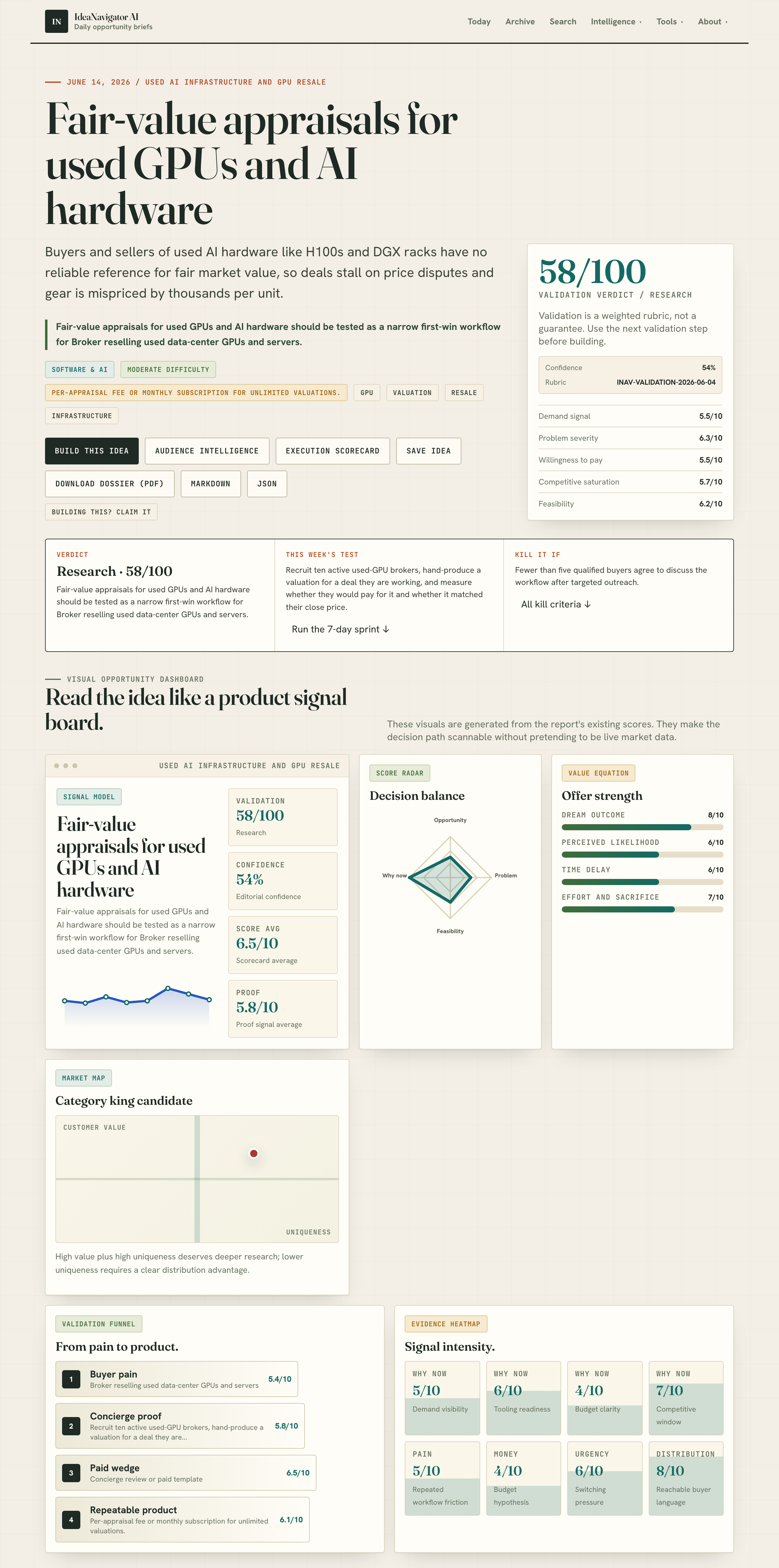
A proposed manual valuation tool for used GPUs and AI hardware seeks to provide brokers with reliable fair-value ranges based on recent comparable sales. This aims to resolve pricing disputes and improve market transparency.
IdeaNavigator AI is developing a manual fair-value appraisal system for used data-center GPUs and AI hardware, targeting brokers involved in resale markets. This initiative aims to create a reliable reference for pricing, addressing widespread market inefficiencies and disputes over hardware valuation.
The proposed system involves a manual valuation sheet where brokers input details such as GPU model, condition, and quantity to receive a curated fair-value range. This range is based on three recent comparable sales pulled from public listings, providing a transparent benchmark for pricing decisions.
Market participants, including brokers reselling hardware like NVIDIA H100s and DGX racks, currently lack a standardized pricing reference, leading to deal stalls and significant mispricing—sometimes by thousands of dollars per unit. The new approach aims to fill this gap with a simple, manual process that can be tested and refined.
According to IdeaNavigator AI, the initial validation involves recruiting ten active used-GPU brokers, producing valuations for deals they are working on, and assessing whether these valuations match their close prices and if brokers would pay for such a service. The model is designed as a per-appraisal fee or a monthly subscription for unlimited valuations.
Implications for Used AI Hardware Market Pricing
This development could significantly improve transparency in the resale market for used AI hardware, reducing pricing disputes and enabling more accurate deal valuations. It offers brokers a practical tool to establish fair market values, potentially accelerating transactions and stabilizing secondary market prices amid rapid hardware refresh cycles by hyperscalers and labs.
By providing a standardized reference, the system could also help prevent over- or under-pricing, ensuring more efficient market functioning and better resource allocation across data centers and AI research facilities.
As an affiliate, we earn on qualifying purchases.
Growing Market Pressure and Lack of Standardized Valuations
As hyperscalers and AI labs upgrade their GPU fleets rapidly, large volumes of recent-generation hardware are entering secondary markets. Currently, there is no transparent or standardized pricing benchmark for used AI hardware, which causes deal delays and mispricing. Brokers have relied on subjective assessments or limited comparable sales, leading to inconsistent valuations.
Previous efforts to establish market prices have been limited in scope, and the lack of a reliable reference has hampered deal efficiency. The proposed manual valuation system by IdeaNavigator AI aims to address this gap with a straightforward, practical tool for brokers to determine fair values based on recent comparable sales.
“A standardized fair-value appraisal tool could transform how used AI hardware is priced, reducing disputes and increasing market transparency.”
— an anonymous researcher
As an affiliate, we earn on qualifying purchases.
Uncertainties in Adoption and Accuracy
It is not yet clear how accurately the manual valuation sheet will reflect actual market prices over time or how quickly brokers will adopt this new system. The effectiveness of the curated comparable sales method in volatile secondary markets remains to be validated through ongoing testing.
Further, the scalability of the approach and its ability to handle diverse hardware models and conditions are still under assessment, and broader industry acceptance is uncertain at this stage.
As an affiliate, we earn on qualifying purchases.
Next Steps in Validation and Industry Adoption
IdeaNavigator AI plans to recruit ten active used-GPU brokers to test the valuation tool on their current deals, collect feedback on its accuracy, and determine willingness to pay for the service. The initial testing phase will inform further refinement and potential commercialization of the platform.
If successful, the system could be expanded to include automated data collection, broader hardware models, and integration with existing resale platforms, potentially becoming a standard reference in the used AI hardware market.
As an affiliate, we earn on qualifying purchases.
Key Questions
How will the fair-value appraisal system improve current GPU resale practices?
It will provide brokers with a transparent, data-driven range based on recent comparable sales, reducing disputes and enabling more accurate pricing.
What hardware models will the valuation system cover initially?
The initial focus is on recent-generation data-center GPUs such as NVIDIA H100s and DGX racks, with potential expansion to other models based on market demand.
Will this system replace existing valuation methods?
It is intended as a complementary tool to improve accuracy and transparency, not as a complete replacement for broker judgment or other valuation approaches.
When can brokers expect to use this valuation tool widely?
The initial testing phase is ongoing, with broader industry adoption likely contingent on successful validation and refinement over the coming months.
Could this approach influence market prices long-term?
Yes, establishing a transparent, standardized valuation could stabilize pricing and reduce volatility in the secondary market for AI hardware.
Source: IdeaNavigator AI
Fall Picks
fall essentials
As an affiliate, we earn on qualifying purchases.