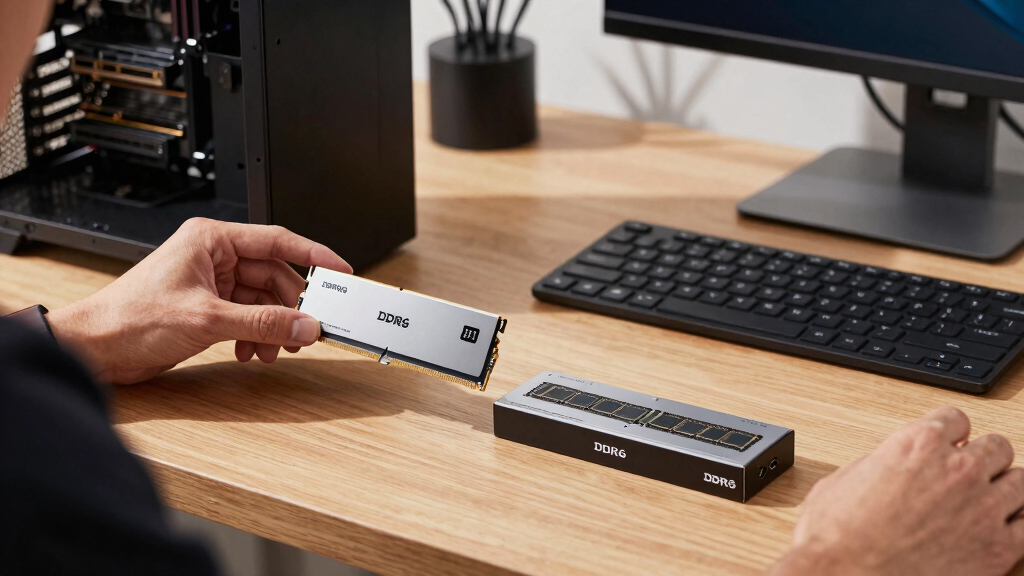

📊 Full opportunity report: DDR5 Now, DDR6 Soon: A Buyer’s Field Guide on ThorstenMeyerAI.com — validation score, market gap, and execution plan.

Get business pricing on tech for your team
- Business-only prices and quantity discounts
- Tax-exempt purchasing
- Multiple users, one account, clear invoices
TL;DR
Current market conditions favor purchasing DDR5 now rather than waiting for DDR6, which won’t be widely available until 2027. Prices for DDR5 remain high, and DDR6’s early adoption costs are steep. Building with DDR5 today offers better value and performance.
Market conditions in 2026 strongly advise against waiting for DDR6. Experts say that DDR5 remains the best choice for most users now, as DDR6 won’t be broadly available until 2027 and will come at a premium. This shift in strategy is due to persistent high prices, slow market relief, and the high costs associated with DDR6’s early adoption.
According to industry sources, prices for DDR5 memory kits remain elevated, with forecasts indicating that significant price reductions are unlikely before 2028. The consensus is that waiting for DDR6, which is expected to launch around 2027, is not cost-effective for most consumers. DDR6 introduces a new architecture with higher bandwidth potential, but it will require new CPUs and motherboards, and initial prices are projected to be 2-3 times higher per gigabyte than DDR5.
For mainstream users, the recommended DDR5 configuration is DDR5-6000 with CL30 timings, as this offers optimal performance for both AMD and Intel platforms. Higher-speed kits, such as DDR5-8000, provide minimal real-world benefits for gaming or productivity and are considered a waste of money given current market conditions. Capacity-wise, 32GB is sufficient for most general use, with 64GB suited for content creators or heavy multitasking. Buying more than that, such as 128GB, is discouraged unless specific large-scale AI or data workloads are involved.
DDR5 now, DDR6 soon
A buyer’s field guide. The 20-year instinct — wait for prices to drop, or wait for the next generation — is broken this cycle. Buy the DDR5 you actually need now; don’t wait for DDR6. Here’s the reasoning.
Driven to end-of-life, production slashed. Same money, dead-end socket. Leave a working DDR4 box alone — but never start a new build on DDR4 to “save.”
A framework, not a gamble. Buy the DDR5 you need now, at the sweet spot, in the capacity you’ll actually use — don’t buy DDR4, don’t wait for DDR6. The two costliest mistakes in this market are the ones that feel prudent: waiting for a price drop that isn’t coming, and waiting for a next-gen part that launches dearer than what’s on the shelf. Next: The SSD Squeeze.
Why Immediate DDR5 Purchase Is the Best Strategy
For most consumers, purchasing DDR5 now avoids the premium and scarcity associated with DDR6’s early rollout. Delaying upgrades to wait for DDR6 could result in paying more later, while missing out on platform improvements and performance gains in the meantime. Building with DDR5 ensures compatibility with current and upcoming systems, providing a more cost-effective and future-proof solution for the next few years.
As an affiliate, we earn on qualifying purchases.
Market Trends and Future Memory Developments in 2026
Memory prices surged in 2026 due to supply chain disruptions and increased demand, leading to historically high costs for DDR5 kits. The industry expects that DDR6, which promises significantly higher bandwidth, will not arrive at mainstream prices until around 2027, initially targeting enterprise and high-end workstation markets. DDR4 is now largely phased out, and manufacturers have shifted focus entirely to DDR5, with DDR6 still in the standardization phase, not yet available for consumer builds.
The rollout of DDR6 will be staged, starting with enterprise servers and high-performance computing, followed by mainstream desktops and laptops. Early adoption will involve high costs and potential stability issues, making it unsuitable for most buyers in 2026.
“DDR5 remains the best value for mainstream builds through 2028, with DDR6 expected to be a premium product initially.”
— Hardware manufacturer spokesperson
As an affiliate, we earn on qualifying purchases.
Unresolved Questions About DDR6 Availability and Pricing
While DDR6 standardization is progressing, actual broad availability and pricing remain uncertain. The first compatible consumer modules and platforms are expected around 2027, but early market prices and stability are still unconfirmed. Additionally, the precise performance benefits and capacity options at launch are not yet fully known, leaving some ambiguity about the optimal timing for early adopters.
As an affiliate, we earn on qualifying purchases.
Next Steps for Buyers and Industry Watchers
Consumers should focus on selecting high-quality DDR5-6000 kits now, aligning with current platform recommendations. Industry developments, including JEDEC standard approvals and motherboard compatibility lists, will signal when DDR6 is ready for mainstream adoption. Monitoring price trends and early product releases in late 2026 and early 2027 will help determine the best timing for potential upgrades.
As an affiliate, we earn on qualifying purchases.
Key Questions
Should I buy DDR5 now or wait for DDR6?
Most users should buy DDR5 now, as DDR6 will not be widely available until 2027 and will come at a higher cost. Waiting risks paying more later without significant performance gains for typical workloads.
Will DDR6 significantly improve gaming performance?
No, DDR6’s higher bandwidth benefits are mainly relevant for bandwidth-bound tasks like AI, scientific computing, or rendering. Most gaming scenarios will see minimal gains.
Is it worth investing in high-speed DDR5 kits now?
For most users, DDR5-6000 with CL30 timings offers the best balance of performance and price. Higher-speed kits like DDR5-8000 provide little real-world benefit and are not recommended at current prices.
What should I look for to confirm DDR6 is ready for mainstream use?
The key indicators are the official JEDEC DDR6 standard moving from draft to final, and compatible motherboard and CPU models appearing on manufacturer support lists, with early modules and benchmarks emerging around late 2026 or early 2027.
Source: ThorstenMeyerAI.com
Fall Picks
fall essentials
As an affiliate, we earn on qualifying purchases.