TL;DR
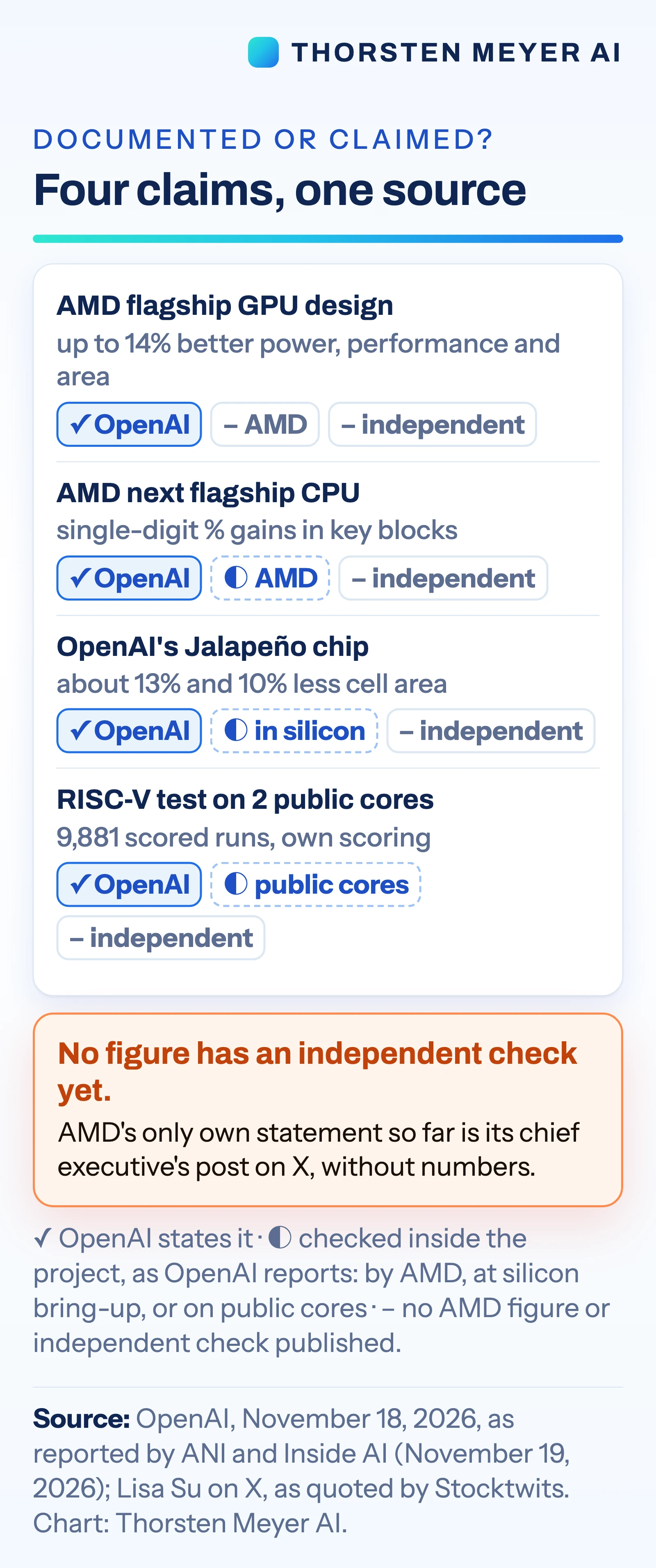
OpenAI said on November 18 that its models rewrote parts of AMD chip designs, producing up to 14% better power, performance and area against heavily optimized baselines. The figure is OpenAI’s best reported result; block names, average gains and an independent review have not been published.
OpenAI said November 18 that its models rewrote parts of AMD chip designs and achieved up to 14% improvement in power, performance and area (PPA) on a flagship GPU design. The result could shorten some chip-design work, but the figure is a best case reported by OpenAI, and no independent audit or block-level results have been published.

Get business pricing on tech for your team
- Business-only prices and quantity discounts
- Tax-exempt purchasing
- Multiple users, one account, clear invoices
OpenAI said its models rewrote SystemVerilog register-transfer-level (RTL) code, which describes how chip circuits behave. According to the company, Synopsys design tools checked whether each proposed rewrite preserved the original behavior and assessed its PPA trade-offs. OpenAI said the GPU result was measured against heavily optimized baselines. It did not identify the blocks involved, give an average across the design, or publish the underlying measurements.
OpenAI said some model-generated changes had been included in an AMD design sent for manufacturing, while other changes were added to design files for future versions. It also said AMD had verified single-digit percentage PPA gains in key blocks of its next flagship CPU. AMD CEO Lisa Su praised the work on X, but AMD has not published its own figures, according to the source material.
The announcement also described results on OpenAI’s own Jalapeño inference chip. OpenAI said model-proposed changes reduced standard-cell area by about 13% in one unit and 10% in another, with the changes validated after the first chips returned. Reports differ on the name of the first unit: ANI calls it the vector unit, while Inside AI calls it the warp engine. OpenAI also reported testing five models on the PicoRV32 and Ibex open-source processor cores across 9,881 scored runs; it said GPT-6.2 Astra scored highest.
AI Moves Into Chip Design
If the reported changes hold up in production, they could help chip teams improve performance, power use or die area without changing a design’s intended behavior. Those trade-offs affect manufacturing cost, energy demand and the computing capacity available for AI systems. OpenAI described the AMD work as “roughly a year of progress achieved in less than 5 months,” but that is the company’s characterization of its development pace, not an independently measured industry-wide benchmark.
The report also points to a feedback loop: AI models may help optimize the hardware used to train and run later AI models. The practical scale of that effect remains unknown. A best-case result in selected blocks does not establish the average improvement across a full chip, or show how much time or money the process saves in routine design work.
Products Worth Considering

Samsung Galaxy Tab A11+ Tablet (6GB RAM, 128GB Storage, Gray)

Kindle Paperwhite Signature Edition 32GB (2024 Model) – Metallic Black

Samsung Galaxy Tab A11+ Kids Edition, 128GB, Royal Blue
As an affiliate, we earn on qualifying purchases.
From RTL Code to Silicon
The work described by OpenAI covers one stage of chip development. At the RTL stage, engineers write code describing a circuit’s operations. Synthesis tools translate that description into logic gates; later stages arrange and connect those gates for manufacture. OpenAI said its models proposed alternate RTL implementations and that design tools checked behavior and measured trade-offs before changes were retained.
The companies’ commercial relationship is relevant when weighing the announcement. Since October 2025, OpenAI has held a warrant for up to 160 million AMD shares, which vests as AMD chips are deployed, according to the source material. That relationship does not show that the technical results are wrong, but it is a reason to distinguish OpenAI’s reported findings from independently verified evidence.
“Su praised the results.”
— AMD chief executive Lisa Su, on X
Missing Data and Independent Review
The public account does not specify which GPU blocks produced the up-to-14% figure, how many blocks were measured, or the average change across them. It also does not provide enough detail to compare the “heavily optimized baselines” with other designs. The source material says no independent audit of the chip-design results has been published.
OpenAI says some changes entered a design sent for manufacturing, but it has not identified the design or said when results from manufactured chips will be available. AMD’s CPU gains are described only as single-digit, and the company has not released supporting measurements. The exact name of one Jalapeño unit is also inconsistent across reports.
Evidence From Manufactured Designs
The next useful evidence would be block-level measurements and methods from OpenAI or AMD, including the comparison baselines and results across more than the best-performing cases. Data from manufactured designs could show whether the reported improvements survive later chip-design stages and translate into usable hardware.
For now, the November 18 announcement establishes what OpenAI says its models accomplished and what it says AMD has incorporated. It does not settle the size of the gains across a full chip, the time saved for engineering teams, or how the approach compares with conventional optimization.
Key Questions
What does “up to 14%” refer to?
It is OpenAI’s reported best-case improvement in power, performance and area on AMD’s flagship GPU design, measured against what the company called heavily optimized baselines. The public account gives no average or block-level breakdown.
Did AMD independently confirm the 14% result?
The source material attributes the 14% figure to OpenAI. OpenAI said AMD verified single-digit PPA gains in key blocks of a next flagship CPU, and that Lisa Su praised the results. AMD has not published its own figures for either claim.
Were the AI-generated chip changes manufactured?
OpenAI said some changes were included in an AMD design sent for manufacturing. The announcement does not identify that design or report results from the manufactured chips.
How did OpenAI check the model’s changes?
OpenAI said Synopsys design tools checked that rewritten SystemVerilog RTL preserved the original behavior and assessed power, performance and area. The company has not published an independent audit of the results.
Source: Thorsten Meyer AI