
🔍 Read the full analysis: 26.7 Million Animals, One Big Change: The Rise Of Tractors on ThorstenMeyerAI.com

Get business pricing on tech for your team
- Business-only prices and quantity discounts
- Tax-exempt purchasing
- Multiple users, one account, clear invoices
TL;DR
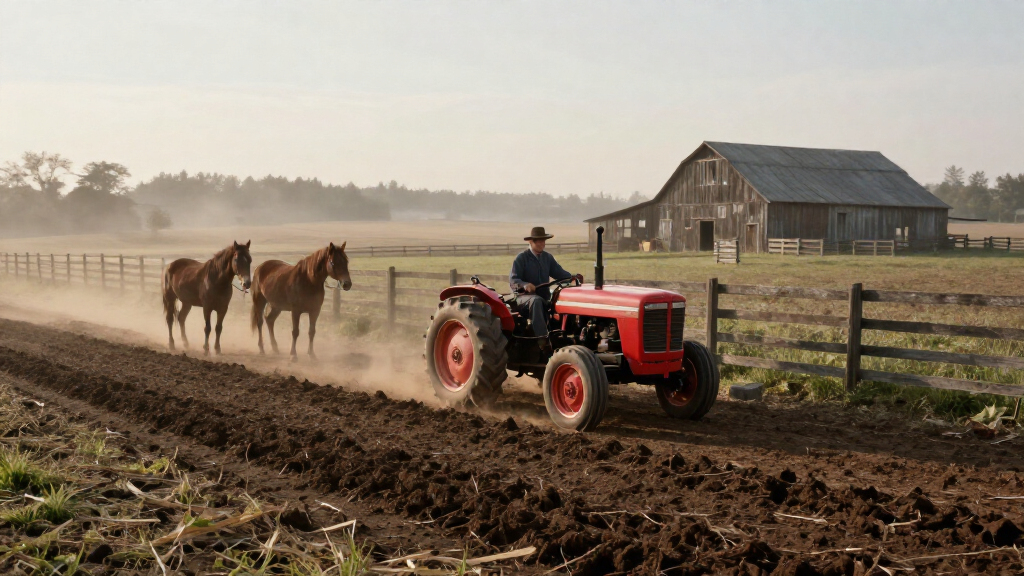
U.S. farm horses and mules peaked at 26.7 million in 1918, then fell to 3.1 million by 1960 as tractors and other machinery spread. The shift freed land used for animal feed and reduced farm labor, but the horse-to-tractor story is an analogy—not proof that automation will affect human workers in the same way.
U.S. farm horses and mules declined from a peak of 26.7 million in 1918 to 3.1 million by 1960 as tractors and other machinery took over much farm work, according to historical figures reviewed in a November 4 article by ThorstenMeyerAI.com. The change reshaped agricultural labor and land use, while offering a historical comparison—not a direct forecast—for debates about automation and human jobs.
The combined peak included 21.2 million horses and 5.5 million mules; horses alone had peaked at 21.4 million in 1915. The animals supplied the power for ploughing, planting, harvesting and hauling. They also required substantial feed: in 1915, about 93 million acres of harvested U.S. cropland grew oats, corn and hay for horses and mules, out of 340 million harvested acres overall.
Tractor numbers rose quickly across the following decades. The source’s historical series puts tractors on U.S. farms at about 1,000 in 1910, 246,000 in 1920, 920,000 in 1930 and 4.69 million in 1960. Around 1955, tractors slightly outnumbered horses and mules. By 1960, the animal count had fallen to 3.1 million, while land devoted to their feed had dropped to about 5 million acres.
Mechanization extended beyond tractors. U.S. combine harvesters increased from about 4,000 in 1920 to 1.042 million in 1960, alongside the spread of corn pickers, balers and milking machines. The Department of Agriculture’s estimate of the number of people supplied by one farm worker rose from 7.1 in 1910 to 47.1 in 1970; the latter figure includes people abroad supplied through exports.
What Mechanization Changed on Farms
The figures show that mechanization changed more than the source of power in a field. Replacing working animals reduced the acreage needed to grow feed, allowing that land to be used for other crops. A tractor also did not need year-round feeding when it was idle, unlike a horse. Those changes helped farms produce more with fewer workers, although the figures do not isolate tractors from other developments such as improved seeds, fertilizer and additional machines.
Farm employment fell from a peak of 13.6 million in 1916 to 4.5 million in 1970, while the overall U.S. labor force doubled, according to the source. The article says new jobs grew in cities and that workers had to move. That history is relevant to current automation debates because it shows how technology can alter work and where jobs are found. It does not, on its own, establish how quickly or widely modern machines will replace human workers.
Products Worth Considering

Logitech MX Mechanical Wireless Illuminated Keyboard, Tactile Quiet, Graphite

Bose TV Speaker (2nd Gen) Compact Soundbar

Samsung Galaxy Tab A11 Wi‑Fi (International Version), 8.7, 64GB + 4GB, Gray
As an affiliate, we earn on qualifying purchases.
From Fordson to Farm Autonomy
Tractors existed before World War I, but early models were heavy, costly and better suited to large farms. In 1917, Ford launched the Fordson. The Henry Ford museum describes it as “the first mass-produced and inexpensive lightweight tractor” designed for small farmers, and says it rapidly became popular in the United States. The 100,000th Fordson left the assembly line on February 21, 1920.
The history also has a frequently cited link to automation arguments. In 1983, economist Wassily Leontief compared workers to horses displaced by tractors. The article notes a difference Leontief himself identified: horses could not vote. That difference limits how far the analogy can be taken, since people can respond politically and socially to economic change.
Modern agricultural automation remains more limited than a broad idea of driverless farming might suggest. The source says John Deere introduced a 16-camera autonomy kit in February 2025 for tillage on select large tractors. It also reports that China said about 74% of ploughing, sowing and harvesting was mechanized in 2023. These are distinct examples: one is a company product description, and the other is a national figure attributed to China, not evidence that all farm work is autonomous.
Where the Horse Analogy Falls Short
The historical counts document a major change in U.S. agriculture, but they do not show that tractors alone caused the full decline in farm employment or the rise in output per worker. The source lists several other changes—including combines, fertilizer and improved seed—that occurred alongside tractor adoption. The reported figures also use different counting dates and methods across some years, so they are not a perfectly uniform annual series.
It is also unclear how closely today’s farm automation will follow the historical pattern. The article describes an autonomy system for tillage on select large tractors, not a machine that performs every task on every farm. The China figure concerns mechanization, which is not the same as autonomous operation. The material does not establish how many jobs current systems have replaced, how many new jobs they create, or the pace at which adoption will spread.
What to Watch in Farm Automation
The next useful evidence will be operational rather than historical: which farms adopt autonomous equipment, which tasks the systems can perform, and how their costs and reliability compare with existing practices. The source does not identify a specific future launch, policy decision or release date. It also provides no new U.S. employment forecast tied to the John Deere system.
Readers can use the 1918–1960 record as a measure of how deeply machinery once changed farming, while treating claims about today’s effects as open questions. More evidence on adoption, labor demand and the land freed from feed production will be needed to judge whether modern farm robots are producing comparable changes.
Key Questions
How many horses and mules worked on U.S. farms at the peak?
The combined total peaked at 26.7 million on January 1, 1918, including 21.2 million horses and 5.5 million mules, according to the historical figures cited in the source article.
When did tractors outnumber farm horses and mules?
The source places the crossover around 1955, when it lists about 4.35 million tractors and 4.31 million horses and mules.
What happened to the animals as tractors spread?
The source says farmers generally stopped breeding replacements, and the working population declined over time. It does not describe a single mass event that removed the animals from farms.
Does the historical shift prove that AI will replace human workers?
No. The history shows that machinery transformed farm work, but it does not prove that AI will affect workers in the same way. The source notes that people, unlike horses, can vote and respond politically to economic change.
Are today’s farm tractors fully driverless?
The source describes a February 2025 camera-based autonomy kit for tillage on select large tractors. It does not say that the system can perform every farm task or that autonomous tractors are in use on every farm.
Source: ThorstenMeyerAI.com