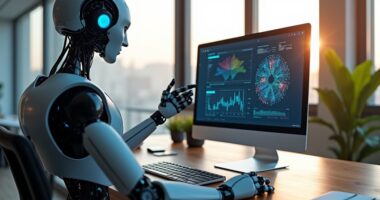

📊 Full opportunity report: Forezai · Polybot: When the AI Disagrees With the Odds on ThorstenMeyerAI.com — validation score, market gap, and execution plan.

Get business pricing on tech for your team
- Business-only prices and quantity discounts
- Tax-exempt purchasing
- Multiple users, one account, clear invoices
TL;DR
Polybot is an experimental AI designed to identify when its probability estimates differ from market prices. It aims to assess whether AI can reliably challenge prediction markets, but remains a research tool with significant limitations.
Polybot, an AI trading bot, is testing whether it can identify meaningful disagreements with prediction market prices based on public information. This experiment explores the potential and limitations of AI in challenging aggregated market wisdom, highlighting risks and calibration challenges.
Polybot is designed to research when an AI’s probability estimate diverges significantly from the market’s implied odds. It compares its own independent research to market prices on Polymarket, a prediction platform, and only acts when the gap exceeds a threshold that accounts for costs like fees and slippage.
The system records its reasoning for each estimate, enabling post-hoc inspection and calibration over time. Its default stance is to refrain from trading unless the disagreement is strong enough to justify action, reflecting a risk-averse approach that prioritizes research and understanding over frequent trading.
Developed privately and not publicly available, Polybot emphasizes experimental validation over profitability, acknowledging that market edges are difficult to sustain and that models can be confidently wrong despite appearing accurate in backtests.
Polybot — when the AI disagrees with the odds
A prediction market puts a price on the future. Polybot asks: can an AI’s own estimate diverge from that price for real — and should it ever act on the gap?
Not financial, investment, legal or tax advice; not a recommendation or solicitation to trade, invest or use any software. Forezai · Polybot is experimental software, provided “as is” without warranty of accuracy or profitability. Trading and automated trading carry a substantial risk of loss including total loss of capital; past or backtested performance does not indicate future results. Prediction-market participation is restricted or prohibited in some jurisdictions (including for US persons) — you are solely responsible for compliance with applicable law. Consult a licensed professional before any financial decision. Produced with AI assistance under human editorial oversight; independent commentary, the author’s own views. Product and company names are trademarks of their respective owners; mention does not imply endorsement.
Implications of AI Challenging Market Consensus
This experiment highlights the potential for AI systems to independently evaluate and challenge crowd-sourced market predictions, raising questions about market efficiency and the future role of AI in financial decision-making. It also underscores the importance of calibration, transparency, and risk management in automated trading systems, especially those based on probabilistic estimates.
As an affiliate, we earn on qualifying purchases.
Background on Prediction Markets and AI Experiments
Prediction markets like Polymarket aggregate public opinions and information into a single price, often considered a reliable forecast. However, the idea of an AI system independently assessing and acting against these prices is novel and controversial. Prior attempts to beat markets with algorithms have faced challenges due to costs, market adaptation, and the difficulty of maintaining an edge.
Polybot builds on ongoing research into AI calibration, transparency, and risk-aware trading, representing a significant step in understanding when and how AI can meaningfully challenge collective intelligence in markets.
“Polybot is an experiment in understanding when an AI can reliably disagree with market odds, and whether that disagreement can be acted upon without falling into common pitfalls.”
— Thorsten Meyer, creator of Polybot
prediction market analysis software
As an affiliate, we earn on qualifying purchases.
As an affiliate, we earn on qualifying purchases.
Limitations and Challenges of Polybot’s Approach
It remains unclear how often Polybot’s estimates will be calibrated accurately over long periods, or whether it can sustain an edge in live markets. The system is experimental, and its success depends on factors like model accuracy, market liquidity, and cost management, which are still being evaluated.
Additionally, the broader implications for automated trading and market manipulation are not yet fully understood, and regulatory considerations may limit practical deployment.
As an affiliate, we earn on qualifying purchases.
Next Steps for Testing and Validating Polybot
Developers plan to expand Polybot’s testing across different markets and timeframes, monitor its calibration performance, and refine thresholds for action. Further research will focus on long-term stability, risk controls, and transparency, aiming to better understand the conditions under which AI can reliably challenge market prices.
Community engagement and peer review are also expected to play a role in assessing the system’s robustness and ethical considerations.
As an affiliate, we earn on qualifying purchases.
Key Questions
What is Polybot designed to do?
Polybot aims to research when an AI can independently identify meaningful disagreements with prediction market prices and whether it should act on those disagreements, primarily for experimental purposes.
Is Polybot a profitable trading system?
No. Polybot is a research experiment, not a commercial trading tool. It emphasizes calibration and understanding over profitability, and trading involves significant risks.
Can Polybot beat prediction markets?
It is not yet clear. While it tests the possibility of disagreement, market efficiency and costs make consistent outperformance difficult. The system is designed to identify potential edges, not guarantee profits.
What are the risks of using systems like Polybot?
Automated trading based on AI estimates can lead to significant losses, especially if the model is overconfident or the market behaves unpredictably. It also involves legal and ethical considerations.
Source: ThorstenMeyerAI.com
Halloween Picks
halloween
As an affiliate, we earn on qualifying purchases.