

TL;DR
IBM and Microsoft announced Imagine Enterprise on November 10, 2026, describing it as a platform for building, running and governing AI agents for business processes. IBM contributes consulting expertise and a collection of more than 6,000 agents and other assets; Microsoft provides cloud, data, development and security tools. Pricing, general availability and production deployments have not been disclosed.
IBM and Microsoft announced Imagine Enterprise on November 10, describing it as a platform for enterprises to build, run and govern AI agents that carry out industry-specific processes. The offering combines IBM Consulting’s agent assets and implementation services with Microsoft’s cloud, AI, data and security products, targeting large organizations, particularly those in regulated sectors.

Get business pricing on tech for your team
- Business-only prices and quantity discounts
- Tax-exempt purchasing
- Multiple users, one account, clear invoices
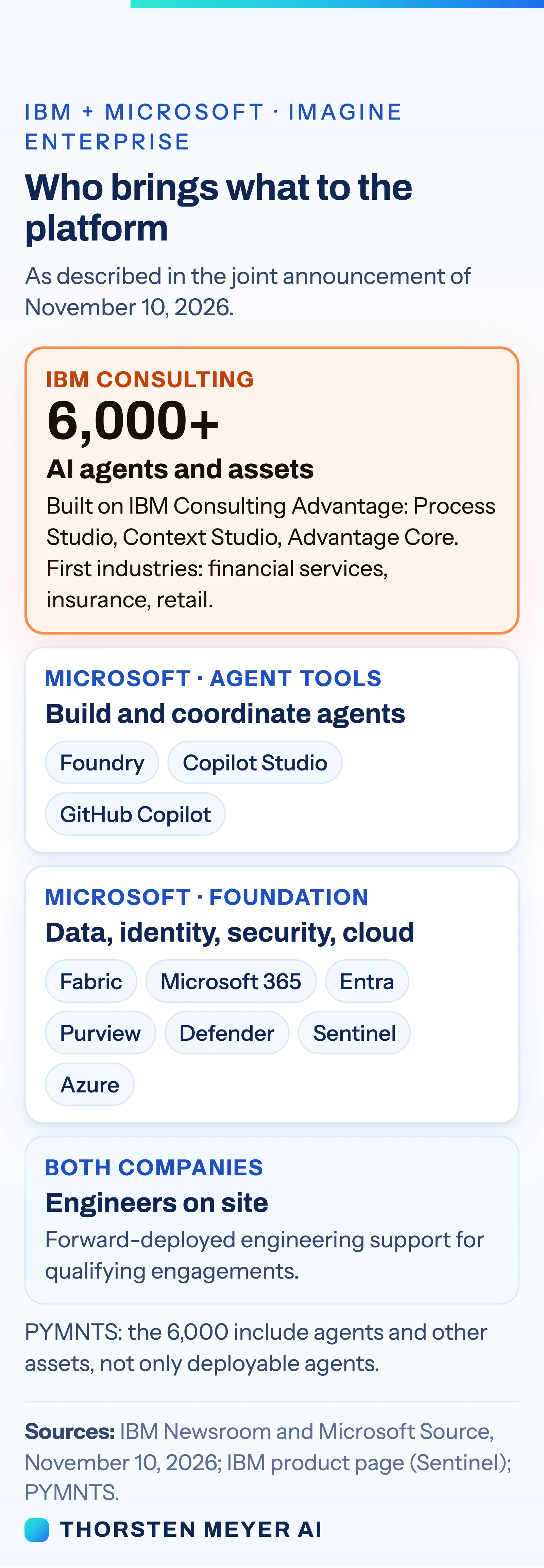
IBM says its contribution includes more than 6,000 AI agents and assets, along with IBM Consulting Advantage, its platform for designing and deploying agents. The count combines agents with other assets; the companies have not said how many are deployable agents. IBM Consulting Advantage includes Process Studio, Context Studio and Advantage Core, which IBM says support agent design, access to organizational context, deployment and governance.
Microsoft supplies technology including Foundry, Copilot Studio and GitHub Copilot for agent development and coordination. The announcement also lists Fabric, Microsoft 365, Entra, Purview, Defender and Azure as parts of the data, identity, governance, security and cloud foundation. IBM’s product page also names Microsoft Sentinel among the security tools.
The companies say the initial industry frameworks cover financial services, insurance and retail. They also offer forward-deployed engineering support for qualifying engagements, with IBM and Microsoft engineers working alongside customer teams. IBM says clients can engage IBM Consulting to deploy and operate the platform, co-innovate on large implementations, or use self-management options. The companies have not explained the eligibility criteria or the self-management arrangements.
A Consulting Route to Enterprise Agents
Imagine Enterprise brings IBM’s consulting-led delivery model together with Microsoft’s existing AI and cloud products. For large companies, especially those with complex processes and regulatory obligations, the offer is a packaged route to adapting agents for business workflows, rather than assembling every component alone. Whether that reduces implementation time or cost has not been established.
Governance is central to the pitch. IBM says organizations can set limits on what agents may do autonomously, where human approval is required and when an agent must escalate a case. IBM also says agent actions, decisions and escalations are logged. Those descriptions may matter to organizations that need oversight of automated work, but they are vendor claims; no independent assessment of the controls was included in the launch material.
The announcement also reflects a commercial pairing: Microsoft contributes a broad technology stack, while IBM Consulting supplies industry expertise and customer implementation services. The practical value will depend on how the platform fits each customer’s systems, what it costs and whether deployments deliver reliable results in production.
Products Worth Considering

LG UltraGear 34G600A-B 34-Inch Curved WQHD Gaming Monitor, 160Hz

Samsung Odyssey G9 QD-OLED 49 Dual QHD Curved Gaming Monitor

LG UltraGear 32-inch Curved QHD Gaming Monitor (2560×1440, 180Hz, 1ms, 1000R, HDR10)
As an affiliate, we earn on qualifying purchases.
From AI Pilots to Workflows
IBM’s launch blog describes a gap between organizations experimenting with AI and changing how their businesses operate. The company says many organizations are running pilots but few have fundamentally changed their operations. Imagine Enterprise is presented as a way to build on existing industry-specific agents and assets, then adapt them to a client’s data, processes and systems.
The arrangement builds on products the companies already offer. Microsoft sells tools such as Foundry and Copilot Studio directly; in Imagine Enterprise, those products form part of a larger package delivered with IBM Consulting. IBM positions its Consulting Advantage tools as the environment for developing and governing tailored agents. The announcement does not describe a new underlying AI model, nor does it identify which models the platform will use.
IBM’s example is an insurance claim workflow. It says a coordinating agent, called the “Digital Steward,” could assess claim complexity, flag possible fraud signals, check policy coverage and route cases to adjusters. Simple cases would go to junior adjusters, while ambiguous or complex cases would be sent to more experienced staff or specialists. This is an illustration from IBM, not evidence of a customer deployment.
““An agentic platform designed to help enterprises build, run, and govern AI agents that help people execute industry-specific processes.””
— IBM and Microsoft, in their joint announcement
Pricing, Models and Deployment Status
The announcement does not disclose pricing, a general availability date or the regions where Imagine Enterprise will be offered. It also does not identify the AI models that will run underneath the platform or explain the technical requirements for connecting customer systems.
The headline figure of more than 6,000 refers to agents and other assets together. The share that consists of working agents is unknown. The companies have not identified customers using the platform in production, and no independent evaluation of IBM’s described monitoring and governance controls was provided. IBM’s insurance workflow remains an example rather than a confirmed deployment.
Other open questions include which engagements qualify for on-site engineering support and what self-management options involve. The announcement does not provide customer results or evidence that the platform has moved existing pilots into routine production use.
Customer Rollouts and Availability
IBM and Microsoft say customers can work with IBM Consulting to deploy and operate the platform or collaborate on enterprise-scale implementations; self-management options are also mentioned. The companies have not published a timetable for general availability. Further details on price, supported regions, model choices and customer deployments would help establish when organizations can adopt the offering and how it performs in practice.
For prospective customers, the next concrete evidence will be the release of implementation terms and examples from live deployments, including how human approvals, escalation rules and audit logs operate in specific workflows. Until then, Imagine Enterprise’s capabilities and governance features remain descriptions from its vendors.
Key Questions
What is Imagine Enterprise?
Imagine Enterprise is a platform IBM and Microsoft announced for building, running and governing AI agents used in industry-specific business processes.
What does IBM contribute?
IBM contributes IBM Consulting Advantage, consulting and implementation support, and a collection described as more than 6,000 AI agents and other assets. The companies have not disclosed how many of those assets are deployable agents.
What does Microsoft provide?
Microsoft’s listed products include Foundry, Copilot Studio, GitHub Copilot, Fabric, Microsoft 365, Entra, Purview, Defender and Azure. IBM’s product page also lists Microsoft Sentinel.
How does the platform handle agent oversight?
IBM says customers can define which actions agents may take on their own, which require human approval and when escalation is mandatory. IBM also says agent actions and decisions are logged. These controls have not been independently tested in the launch material.
When will Imagine Enterprise be available, and what will it cost?
The announcement gives no general availability date or pricing. It also does not specify regions or identify customers running the platform in production.
Source: Thorsten Meyer AI