
📊 Full opportunity report: The Collaborative Social Media Workspace For Creators And Agencies on IdeaNavigator AI — validation score, market gap, and execution plan.

Get business pricing on tech for your team
- Business-only prices and quantity discounts
- Tax-exempt purchasing
- Multiple users, one account, clear invoices
TL;DR
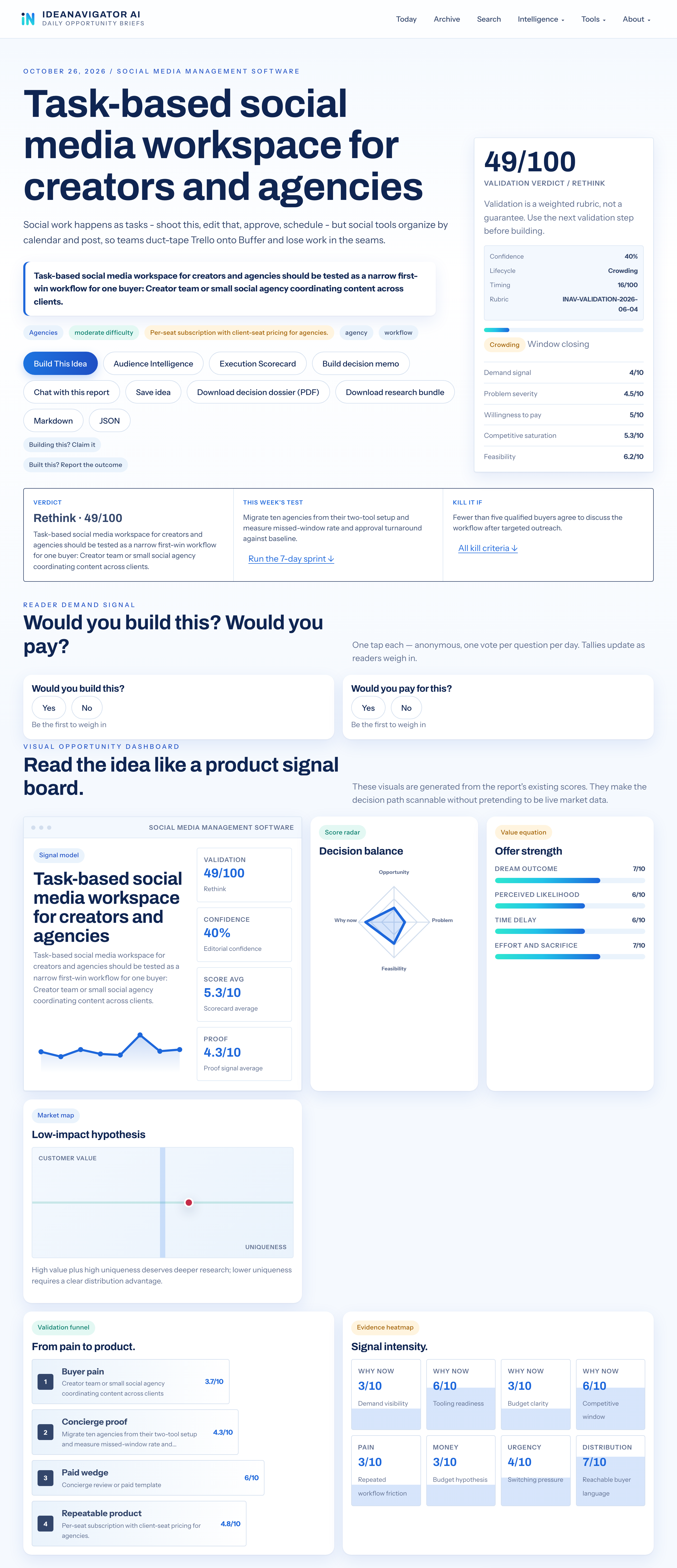
IdeaNavigator AI has outlined a product opportunity for a task-based social media workspace aimed at creator teams and small agencies. The proposal would bring briefs, editing, approvals and scheduling into one workflow, but it is an MVP concept, not a reported product launch or validated result.
IdeaNavigator AI has proposed a task-based social media workspace for creator teams and small agencies, with each post moving through briefing, asset creation, editing, approval and scheduling in one pipeline. The proposal recommends testing the product with ten agencies; no completed trial, product launch or measured result is reported, so the business case remains unverified.
According to IdeaNavigator AI’s proposal, the concept targets teams that manage social content across several clients. The proposal’s central premise is that day-to-day social work is organized around tasks—such as preparing a brief, editing an asset and securing approval—while social media management tools are often organized around calendars and scheduled posts. IdeaNavigator AI says teams may bridge that gap by combining a scheduling product with a separate project-management tool, creating handoffs where work can be missed.
IdeaNavigator AI proposes a minimum viable product that would treat each post as a task with defined stages: brief, asset, edit, approval and scheduled. The proposed features include client-facing approval links, versioning for creative assets, and native scheduling once content is approved. The stated aim is to connect an idea to publication without requiring teams to move between separate systems for workflow tracking and posting.
The proposal suggests a per-seat subscription, with pricing for client seats at agencies. To test demand and performance, IdeaNavigator AI recommends migrating ten agencies from their existing two-tool setups and measuring missed-window rates and approval turnaround against each agency’s baseline. The proposal provides no pricing, trial results, customer commitments or launch timetable.
Why Agencies May Want One Pipeline
IdeaNavigator AI argues that, if the workflow problem is widespread, a shared workspace could reduce the coordination burden on teams handling multiple accounts. In the proposed setup, briefs, revisions, approvals and scheduling would be visible in one place, potentially making it easier to identify which posts are waiting on an editor or client rather than relying on separate boards, messages and calendars.
The proposal’s suggested test focuses on two operational measures: missed publishing windows and approval turnaround. Those metrics matter to agencies because delays at one stage can affect a planned posting schedule and increase follow-up work. However, the proposal does not establish that a dedicated product would improve either measure; that would need to be shown against each agency’s existing process.
The idea also raises a product-positioning challenge. A new workspace would need to offer enough workflow value to justify replacing or supplementing tools teams already use, while retaining scheduling functions they rely on. Agency-specific client access and clear approval controls could be part of that case, but IdeaNavigator AI’s concept does not specify how permissions, reporting or integrations would work.
Products Worth Considering

Jackery HomePower 3600 Plus Portable Power Station, 3584Wh, 3600W

Bose QuietComfort True Wireless Earbuds with Active Noise Cancellation, Black

DJI Osmo Mobile 8 3-Axis Smartphone Gimbal Stabilizer
As an affiliate, we earn on qualifying purchases.
The Gap Between Calendars and Tasks
In its proposal, IdeaNavigator AI places the concept within the social media management software market. It characterizes scheduling tools as primarily structured around calendars and posts, while generic project-management tools can track tasks but may not be built around social publishing requirements. The suggested product would bring those functions together rather than asking teams to coordinate between them.
IdeaNavigator AI frames the opportunity around rising content-velocity expectations and increasingly complex team workflows. Those points are the proposal’s rationale, not independently measured market data: it provides no figures on industry growth, agency demand or the number of teams using two-tool setups. The practical next step it identifies is therefore a small operational test, rather than treating demand as established.
Demand and Results Still Unproven
IdeaNavigator AI presents this as a product proposal, not a report of an existing service. The proposal does not say whether a prototype has been built, whether agencies have agreed to participate, or whether the recommended ten-agency test has begun. It provides no baseline figures, comparison results or customer feedback.
Important product decisions are also unspecified in the proposal, including exact client-seat pricing, supported social platforms, integrations, asset storage limits, permission controls and how scheduling would work across accounts. It does not define what counts as a missed publishing window or how approval turnaround would be measured. Those details would affect whether a test can produce comparable results and whether any observed change comes from the workspace itself.
A Ten-Agency Workflow Test
IdeaNavigator AI’s proposed next step is to move ten agencies from their current two-tool workflows into a test of the combined workspace. A useful evaluation would record each agency’s existing missed-window rate and approval turnaround before migration, then track the same measures during the trial. The proposal does not state a trial length or specify how agencies would be selected.
Until such a test is conducted and results are reported, the workspace should be understood as an untested product opportunity, not a proven solution. Evidence on workflow outcomes, willingness to pay and the practical burden of switching tools would clarify whether the concept merits a broader rollout.
Source: IdeaNavigator AI
Key Questions
Has the social media workspace launched?
No launch is reported in IdeaNavigator AI’s proposal. It describes a potential minimum viable product and recommends testing it with agencies.
Who is the proposed workspace for?
IdeaNavigator AI says it is aimed at creator teams and small social agencies coordinating content across clients.
What would the product include?
The proposal describes a workflow that would track each post through briefing, asset creation, editing, approval and scheduling, with client approval links and asset versioning.
How would the idea be evaluated?
IdeaNavigator AI recommends migrating ten agencies from their current two-tool setups and comparing missed publishing windows and approval turnaround with each agency’s baseline. The proposal reports no test results.
What remains unknown about the business?
The proposal does not establish pricing, platform support, integrations, trial timing or customer demand.
Source: IdeaNavigator AI