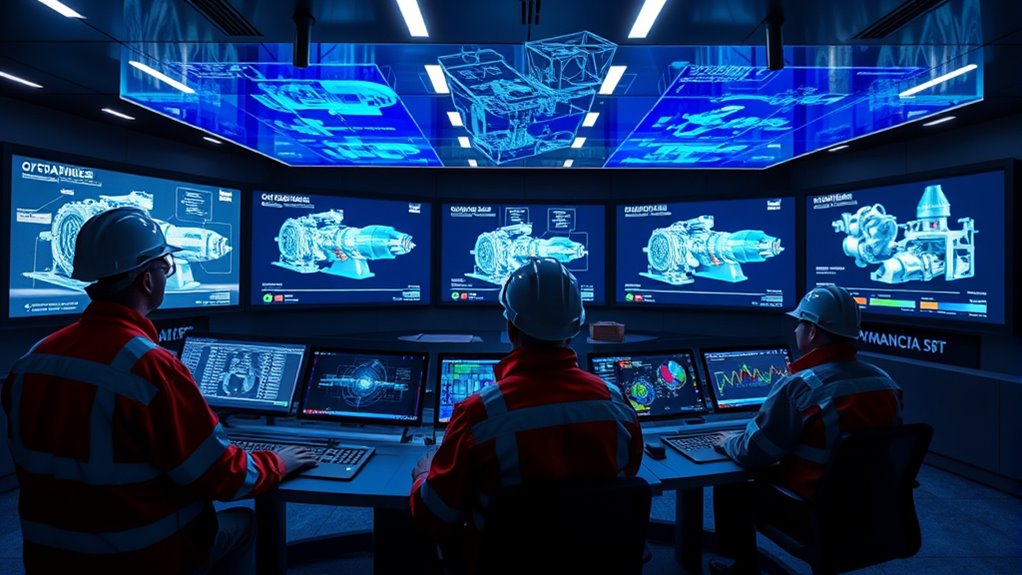

To deploy a digital twin for predictive maintenance, first connect sensors to your assets to gather real-time data on key parameters like temperature and vibration. Use robust data processing techniques to analyze this information for accuracy and early anomaly detection. Establish reliable communication channels to synchronize data promptly with the digital twin, ensuring your virtual model reflects current asset conditions. If you keep exploring, you’ll discover how to optimize your maintenance strategies effectively.
Key Takeaways
- Integrate sensors with physical assets to gather real-time operational data for the digital twin.
- Employ advanced data processing techniques to analyze sensor inputs and detect anomalies early.
- Establish a reliable communication infrastructure to synchronize sensor data promptly with the virtual model.
- Continuously monitor asset performance through the digital twin to enable predictive maintenance strategies.
- Ensure data accuracy and consistency to improve decision-making and prevent equipment failures.
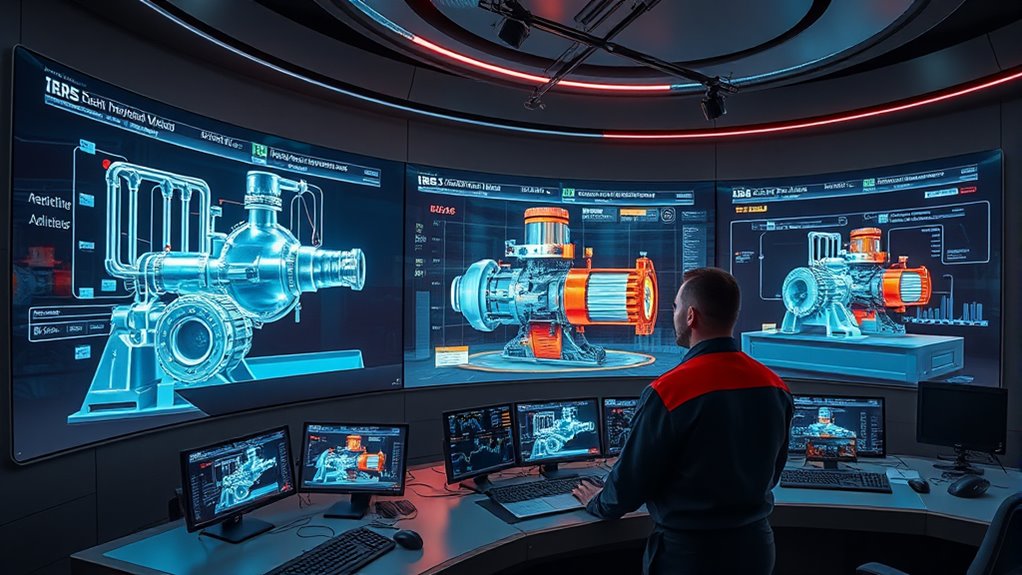
Deploying a digital twin transforms how you manage and optimize physical assets by creating a real-time virtual replica. This virtual model mirrors your equipment’s current state, allowing you to monitor performance closely and identify potential issues before they escalate. To make this work seamlessly, sensor integration plays a crucial role. You need to connect a network of sensors to your physical assets, capturing vital data such as temperature, vibration, pressure, and operational speed. These sensors act as the eyes and ears of your digital twin, continuously feeding it real-time information. Without proper sensor integration, your virtual replica would lack the accuracy needed for effective predictive maintenance. It’s essential to select sensors that are compatible with your assets and capable of transmitting data reliably and consistently. Additionally, employing robust data processing techniques helps analyze sensor data more effectively, ensuring accurate insights. Once sensors are integrated, data synchronization becomes the backbone of your digital twin’s effectiveness. This process ensures that the data collected from sensors is accurately and promptly reflected in the virtual model. Data synchronization involves establishing a robust communication framework, often leveraging IoT platforms and cloud infrastructure, to transmit sensor data in real-time. This real-time data flow allows your digital twin to stay up-to-date with the physical asset’s current condition, enabling you to spot anomalies and trends quickly. When data isn’t synchronized properly, you risk receiving outdated or inconsistent information, which can lead to incorrect predictions or missed warning signs. As a result, investing in a reliable data synchronization process is essential for accurate, actionable insights.

DIGITAL CHEMICAL PLANT ENGINEERING: 3D modeling IoT sensors and predictive maintenance for industrial systems
As an affiliate, we earn on qualifying purchases.
As an affiliate, we earn on qualifying purchases.
Frequently Asked Questions
How Do Digital Twins Adapt to Changing Environmental Conditions?
You can guarantee your digital twin adapts to changing environmental conditions by regularly updating sensor calibration and refining environmental modeling. When sensors are recalibrated, they provide accurate data reflecting current conditions. Additionally, updating the environmental model allows the digital twin to simulate real-world changes more precisely. This continuous adjustment helps your digital twin stay aligned with real-time shifts, improving predictive maintenance and operational efficiency.
What Cybersecurity Measures Protect Digital Twin Data?
Coincidences often highlight the importance of cybersecurity measures. You should implement robust cybersecurity protocols and data encryption to protect digital twin data. Regular updates, strong access controls, and intrusion detection systems help prevent unauthorized access. By actively monitoring vulnerabilities and applying best practices, you guarantee the integrity and confidentiality of your digital twin data, safeguarding your operations against cyber threats and ensuring seamless, secure predictive maintenance.
How Is Data Quality Maintained in Digital Twin Models?
You maintain data quality in digital twin models by regularly performing sensor calibration to guarantee accurate data collection. Additionally, you implement data validation techniques to detect and correct errors or inconsistencies. These practices help keep your digital twin reliable and precise, enabling better predictive maintenance decisions. Consistent calibration and validation ensure your model reflects real-world conditions, minimizing inaccuracies and improving overall system performance.
What Are the Scalability Challenges of Digital Twin Deployment?
Ever wonder if your digital twin can keep up as it grows? Scalability challenges mainly stem from data synchronization issues and increasing model complexity. As you expand your system, you’ll need robust infrastructure to handle real-time data flow and make sure models stay accurate. Without this, performance drops, and insights become unreliable. To succeed, plan for scalable architecture, optimize data management, and simplify models where possible to maintain seamless operation.
How Do Digital Twins Integrate With Existing Maintenance Systems?
You integrate digital twins with your existing maintenance systems by ensuring seamless sensor integration, which provides real-time data. This allows your digital twin to mirror equipment conditions accurately. You then apply real-time analytics to monitor performance and predict issues proactively. Connecting through APIs or IoT platforms helps synchronize data flows. This integration enhances decision-making, optimizes maintenance schedules, and reduces downtime, making your maintenance process smarter and more efficient.
![[BLE Vibration Sensor] WTVB01-BT50 Smart Vibration Module Ar-duino, 3-axis Vibration(Amplitude+Frequency+Displacement+Speed) Detector, Wireless Acceleration Shock Motor Monitor](https://m.media-amazon.com/images/I/41va7oLvGmL._SL500_.jpg)
[BLE Vibration Sensor] WTVB01-BT50 Smart Vibration Module Ar-duino, 3-axis Vibration(Amplitude+Frequency+Displacement+Speed) Detector, Wireless Acceleration Shock Motor Monitor
【Integrated Vibration Sensor】Real-time capture of 3-axis vibration and temperature data: Vibration displacement (0~30000um) + Speed (0~50mm/s) + Amplitude…
As an affiliate, we earn on qualifying purchases.
As an affiliate, we earn on qualifying purchases.
Conclusion
By deploying a digital twin for predictive maintenance, you can reduce equipment downtime by up to 30%, keeping operations running smoothly. Imagine catching issues before they become costly failures, saving both time and money. With real-time insights, you’re not just reacting — you’re proactively managing your assets. Embrace this technology, and you’ll transform maintenance from a reactive chore into a strategic advantage, ensuring your systems stay reliable and efficient every day.
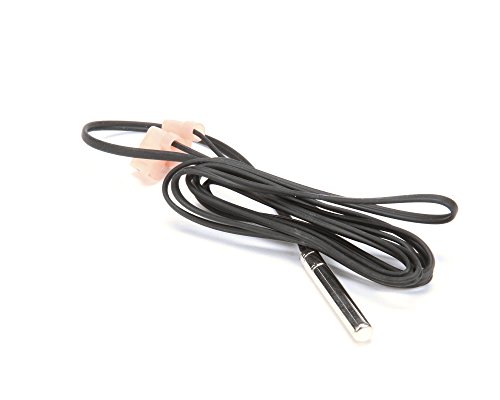
Norlake 145288 Probe, 5 Ft, Dixell, 18Nb-Ntc
Package Dimensions: 15.0 H x 1.8 L x 9.5 W (centimetres)
As an affiliate, we earn on qualifying purchases.
As an affiliate, we earn on qualifying purchases.

DIGITAL TWIN SOFTWARE SYSTEMS: Virtual asset modeling real-time synchronization and predictive analytics
As an affiliate, we earn on qualifying purchases.
As an affiliate, we earn on qualifying purchases.