🔍 Read the full analysis: How Self-Checkout Shifts Everyday Tasks To Shoppers on ThorstenMeyerAI.com

Get business pricing on tech for your team
- Business-only prices and quantity discounts
- Tax-exempt purchasing
- Multiple users, one account, clear invoices
TL;DR
Self-checkout transfers scanning and bagging tasks from store employees to shoppers, a shift that the U.S. Bureau of Labor Statistics identifies as one factor behind projected cashier-job declines. The change has not eliminated the occupation: the BLS counted about 3.1 million cashier jobs in 2025, while retailers have taken different approaches to self-checkout.
Self-checkout shifts scanning and bagging from store employees to customers, while cashier work remains widespread in the United States: the Bureau of Labor Statistics counted about 3.1 million cashier jobs in 2025. The agency projects the occupation will decline through 2035, citing self-service checkout and online sales among the reasons, but the figures do not show that self-checkout alone caused the reduction.
The BLS reported 3,089,410 cashiers in May 2025, down from 3,596,630 in May 2019. Separately, its Occupational Outlook Handbook lists 3,106,300 cashier jobs in 2025 and projects a 6% decline from 2025 to 2035, or about 200,600 fewer jobs. The two 2025 figures come from different BLS measures and should not be treated as interchangeable.
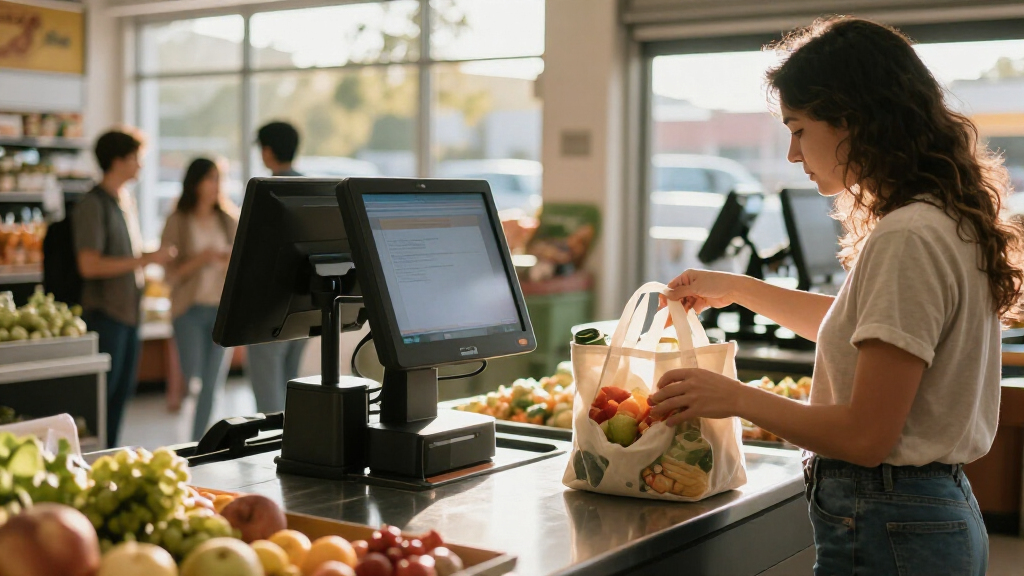
The BLS names self-service checkout stands and increasing online sales as factors in the projected decline. In a January 2026 review, the agency said self-checkout transfers the main task of scanning and bagging goods to customers. Retailers can also have one employee monitor several checkout stations, although the source material does not quantify the labor savings across the industry.
Retailers have not followed one uniform course. The report says Booths in England and U.S. chains Dollar General and Target pulled back on self-checkout between 2023 and 2024, citing issues including service, losses and speed. It also describes continued adoption in Germany and Japan, where self-service and hybrid arrangements remain in use. Those examples show different operating choices, not a single global trend.
Infographic 01 · A short history of self-service
From the clerk to the customer, 1916 to today
Each step moved a piece of the work across the counter: first fetching the goods, then reading the price, then scanning and ordering.
How the customer took over the clerk's work
- Before 1916: a clerk fetched, weighed and wrapped every item at the counter.
- 1916, Piggly Wiggly (Memphis): shoppers take the goods off the shelves themselves and pass a checking station to pay. Clarence Saunders files his patent on 21 October 1916.
- 26 June 1974, Troy, Ohio: a ten-pack of Juicy Fruit gum is the first product scanned with a barcode. A machine now reads the price.
- 9 July 1984: David R. Humble and two colleagues file the CheckRobot patent: the shopper scans, a scale checks the weight, a tunnel stops unscanned items. Payment still goes to a cashier.
- From 1986: CheckRobot machines in several Kroger supermarkets, as reported by CNN (2022).
- 2018: McDonald’s has kiosks in nearly 17,000 restaurants; in France, Italy and Spain well over half of in-restaurant orders go through them (company filing).
Sources differ on the exact opening day of the first Piggly Wiggly (6 or 11 September 1916). The Kroger installation is reported second-hand; we did not retrieve the 1987 newspaper original.
Sources: C. Saunders, US Patent 1,242,872 (1916/17); Tennessee Encyclopedia; GS1 Belgium & Luxembourg; Humble et al., US Patent 4,676,343 (1984/87); CNN (2022); McDonald's Form 10-K 2018.
Powered by Thorsten Meyer AI
Who Does the Checkout Work?
The change affects more than how customers pay. Scanning, bagging and resolving checkout problems become part of the shopping task, while retailers decide how much staff oversight to provide. Customers may move through a checkout without a cashier scanning every item, but they also take on work previously done by store employees.
For workers, the distinction between a projected decline and the disappearance of a job matters. The BLS still counts millions of cashier positions, and its forecast points to a gradual reduction rather than an end to the occupation. The agency identifies more than one influence, including online sales, so the available figures cannot isolate self-checkout’s specific contribution.
The arrangement can also shape service and access. A self-checkout station may offer another way to pay, but shoppers must operate the equipment and seek help when an item or payment does not register as expected. The source material documents retailer concerns about service, speed and losses, but does not provide comparable measures of customer experience or error rates.
Products Worth Considering

Samsung Galaxy Tab A11+ Tablet, 6GB RAM, 128GB Storage, Expandable Storage, Gray

Apple Watch Series 12 GPS 42mm Smartwatch

Apple Watch SE 3 GPS 40mm Smartwatch
As an affiliate, we earn on qualifying purchases.
From Store Aisles to Scanners
Self-service predates electronic checkout. In 1916, Clarence Saunders opened Piggly Wiggly in Memphis, where customers selected goods from shelves rather than asking clerks to fetch them. Saunders filed a patent for a “self-serving store” that year; it describes a route through the store ending at a checking station where goods were billed and paid for. The model moved part of the shopping work to customers long before automated scanners existed.
The barcode later made automated price reading possible. GS1 identifies a ten-pack of Juicy Fruit gum scanned on June 26, 1974, at a Marsh supermarket in Troy, Ohio, as the first product scanned using a barcode. In 1984, David R. Humble and colleagues filed a patent for a self-service distribution system. The system described a shopper scanning items and a scale checking their weight. The early arrangement still included a cashier to collect payment, illustrating that automation changed particular tasks rather than replacing every part of checkout at once.
The report places the first self-checkout installations at Kroger supermarkets in 1986, while noting that the BLS continues to count cashiers decades later. Its historical examples help explain the central development: self-service has repeatedly reassigned tasks, with technology expanding the portion customers can perform themselves.
“Self-checkout reduces the need for labor because the main task of scanning and bagging items is transferred to the customer.”
— U.S. Bureau of Labor Statistics, January 2026 review
What the Employment Figures Cannot Show
The employment figures establish a decline between the 2019 and 2025 BLS counts and a projected decline through 2035. They do not establish how much of that change is caused by self-checkout rather than online shopping or other factors. Nor do the totals show whether affected workers moved into other retail roles, how staffing differs between stores, or how many customers use self-checkout on a typical visit.
The report also does not supply consistent data to compare the results of retailers that expanded self-checkout with those that reduced it. Reasons cited for pullbacks include service, losses and speed, but comparable measurements or detailed company explanations are not provided. The scale of self-checkout use, its effect on customer experience and its long-term employment impact therefore remain uncertain.
Tracking the 2035 Forecast
The next measurable milestone is whether cashier employment follows the BLS projection of a 6% decline between 2025 and 2035. Future BLS employment estimates will show how the occupation changes, but will not by themselves isolate the contribution of checkout technology from online sales and other influences.
Retailers’ choices will also shape what shoppers encounter. Some may keep or expand self-service, while others may limit it or rely on staffed and hybrid checkouts. Further company disclosures and comparable data on staffing, customer service, speed and losses would help clarify why those approaches differ. For now, the confirmed picture is a broad reassignment of checkout tasks alongside a cashier occupation that still employs millions of people.
Key Questions
How many cashiers were employed in the United States in 2025?
The BLS reported 3,089,410 cashiers in May 2025 in its Occupational Employment and Wage Statistics survey. Its Occupational Outlook Handbook separately lists 3,106,300 cashier jobs for 2025; these figures come from different BLS measures.
Does the BLS say self-checkout caused cashier jobs to decline?
The BLS identifies self-service checkout as one factor in the projected decline, alongside increasing online sales. The figures cited do not isolate the effect of self-checkout from other causes.
How many cashier jobs does the BLS project will be lost?
The Occupational Outlook Handbook projects a 6% decline from 2025 to 2035, equal to about 200,600 fewer cashier jobs.
Are retailers all expanding self-checkout?
No. The report says some retailers, including Booths in England, Dollar General and Target in the United States, pulled back between 2023 and 2024, while adoption continues in markets such as Germany and Japan.
Source: ThorstenMeyerAI.com