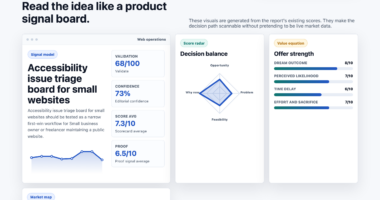
📊 Full opportunity report: A Simple Tool To Flag Scope Creep In Consulting Engagements on IdeaNavigator AI — validation score, market gap, and execution plan.

Get business pricing on tech for your team
- Business-only prices and quantity discounts
- Tax-exempt purchasing
- Multiple users, one account, clear invoices
TL;DR

An IdeaNavigator AI product proposal describes a scope-creep detector for consultants working on fixed-price packages. It would compare incoming client requests with agreed scope, estimate accumulating out-of-scope effort and help draft responses offering paid add-ons; the proposal recommends a three-month test with 30 consultants, but no product launch or test results are reported.
IdeaNavigator AI has proposed a scope-creep detector for consultants selling fixed-price packages, a tool intended to compare client requests with agreed contract terms and flag work that may fall outside them. The concept remains a proposal: no operating product, customer results or test findings are reported, and the suggested next step is a three-month trial with 30 consultants.
According to the IdeaNavigator AI proposal, the tool would connect to a consultant’s email and project-management tools, compare incoming requests with the contracted scope and estimate accumulated out-of-scope effort in real time. It would also draft courteous replies that set a boundary and offer a paid addendum when a request appears to require additional work. The proposal does not specify which platforms it would connect to or how it would resolve ambiguous contract language.
The proposal identifies the intended customer as a consultant delivering fixed-price packages. It describes a gradual problem: a client asks for another revision or a brief call, and each request may seem minor on its own. Over time, the added work can reduce the effective hourly return on a fixed fee, while raising the issue late may create tension with the client. This is the business case presented by IdeaNavigator AI, not a measured finding from a deployed tool.
IdeaNavigator AI suggests a monthly subscription per consultant in the consultant-business-tools market. To test the concept, its proposal recommends tracking 30 consultants over three months, measuring revenue recovered through signed addenda and comparing effective rates with those consultants’ baseline engagements. It provides no subscription price, recruitment plan or trial results.
Consulting operations · Product proposal
A Simple Tool To Flag Scope Creep In Consulting Engagements
IdeaNavigator AI proposes a detector that compares client requests with agreed scope, estimates extra effort and helps consultants discuss paid add-ons. The concept has not launched, and no trial results are reported.
01 / What it would do
From client request to paid addendum
The proposed tool would connect day-to-day communications to contract terms, then help a consultant decide how to respond when work may have expanded.
Input
Read the request
Connect to email and project-management tools to surface incoming client requests. Specific platforms are not named.
Compare
Check agreed scope
Compare each request with contracted work and flag a possible mismatch. Handling ambiguous language is not explained.
Respond
Offer a clear next step
Estimate accumulating extra effort and draft a courteous boundary-setting reply with a paid addendum option.
Request arrives
Email or task request enters the workflow.
Scope is checked
Request is compared with agreed terms.
Effort is estimated
Possible out-of-scope time is accumulated.
Consultant decides
Suggested reply can open a paid change discussion.
02 / Business case
Small asks can add up
IdeaNavigator AI frames the problem as a gradual loss of effective hourly return: each revision or brief call can seem minor until the extra effort accumulates.
Protect fixed-fee margins
- Repeated small requests may expand the job beyond the original agreement.
- Extra effort can lower the effective rate earned on a fixed price.
- Raising the issue late may create tension with the client.
Value depends on execution
- Scope matching must distinguish new work from clarification already covered.
- Effort estimates need to be reliable enough to support a conversation.
- Consultants must trust the tool with sensitive client communications.
03 / Proposed validation
Measure recovery, not just activity
The proposal recommends a three-month test with 30 consultants. It names business outcomes but does not provide a recruitment plan, schedule or results.
Bars identify the proposal’s suggested measures and duration; they do not represent measured performance or targets. Baseline selection and attribution methods are not defined.
04 / Open questions
Product and trial details are pending
No product launch is confirmed. The proposal does not say whether a prototype exists, who would build it or whether participants have agreed to join.
Accuracy
Can it read scope?
Contract formats, unclear terms and requests covered by the original agreement all need a dependable review process.
Trust
Can users review flags?
Consent, client-data protection and the ability to correct classifications are not described.
Commercial case
What counts as success?
There is no subscription price, target for signed addenda, baseline method or benchmark for a meaningful rate change.
Traceability / Proposal to proof
What must happen next
The idea remains a product concept. Claims about improved margins or stronger client relationships require evidence from a real-world trial.
Build and define
Specify integrations, review controls and data protections.
Set the baseline
Choose comparable engagements and effort checks.
Run the trial
Evaluate the proposed 30 consultants over three months.
Report evidence
Publish addenda, rate changes and limitations.
Key questions
What we know so far
What would the detector do?
According to the IdeaNavigator AI proposal, it would compare client requests with contracted scope, estimate possible extra effort and draft a reply that could offer a paid addendum.
Is the tool available now?
No. The information describes a product proposal, not a launched product. No operating product, customer results or test findings are reported.
Protecting Fixed-Fee Margins
In its proposal, IdeaNavigator AI frames the detector as a way to address a difficult part of fixed-fee work: recognizing when repeated small requests have expanded the job before the extra effort becomes costly. A running estimate of additional work could give consultants earlier visibility into their effective rate and a clearer basis for discussing changes with clients.
The drafted response is also central to the pitch. A flag alone would identify a possible mismatch, but it would not resolve the client relationship or agree on payment. The proposal says a suggested message with a paid-addendum option could help a consultant raise the issue consistently, while leaving the decision and conversation to the people involved. Whether clients accept those addenda—and whether consultants find the messages useful—remains to be tested.
If it works as proposed, the tool could make contract boundaries easier to monitor across routine email and project tasks. But its practical value would depend on accurate matching, reliable effort estimates and enough trust from consultants to connect communications that may include sensitive client information. IdeaNavigator AI’s proposal reports no evidence on any of those questions.
Products Worth Considering

Apple iPad Air (4th Generation, 10.9-inch, Wi-Fi, 256GB) – Space Gray

Samsung 27 Odyssey OLED G5 (G50SF) QHD QD-OLED Gaming Monitor

Samsung 27-Inch Odyssey QD-OLED G8 4K 240Hz Gaming Monitor
As an affiliate, we earn on qualifying purchases.
From Hourly Billing to Packages
IdeaNavigator AI frames the idea around consultants who have moved from hourly billing to fixed-price, productized services. A fixed fee gives the client a known price and the consultant a defined payment, but it can leave the consultant carrying the cost if work grows beyond the original agreement. The proposal argues that small requests can make that boundary difficult to enforce in day-to-day exchanges.
The proposal also points to email and task-management integrations as a reason the comparison might now be automated. That is a suggested opportunity, not proof that existing tools cannot perform parts of the task or that a new product can accurately interpret contracts. IdeaNavigator AI does not name a developer, describe a prototype or identify competing products.
The recommended validation focuses on business outcomes rather than adoption alone: signed addenda and effective-rate changes over three months, compared with baseline engagements. Those are the measures IdeaNavigator AI says it would use to assess whether a detector helps consultants identify extra work and recover revenue. The outline does not define how baseline engagements would be selected or how other differences between projects would be accounted for.
Product and Trial Details Pending
No product launch is confirmed, and IdeaNavigator AI reports no results from consultants using a scope-creep detector. Its proposal does not say whether a prototype exists, who would build it, when a trial might begin or whether 30 consultants have agreed to participate.
Key design questions are also unanswered. The proposal does not explain how the tool would interpret different contract formats, distinguish a genuinely out-of-scope request from clarification covered by the original agreement, or estimate the time required for extra work. It also does not describe how it would protect client data, handle consent for connected inboxes or project tools, or let users review and correct flags before responding.
The suggested measures also need definition before results could be interpreted. The proposal gives no baseline method, subscription price, target for signed addenda or benchmark for a meaningful effective-rate change. Until those details and trial results are available, the concept’s accuracy, commercial value and effect on client relationships remain unverified.
Testing Revenue Recovery
The next milestone described in the IdeaNavigator AI proposal is a three-month test involving 30 consultants. The proposed evaluation would count paid addenda signed after requests are flagged and compare consultants’ effective rates with their baseline engagements. The outline gives no schedule, so it is not clear when or whether the test will take place.
A useful assessment would also need to establish how requests are judged against contracts, whether users can correct the system’s classifications and how effort estimates are checked. Those details would help distinguish revenue recovered because of the tool from changes caused by project mix, consultant pricing or client behavior. IdeaNavigator AI reports no evaluation plan beyond the proposed measures.
For now, the development is a product concept rather than a confirmed service. Any claim that it improves margins or helps preserve client relationships would require results from a real-world trial. The proposal is the source for the concept and suggested test; it does not report independent verification or trial findings.
Source: IdeaNavigator AI
Key Questions
What would the proposed scope-creep detector do?
According to the IdeaNavigator AI proposal, it would connect to email and project tools, compare client requests with contracted scope, estimate possible out-of-scope effort and draft a response that could offer a paid addendum.
Is the tool available now?
The information published by IdeaNavigator AI describes a product proposal, not a launched product. It does not confirm that a working prototype exists or provide a release date.
How would the idea be tested?
IdeaNavigator AI’s proposal recommends a three-month test with 30 consultants, measuring revenue from signed addenda and changes in effective rates against baseline engagements. No trial results are reported.
What is still unknown about the tool?
The proposal does not specify the tool’s accuracy, supported integrations, data protections, pricing or ability to handle ambiguous contract terms. It is also unclear whether consultants or clients would find its suggested responses helpful.
Source: IdeaNavigator AI