
📊 Full opportunity report: How SMBs Can Find The Best Place To Begin Automation on IdeaNavigator AI — validation score, market gap, and execution plan.

Get business pricing on tech for your team
- Business-only prices and quantity discounts
- Tax-exempt purchasing
- Multiple users, one account, clear invoices
TL;DR
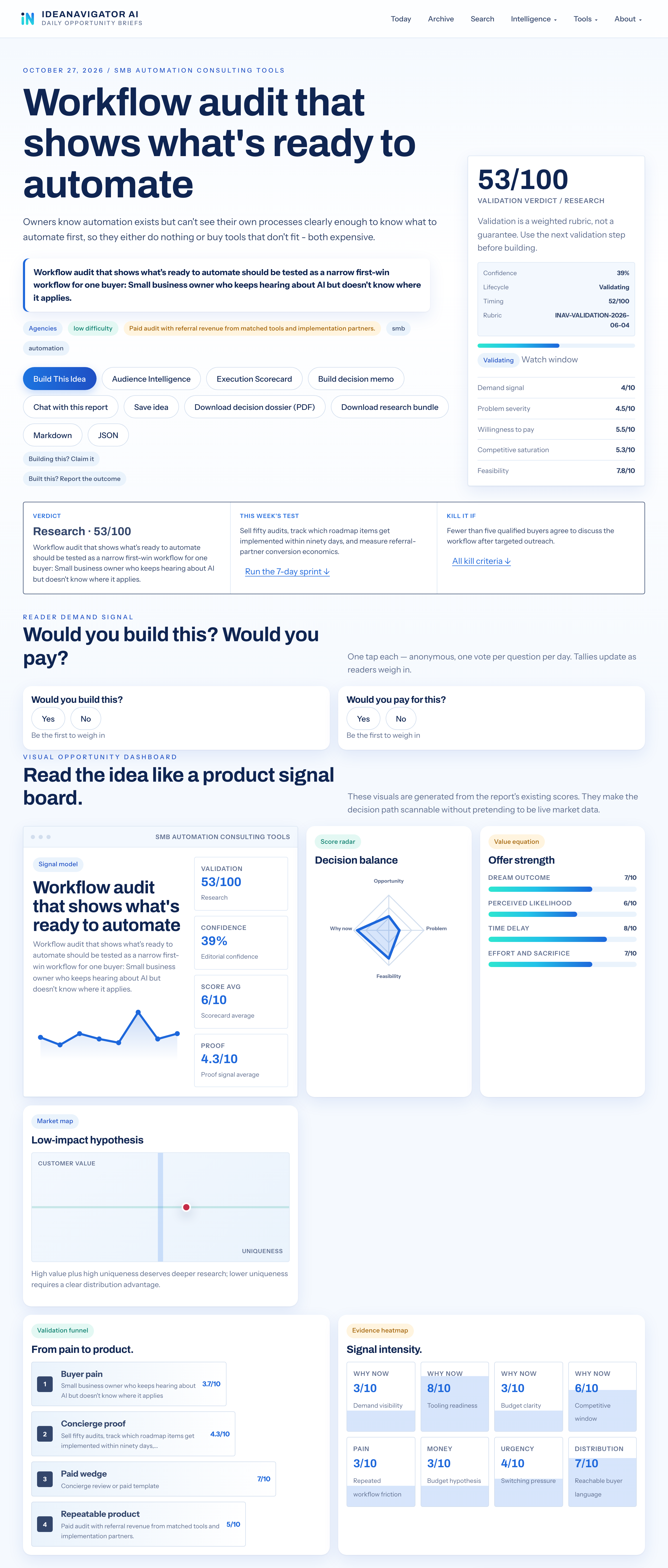
A business concept proposes a guided workflow audit to help small-business owners identify processes that may be ready for automation. The suggested service would rank tasks by readiness, potential return and difficulty, then lay out a 90-day plan; its demand and referral economics have not yet been demonstrated.
IdeaNavigator AI’s proposal outlines a paid workflow-audit service to help small-business owners decide which tasks to automate first, addressing a practical barrier for firms that hear about AI tools but cannot readily map them to their own operations. The concept is an untested business proposal, not a report of a launched product or proven results.
According to the IdeaNavigator AI proposal, the service would guide an owner through an interview about how the business works, then produce a process map with tasks scored for automation readiness, potential return on investment and implementation difficulty. It would also suggest tools for individual steps and sequence recommendations into a 90-day roadmap.
The proposal identifies the intended customer as a small-business owner who knows automation is available but is unsure where it fits. It presents two possible costs of that uncertainty: leaving suitable tasks manual or buying tools that do not match the business’s processes. These are the proposal’s stated problem, not measured findings about how often either outcome occurs.
IdeaNavigator AI suggests combining a paid audit with referral income from recommended software and implementation partners. The proposal recommends testing the idea by selling 50 audits, then tracking which roadmap items customers implement within 90 days and whether referrals convert into economically viable business. It reports no audit sales, implementation rates or referral results.
SMB automation · Concept in focus
How SMBs Can Find The Best Place To Begin Automation
A proposed guided workflow audit would help small-business owners rank automation opportunities by readiness, potential return and difficulty, then turn the findings into a 90-day plan. Demand and referral economics remain unproven.
Recommended by technocapture.com · Updated October 2026
A practical starting point for automation
01 / The opportunitySmall businesses may know automation is available without knowing where it fits. A structured review could make everyday processes easier to compare before an owner commits time, money or implementation support. The proposal sells decision support; its value would depend on whether recommendations are specific, realistic and useful enough to act on.
Where should we begin?
The stated audience is an owner who is unsure which tasks fit automation. Leaving suitable work manual or buying mismatched tools are proposed risks, not measured findings.
Turn operations into a map
A guided interview would capture tasks, handoffs and decisions, then organize candidate workflows for review.
Make next steps concrete
Scores, tool suggestions and a sequenced roadmap are intended to help owners choose what to test first.
From interview to 90-day roadmap
02 / Proposed workflowThe central proposition is that an owner can describe how the business works and receive recommendations detailed enough to guide implementation.
Interview
Ask how work moves through the business, including steps and handoffs.
Map processes
Organize tasks, decisions and dependencies into a process map.
Score candidates
Assess readiness, possible return and implementation difficulty.
Sequence action
Suggest tools and order selected work into a 90-day roadmap.
What the idea still needs to prove
03 / Evidence gapWill owners pay?
No audit sales, price, named customers or customer research are reported. The proposal does not establish demand.
Will maps be useful?
There is no evidence that guided interviews or language models can produce accurate, business-ready maps across industries without review.
Will advice lead to action?
No implementation rates, savings data, independent evaluation or case studies are provided.
Test the first fifty audits
04 / Validation planSell the audits, then follow customers for 90 days.
IdeaNavigator AI proposes tracking which roadmap items customers implement and whether referrals convert into economically viable business. This is a suggested experiment, not a completed study.
To make results interpretable, the service would need clear definitions for an implemented recommendation and a successful referral, plus the audit price, customer profile and cost of delivering each assessment.
Key questions
Reader guideWhat is the proposed service?
A paid assessment that would interview an owner, map processes, score automation candidates and provide tool suggestions with a 90-day roadmap.
Has it launched or been proven?
No. The proposal reports no product launch, paying customers or measured outcomes. It recommends testing 50 audits.
How might it make money?
The suggested model combines audit fees with referral revenue from software and implementation partners. Pricing and conversion results are not reported.
What should owners do meanwhile?
Document a process, compare the effort and expected benefit of changing it, and test a limited recommendation before expanding.
A Practical Starting Point for Automation
For a small business, choosing an automation project can be as consequential as selecting a tool. A structured review could, if it works as intended, help owners compare everyday processes before committing time and money to software or outside implementation support. The proposed scores and roadmap are meant to make that choice more concrete.
The idea also speaks to a broader adoption challenge: availability of AI products does not automatically tell a company what to automate. A workflow-focused service would sell decision support, not just access to another tool. Its value would depend on whether the recommendations are specific, realistic and useful enough to lead to implementation.
That distinction matters to prospective customers and partners. An audit could help reduce mismatched purchases, but it could also steer clients toward products that generate referral income for the service. Clear explanations of scoring and disclosure of commercial relationships would help customers judge recommendations on their merits. The proposal does not describe how it would manage that potential conflict.
Products Worth Considering

Jackery Explorer 300 Portable Power Station, 292Wh

Jackery HomePower 3600 Plus Portable Power Station, 3584Wh, 3600W

Bose QuietComfort True Wireless Earbuds with Active Noise Cancellation, Black
As an affiliate, we earn on qualifying purchases.
From AI Tools to Process Mapping
IdeaNavigator AI frames the proposal’s timing around the rapid growth of AI tools, which it says has left some small-business owners unsure which options apply to their work. The proposal also points to guided interviews and language models as a possible way to make process-mapping more accessible. That is the concept’s rationale; it provides no evidence that a model can produce accurate, business-ready maps across different industries without review.
Process mapping involves identifying the steps, handoffs and decisions involved in a task. In the proposed service described by IdeaNavigator AI, the map is not an end in itself: it would be used to assess candidate workflows and order next steps. The service’s central proposition is that an owner can describe operations through a guided interview and receive recommendations detailed enough to act on.
The proposal places the idea in the SMB automation consulting tools market. It specifies an initial customer, a possible product and a validation test, but does not identify a launched platform, named customers, pricing, a team or a development timeline. Those details would be needed to judge whether the concept is moving beyond planning.
Demand and Outcomes Remain Untested
The IdeaNavigator AI proposal does not establish that small businesses will pay for an audit, that its rankings will identify the right workflows or that customers will carry out the recommended changes. It also gives no definition of a successful referral conversion, no audit price and no target for implementation rates. The proposed 50-audit test is a validation plan, not a completed study or evidence of market demand.
Other practical questions remain open. The proposal does not explain how the audit would handle sensitive business information, check the accuracy of owners’ descriptions or account for tasks that require human judgment. Nor does it state how the service would compare potential benefits with costs, including software subscriptions, setup and staff time. Tool suggestions and readiness scores would need to reflect those factors to support sound decisions.
The proposal reports no customer interviews, independent evaluations, case studies or performance data. It is also unclear whether the service would be delivered primarily by software, consultants or a combination. Until those points are addressed, the proposed roadmap should be understood as a product concept rather than a verified method for achieving savings.
Testing the First Fifty Audits
IdeaNavigator AI’s proposal describes a next step of selling 50 workflow audits and following customers for 90 days. The proposed test would track which recommended roadmap items are implemented and measure referral-partner conversion economics. Those measures could help determine whether customers act on the guidance and whether referrals can support the proposed business model.
For that test to offer a clear signal, the service would need to define how it counts an implemented recommendation, what period it uses to measure results and how it distinguishes software referrals from completed automation projects. Reporting the audit price, customer profile and the costs of delivering each assessment would also help readers assess the economics. The proposal announces no launch date or results.
Until such evidence is available, small-business owners considering automation can treat the audit model as one possible approach: document how a process works, compare the effort and expected benefit of changing it, and test a limited recommendation before expanding. Whether a dedicated paid service can deliver that guidance reliably remains to be seen.
Source: IdeaNavigator AI
Key Questions
What is the proposed workflow-audit service?
According to IdeaNavigator AI’s proposal, it is a paid assessment that would interview a small-business owner about operations, map processes, score possible automation tasks and provide tool suggestions with a sequenced 90-day roadmap.
Has the service been launched or proven?
The proposal reports no product launch, paying customers or measured outcomes. It describes an idea and recommends testing it by selling 50 audits.
How would the proposed service make money?
The proposal suggests combining fees for audits with referral revenue from matched tools and implementation partners. It provides no pricing or referral-conversion results.
How would the idea be tested?
The proposed test would follow 50 audits, measure which roadmap items customers implement within 90 days and evaluate referral-partner conversion economics.
Source: IdeaNavigator AI