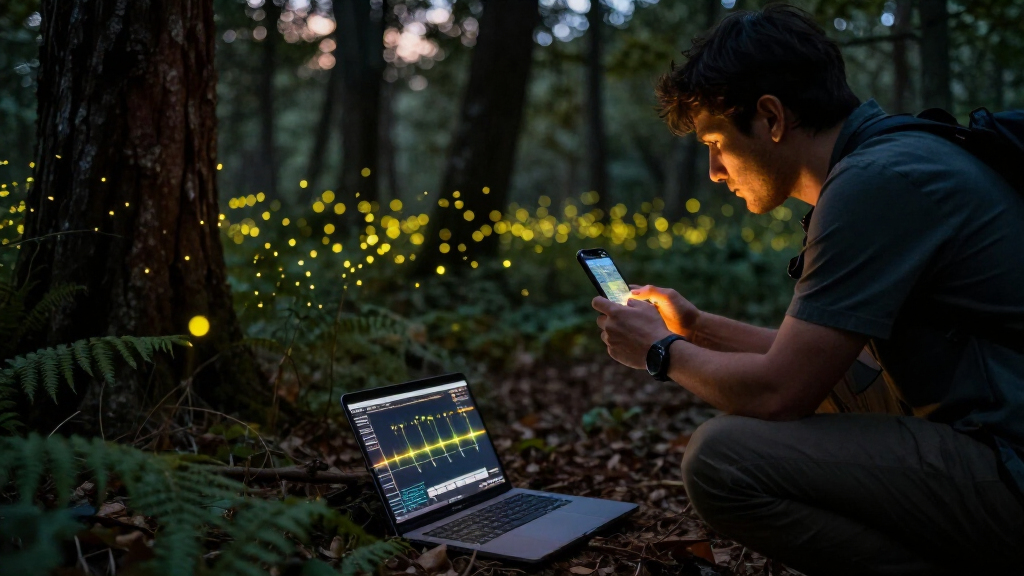

🔍 Read the full analysis: How To Make An AI Film About Synchronous Fireflies on ThorstenMeyerAI.com

Get business pricing on tech for your team
- Business-only prices and quantity discounts
- Tax-exempt purchasing
- Multiple users, one account, clear invoices
TL;DR
Room 155, “Luciole — The Synchronous Fireflies of Vallon Creux,” is an AI-built interactive exhibition about simulated fireflies falling into a shared rhythm. Its 96-oscillator model lets visitors watch synchronization, disturb it and observe a measured recovery; the setting and field study are fictional.
Room 155 of 175, an AI-built web exhibit called “Luciole — The Synchronous Fireflies of Vallon Creux,” turns a simulation of firefly synchronization into an interactive field notebook, as detailed in the original analysis. Visitors can watch 96 simulated fireflies move from mismatched flashes toward a shared rhythm, then disturb the simulation and see how it responds. The exhibit’s fictional setting and organisms are not a real field study; its central behavior is generated by a mathematical model.
The site represents each simulated firefly as an oscillator with an individual phase and tempo. Each oscillator is influenced by nearby signals, and a control changes the strength of that coupling. The exhibit displays a live coherence measure as the simulated flashes align. Pointer interaction perturbs the phases, while a trace records the resulting change and recovery. The accompanying phase diagram also draws on the simulation rather than serving as a separate decorative illustration.
The visual presentation separates the simulated field from the human observer’s notes. A dark green background and chartreuse flashes distinguish the insects, while muted mauve marks annotations. Serif text carries the naturalist-notebook voice; handwritten-style details appear in the margins. According to the source description, the insects, gradients and other visual elements are built with HTML, CSS, SVG and canvas, rather than downloaded images or prerecorded firefly footage.
The exhibition page also makes its originating art-direction prompt available through a footer link labeled “Prompt,” according to the supplied material. That brief calls for a self-contained site with responsive layouts, accessible controls, reduced-motion support and animation that pauses when the page is hidden. It describes a three-pass production process, including critique and screenshots at several screen widths. The source does not provide independent verification of each production step.
ROOM 155 / INTERACTIVE EXHIBITION
How to Make an AI Film About Synchronous Fireflies
Inside Luciole — The Synchronous Fireflies of Vallon Creux, a browser-built field notebook turns a mathematical simulation into a moving story: 96 individual rhythms drift, align, and recover after disruption.
01 / THE DEVELOPMENT
Making Synchronization Visible
A shared rhythm can emerge from many individual clocks responding to nearby signals. The exhibition lets visitors watch that transition unfold instead of presenting only a finished chorus. They can change coupling strength, disturb the field, and follow the measured response.
From scattered flashes to chorus
Each simulated firefly has its own phase and tempo. Nearby signals influence those rhythms, allowing flashes to become more coordinated over time.
Turn the coupling
A control changes the strength of interaction between oscillators. The field responds as conditions shift, while a live coherence measure tracks alignment.
Interrupt the pattern
Pointer interaction disturbs phases. A trace records the change and recovery, making the model’s response part of the visitor’s experience.
02 / THE MODEL
Order, Measured in Motion
The field is described as a Kuramoto-style oscillator model: individual rhythms interact and can become more coordinated. A phase diagram and coherence display draw from the simulation itself.
The source does not provide the implementation’s full equations, parameter values, or the calculation behind its coherence measure. The chart below is an explanatory visual, not reported experimental data.
Illustrative stages only. The source describes a live coherence measure but supplies no underlying values for this comparison.
03 / CREATIVE PRODUCTION
Build the Experience in Four Passes
The reproduced art-direction brief describes a self-contained site with responsive layouts, accessible controls, reduced-motion support, and animation that pauses when the page is hidden. It proposes a three-pass production process with critique and screenshots at several screen widths; the supplied source does not independently verify each step.
Set the premise
Frame a fictional naturalist notebook around one legible idea: many clocks can find a shared rhythm.
Make the system
Describe 96 oscillators, nearby influence, coupling controls, a coherence readout, and phase disturbance.
Shape the scene
Use dark green and chartreuse flashes, with serif notes and muted mauve annotations for a night-field mood.
Review the page
Check responsive layouts, accessibility, reduced motion, and behavior across screen widths as the brief requests.
Follow the Visitor’s Experiment
04 / FICTION & LIMITS
A Field Notebook, Not a Field Study
“Luciole” and “Vallon Creux” are fictional names created for the exhibit. Invented species, flash-pattern notes, and a two-week season calendar belong to its creative direction; they are not confirmed field data.
“CLICK anywhere to perturb — inject chaos and watch order re-emerge.”
ART-DIRECTION BRIEF“Luciole and Vallon Creux are fictional, created for the exhibit.”
EXHIBITION DESCRIPTIONSimulation recovery describes programmed behavior, not a wild population.
HOW TO READ THE RESULTWhat the source describes
An AI-built browser exhibit using HTML, CSS, SVG, and canvas, with no downloaded image assets or prerecorded firefly footage, according to its description.
What remains undocumented
The division of work between AI and people, independent technical review, visitor testing, model parameters, and the exhibit’s launch date are not supplied.
05 / VISITOR GUIDE
What Visitors Can Test
Open the exhibition, compare the field at different coupling strengths, then click or tap to perturb it. Watch the displayed coherence and trace as the simulation responds. No follow-up release, research validation, or planned update is confirmed in the supplied material.
Are the fireflies or Vallon Creux real?
No. The supplied exhibit description identifies both as fictional. This is not a real field study.
What does the simulation show?
It models 96 oscillators with individual phases and tempos. Their signals influence nearby oscillators, so visitors can watch the simulated flashes become more coordinated.
Can visitors change the simulation?
Yes. The description says visitors can adjust coupling strength and disturb phases with pointer interaction, then observe the model’s response.
Does it prove how wild fireflies synchronize?
No. It shows a mathematical simulation, not observations of wild fireflies or evidence about a particular population.
How was the website made?
The source describes an AI-built site made with HTML, CSS, SVG, and canvas. It reproduces an art-direction brief but does not detail the human and AI contributions.
Where can I view the exhibit?
The source identifies it as Room 155 in a 175-room series and links to the Luciole exhibition.
Making Synchronization Visible
The exhibit gives visitors a way to observe a pattern that can be difficult to grasp from a static explanation: a shared rhythm can arise from many individual clocks responding to nearby ones. Instead of showing only a finished chorus, it puts the movement toward synchrony on screen and lets visitors change the conditions by adjusting coupling or disturbing the field.
That makes the project relevant both as an explanation of a mathematical idea and as an example of AI-assisted creative production. Its own account treats the site’s construction as part of the exhibit, while the exposed prompt offers readers a view of the instructions used to shape the design. The source does not establish how much of the final work was produced autonomously by AI, what human review took place, or whether the experience has been evaluated with visitors.
interactive firefly simulation software
As an affiliate, we earn on qualifying purchases.
As an affiliate, we earn on qualifying purchases.
A Fictional Field Notebook
“Vallon Creux” and “Luciole” are fictional names in this exhibition, not a real location, company or biological research project. The source describes the underlying synchronization concept through a Kuramoto-style oscillator model: individual rhythms can become more coordinated through interaction. The exhibit’s on-screen behavior should be understood as a simulation, not as recorded observations of fireflies or evidence about a particular population.
The supplied material describes a browser experience built without a framework or external image assets, with a focus on night-time atmosphere and measured interaction. Its design brief also proposes invented species, flash-pattern notes and a two-week season calendar. Those are elements of the creative direction, not confirmed field data. The site is identified in the source as Room 155 in a 175-room series and is linked at fable-25-830.netlify.app/sites/luciole/.
““Its signature move is to make patience visible.””
— Exhibition description
As an affiliate, we earn on qualifying purchases.
Limits of the Simulation
The source material does not state the model’s parameter values, the full equations used in the implementation, or how the reported coherence measure is calculated. It also does not provide an independent technical review, performance measurements, or user testing. The described recovery is a behavior of the programmed simulation; it should not be taken as proof that a real firefly population would respond in the same way.
The material identifies the site as AI-built and reproduces its art-direction prompt, but it does not document which parts were generated by an AI system, which were written or revised by people, or how the stated three-pass process was recorded. The date the exhibit went live is also not supplied.
firefly synchronization educational kit
As an affiliate, we earn on qualifying purchases.
As an affiliate, we earn on qualifying purchases.
What Visitors Can Test
Visitors can open the live exhibit and compare how the field behaves at different coupling strengths, then click or tap to perturb the simulation and watch the displayed coherence and trace. The source gives no announcement of a follow-up release, research validation or planned update, so no next milestone is confirmed. For now, the clearest next step is to treat the page as an interactive demonstration and distinguish its fictional naturalist framing from the behavior of its model.
mathematical modeling tools for simulations
As an affiliate, we earn on qualifying purchases.
As an affiliate, we earn on qualifying purchases.
Key Questions
Are the fireflies or Vallon Creux real?
No. The supplied exhibit description says Luciole and Vallon Creux are fictional, and the page is not a real field study.
What does the simulation show?
It models 96 oscillators with individual phases and tempos. Their signals influence nearby oscillators, allowing visitors to watch the simulated flashes become more coordinated.
Can visitors change the simulation?
Yes. The description says visitors can adjust the coupling strength and use pointer interaction to disturb the phases, then observe the model’s response.
Does the exhibit prove how wild fireflies synchronize?
No. It presents a mathematical simulation, not observations of wild fireflies. The source does not claim that the displayed recovery establishes how a real population behaves.
How was the website made?
The source describes an AI-built site using HTML, CSS, SVG and canvas, with no downloaded image assets or prerecorded firefly sequence. It also reproduces an art-direction brief, but does not detail the division of work between AI and human contributors.
Source: ThorstenMeyerAI.com
Halloween Picks
halloween
As an affiliate, we earn on qualifying purchases.