TL;DR

Get business pricing on tech for your team
- Business-only prices and quantity discounts
- Tax-exempt purchasing
- Multiple users, one account, clear invoices
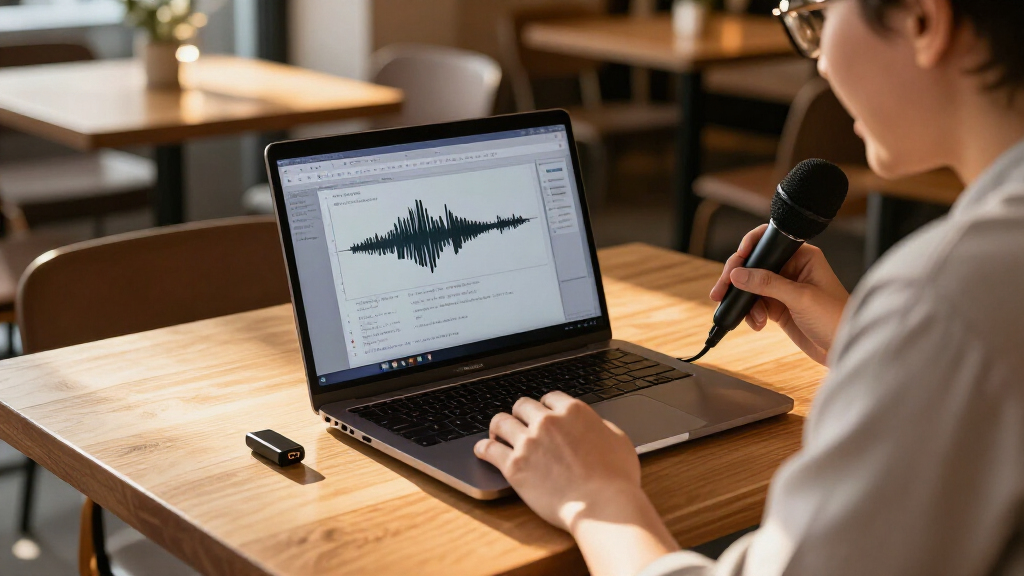
A developer has adapted Google’s EmbeddingGemma 2 embedding model into a Mac speech-to-text app by training a small reader to map audio representations to words. The maker reports that it transcribes an hour of audio in 12.6 seconds on a base M3 MacBook Air, but says its current word error rate is about 5%, above the 2–3% cited for leading speech models.
A developer has adapted Google’s EmbeddingGemma 2, an embedding model not trained for speech-to-text, into a Mac transcription app that runs on Apple Silicon. The project reports processing an hour of audio in 12.6 seconds on a base M3 MacBook Air, while acknowledging that its current accuracy trails leading speech-recognition models.
The approach leaves EmbeddingGemma 2’s audio encoder unchanged. A separately trained, small reader maps short audio slices into the model’s text space, where the system selects the closest match from about 229,000 English words. A second, small model adds capitalization and punctuation. The project says the base embedding model itself was never trained to transcribe speech, unlike a speech-to-text model.
According to the project website, only the reader was trained, in under two hours on eight H100 GPUs using openly licensed English speech. The downloadable Mac app is listed as free, version 1.6, and requires macOS 14 or later on Apple Silicon. Its models download on first launch; the site gives their download size as 715 MB.
The app can transcribe an audio file or dictate into another application: the user holds the Right Option key while speaking and releases it to enter the text. The project says processing uses the Mac’s Neural Engine and that audio remains on the device.
Fast Local Transcription, With an Accuracy Gap
The report highlights a way to repurpose an embedding model for a task it was not built to perform. If the stated results hold in broader use, the approach could offer developers a compact, local transcription option without sending recordings to a remote service. On-device processing can matter for users who want to keep audio off external servers, although the privacy statement here is the project’s own description of its app.
Speed does not settle the question of usefulness. The developer puts the system’s current word error rate at about 5%, compared with 2–3% for leading speech models. Word error rate measures transcription mistakes against reference text; real-world results can vary with speakers, accents, background noise, and recording quality. The reported benchmark is promising for throughput, but the accuracy gap may matter for users who need dependable transcripts with little editing.
The result is also not a like-for-like model ranking. The project compares its system and IBM Granite Speech on the same base M3 MacBook Air, but its other listed comparisons come from FluidAudio benchmarks on newer Macs and different audio. Those figures offer context, not a controlled performance comparison.
Mac speech-to-text app for Apple Silicon
As an affiliate, we earn on qualifying purchases.
As an affiliate, we earn on qualifying purchases.
EmbeddingGemma 2 is described by the project as a multimodal embedding model that places text, images, audio, and video in a shared representational space. The experiment builds on the idea that spoken audio and its written words can land near one another in that space. Rather than changing the underlying audio encoder, the developer trained a reader to recover word sequences from its representations.
The project’s benchmark table reports 288 times real time for its system on a base M3 MacBook Air with 8 GB of memory: one hour of audio processed in 12.6 seconds. On the same machine, it lists IBM Granite Speech 5.0 Turbo at roughly 150 times real time, or 25.7 seconds per hour, using GPU processing through MLX. The site says these first two results are its own tests; the comparisons involving Parakeet models are FluidAudio’s published results on different hardware and audio.
The developer says the next iteration will focus on training a better reader to reduce transcription errors. That distinction matters: the current result is a project report about an experimental adaptation, not evidence that the underlying embedding model has become a general-purpose speech-recognition product.
““The base model was never trained for speech-to-text.””
— The project website
on-device audio transcription software
As an affiliate, we earn on qualifying purchases.
As an affiliate, we earn on qualifying purchases.
Accuracy Beyond the Reported Tests
The project does not provide enough detail in the supplied report to establish how its 5% word error rate was measured, including the test set, audio conditions, or evaluation method. It is therefore unclear how well the figure reflects varied accents, noisy recordings, long-form speech, or languages other than English. The reader was trained on openly licensed English speech, and the described vocabulary is English.
The performance numbers also should not be read as a single controlled leaderboard: only the first two listed systems were tested on the same base M3 MacBook Air, while the remaining figures use different machines and audio. The report does not provide independent verification of the speed, accuracy, or local-processing claims. It also remains unclear how much a better-trained reader would improve accuracy or what trade-offs that might bring.
privacy-focused speech recognition Mac
As an affiliate, we earn on qualifying purchases.
As an affiliate, we earn on qualifying purchases.
Reader Training Is the Next Test
The project says its next iteration will train the reader further in an effort to narrow the reported accuracy gap. It has not supplied a release schedule, a new target error rate, or results from that future work. Until updated evaluations are published, the current figures describe version 1.6 as reported by its developer, not a forecast of later performance.
For users considering the app now, the practical next step is to test it on their own recordings and check transcripts before relying on them. Broader, clearly described evaluations would help establish how the system performs across speakers and conditions, and whether the speed advantage remains useful when accuracy is taken into account.
local speech-to-text transcription tool
As an affiliate, we earn on qualifying purchases.
As an affiliate, we earn on qualifying purchases.
Key Questions
What is the EmbeddingGemma 2 transcription project?
It is a Mac app that uses EmbeddingGemma 2’s audio representations and a separately trained reader to produce English transcripts. The project says the base model was not trained for speech-to-text.
How fast does it transcribe audio?
The project reports processing one hour of audio in 12.6 seconds on a base M3 MacBook Air with 8 GB of memory. That is the developer’s benchmark; comparisons with results from other Macs and audio are not like-for-like.
How accurate is the transcription?
The developer reports a current word error rate of about 5% and compares it with 2–3% for leading speech models. The supplied report does not specify the evaluation set or enough testing details to judge how broadly the figure applies.
Does the app send recordings to a server?
The project says the app runs on the Mac’s Neural Engine and that audio stays on the device. This is the developer’s description; the report does not include an independent privacy audit.
Which Macs and operating systems does it support?
The download is listed for Apple Silicon Macs running macOS 14 or later. The project says the models download on first launch and lists a download size of 715 MB.
Source: hn
Halloween Picks
halloween
As an affiliate, we earn on qualifying purchases.