📊 Full opportunity report: How Digital Benefit Check Bots Are Transforming Social Determinants Of Health on IdeaNavigator AI — validation score, market gap, and execution plan.
Open a free Amazon Business account
Business pricing, bulk buying and tax-exempt orders.
Create a free accountAs an affiliate, we earn on qualifying purchases.
TL;DR
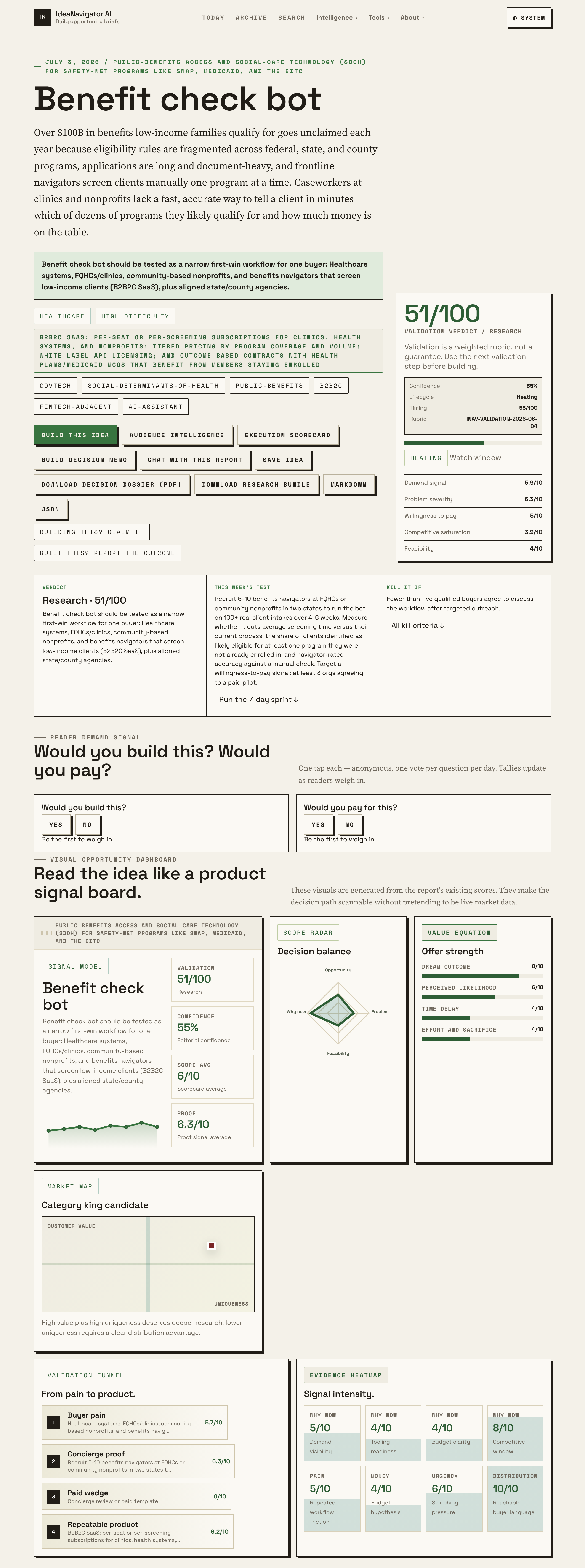
AI-driven benefit check bots are emerging as a key tool for healthcare providers and nonprofits to streamline eligibility screening for social programs. This innovation addresses longstanding barriers, such as complex eligibility rules and manual processes, especially after nonprofit closures and pandemic-related redeterminations. The development promises to improve access and reduce unclaimed benefits for low-income families.
Digital benefit check bots are being piloted across healthcare and community organizations to automate and accelerate eligibility screening for social programs, addressing a major gap left by nonprofit closures and pandemic-related redeterminations. These AI-powered tools aim to identify benefits that low-income families qualify for but often go unclaimed due to complex rules and manual screening processes.
The benefit check bot, developed as a white-label conversational screening tool, asks clients a series of yes/no and multiple-choice questions via web or SMS. It then provides an estimated list of benefits, including SNAP, Medicaid, EITC/CTC, WIC, and LIHEAP, along with next steps for application and document checklists. The tool is designed to be embedded on clinics’ websites or used by benefits navigators, streamlining the process from hours to minutes.
This innovation is driven by recent disruptions: the closure of Benefits Data Trust in 2024, which previously served seven states, and the surge in Medicaid redeterminations following the pandemic. These factors created a pressing need for scalable, low-cost screening solutions, which conversational AI now makes feasible. The initial focus is on testing in two states, with plans to expand based on pilot outcomes.
The market for these tools includes Federally Qualified Health Centers (FQHCs), community nonprofits, state agencies, and health plans. Revenue models are primarily B2B2C SaaS subscriptions, tiered by program coverage and volume, with additional revenue from API licensing and outcome-based contracts with Medicaid managed care organizations. The goal is to improve benefits access, reduce administrative burdens, and promote continued enrollment in social programs.
Impact on Benefits Access and Health Equity
The deployment of benefit check bots could significantly improve access to social determinants of health (SDOH) programs, which are critical for addressing health disparities among low-income populations. By automating eligibility screening, these tools reduce the time and resource burden on frontline staff and enable faster identification of benefits, potentially increasing uptake of programs like Medicaid, SNAP, and WIC.
Experts suggest that this technology could help recover billions in unclaimed benefits annually, directly impacting families’ financial stability and health outcomes. Moreover, the scalability of AI-driven screening offers a way for health systems and state agencies to better meet the demands of post-pandemic redeterminations and ongoing social needs.
However, questions remain about the accuracy of these tools across diverse populations and their integration into existing workflows. The success of early pilots will determine whether these benefits translate into widespread adoption and measurable improvements in health equity.
As an affiliate, we earn on qualifying purchases.
Background on Benefits Screening Challenges
For years, low-income families have left over $100 billion in benefits unclaimed annually due to fragmented eligibility rules, lengthy application processes, and manual screening by caseworkers. Nonprofits like Benefits Data Trust played a vital role in bridging this gap but shut down in 2024, leaving a void in outsourced benefits access.
The pandemic further complicated the landscape, with millions undergoing Medicaid redeterminations that required rapid eligibility checks. Traditional call centers and manual processes proved insufficient to meet the surge in demand, prompting the exploration of automation and AI solutions.
Recent advances in conversational AI and natural language processing now make it possible to deliver multilingual, multi-program screening at near-zero marginal cost, offering a scalable alternative to expensive human-led workflows. This context has accelerated interest in deploying benefit check bots as a new standard in social determinants of health screening.
social program eligibility screening software
As an affiliate, we earn on qualifying purchases.
As an affiliate, we earn on qualifying purchases.
Unanswered Questions About Accuracy and Adoption
It remains unclear how well these benefit check bots will perform across diverse populations, particularly in terms of accuracy and cultural competence. Early pilot results are promising but limited in scope, and broader validation is needed to confirm reliability. Additionally, questions about integration with existing health and social service workflows, data privacy, and long-term sustainability are still being addressed.
Medicaid and SNAP benefits checker
As an affiliate, we earn on qualifying purchases.
As an affiliate, we earn on qualifying purchases.
Next Steps for Pilot Expansion and Validation
Health systems, nonprofits, and state agencies involved in pilot programs plan to evaluate the effectiveness of benefit check bots over the coming months. Key metrics include reduction in screening time, increase in benefits identified, and navigator-rated accuracy. If pilot results are positive, wider deployment and integration into standard workflows are expected, alongside further development of multilingual and multi-program capabilities.
Stakeholders anticipate that successful validation will lead to broader adoption, with potential for scaling across more states and programs, ultimately transforming how social determinants of health are addressed at the community level.
As an affiliate, we earn on qualifying purchases.
Key Questions
How do benefit check bots improve the process for clients?
They automate eligibility screening, reducing wait times and providing quick, accurate estimates of benefits for low-income families, often in minutes rather than hours or days.
Are benefit check bots accurate across different populations?
Early results are promising, but broader validation is ongoing to determine accuracy and cultural competence across diverse groups.
What are the main barriers to widespread adoption?
Key challenges include ensuring data privacy, integrating with existing workflows, and validating accuracy at scale. Funding and stakeholder buy-in are also critical factors.
Will this technology replace human benefits navigators?
Rather than replacing staff, the goal is to augment their capacity, allowing navigators to focus on complex cases while automation handles routine screening.
What is the timeline for broader deployment?
If pilot outcomes are positive, wider adoption could occur within the next 12-24 months, with ongoing improvements based on feedback and validation results.
Source: IdeaNavigator AI
Fall Picks
fall essentials
As an affiliate, we earn on qualifying purchases.