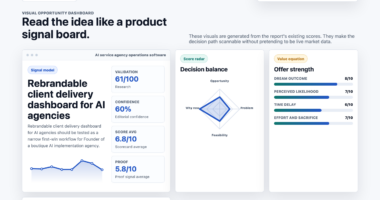

📊 Full opportunity report: Sovereign AI: Which Approach Is More Cost-Effective? on ThorstenMeyerAI.com — validation score, market gap, and execution plan.

Get business pricing on tech for your team
- Business-only prices and quantity discounts
- Tax-exempt purchasing
- Multiple users, one account, clear invoices
TL;DR
In 2026, the cost gap between self-hosted and managed AI models has shifted, with self-hosting often being more expensive at typical utilization levels. Recent open models now rival proprietary ones in performance, challenging the traditional capability gap. The decision hinges more on control than cost, but uncertainties remain about long-term economics and practical deployment.
In 2026, the cost of self-hosting sovereign AI models often exceeds that of purchasing managed inference services, contradicting earlier assumptions that self-hosting was inherently cheaper for control-focused organizations. This shift is driven by rising GPU costs, low utilization efficiencies, and improved open-weight models that rival proprietary options, making the economics of sovereignty more complex than before.
Recent industry analysis indicates that the cost of GPU infrastructure for self-hosting has increased, with bare-metal GPU rentals now ranging from $2,000 to over $20,000 per month, depending on model size and deployment scale. On-demand hyperscaler pricing has also risen, with GPU-hour costs climbing approximately 14% year-over-year, further eroding the presumed cost advantage of self-hosting.
Additionally, utilization inefficiencies significantly inflate the effective cost per token. Most internal deployments operate at 5–10% utilization, leading to costs 2–5 times higher than managed services that pool demand across thousands of users. The ongoing need for human oversight and maintenance adds further expenses, often making self-hosting less economical than buying inference services, especially at typical workloads.
Meanwhile, open-weight models like Z.ai’s GLM-5.2, a 753-billion-parameter model released in June, now demonstrate performance comparable to proprietary models in many tasks such as summarization, extraction, and code assistance. While proprietary models still outperform in long-horizon tasks, the capability gap in broad enterprise workloads is narrowing, challenging the notion that open models are inherently inferior.
Forge or Self-Host?
The Real Cost of Sovereign AI
Sovereignty is the reason. Cost usually isn’t. — Forge Trilogy, Part 3
Two ways to buy control
Managed sovereignty (Forge-style)
- Full lifecycle: pre-training, post-training, RL on your data, in your jurisdiction
- Vendor’s training recipes + orchestration — no ML-infra team required
- Platform dependency: Mistral architectures only, for now
- Open question: do most enterprises need custom-trained models at all?
DIY self-hosting (open weights)
- Maximum control: air-gap capable, no vendor can switch you off
- GPU floor $2–20k/mo; H100 rates rose ~14% y/y
- Idle penalty ~10× below ~30% utilization — the silent budget killer
- The human: DevOps/MLOps runs €62–89k gross in Germany, seniors €100k+
The capability excuse evaporated — GLM-5.2 (open, MIT) vs Claude Opus 4.8
The answer that works: route, don’t choose (Bifröst pattern)
The verdict: self-hosting usually isn’t cheaper — but the capability tax on sovereignty has collapsed to a few points. You no longer sacrifice quality for control; you only pay for it. Price it honestly, then decide whether you’re buying insurance or ideology.
Implications for Organizations Choosing AI Deployment Strategies
This analysis shifts the traditional view that self-hosting is the most cost-effective method for sovereignty. With rising GPU costs, low utilization, and competitive open models, organizations may find that purchasing managed inference services offers better value, especially if control over data residency is the primary concern. The decision now hinges more on data control and compliance rather than cost savings alone, making strategic considerations more complex.
As an affiliate, we earn on qualifying purchases.
Evolution of Sovereign AI Economics and Capabilities in 2026
Over the past two years, the debate around sovereign AI has centered on control versus cost. Earlier, self-hosting was believed to be cheaper for organizations prioritizing data sovereignty, despite performance limitations. However, recent developments—such as rising GPU prices, low utilization inefficiencies, and the emergence of high-performing open models—have challenged that assumption. The launch of Mistral Forge in March 2026 exemplifies this shift, offering a platform for managed sovereignty that competes directly with self-hosted setups.
Historically, self-hosting was justified by control over data and models, but the economic landscape has changed. GPU costs have increased, and the operational overhead of maintaining infrastructure and human oversight has become more apparent. Meanwhile, open models like GLM-5.2 demonstrate that open-weight models can now match many proprietary models in capability, further reducing the technical barriers to sovereignty.
“Forge is designed to provide managed sovereignty with full lifecycle support, competing directly with self-hosted models on cost and control.”
— Mistral’s spokesperson
As an affiliate, we earn on qualifying purchases.
Outstanding Questions on Long-Term Cost and Performance
It remains unclear how the costs of GPU infrastructure will evolve beyond 2026, especially with potential supply chain improvements or further demand-driven price increases. Additionally, the long-term performance and adoption of open models like GLM-5.2 across diverse enterprise workloads are still being evaluated, and the impact on overall sovereignty economics is uncertain.
As an affiliate, we earn on qualifying purchases.
Future Trends in Sovereign AI Deployment and Economics
Next steps include monitoring GPU price trends, utilization efficiencies, and the continued maturation of open-weight models. Organizations will likely reassess their sovereignty strategies as these factors evolve, with potential shifts toward hybrid approaches combining managed services and self-hosted components. Industry reports, vendor updates, and real-world deployment case studies will shape the ongoing debate.
As an affiliate, we earn on qualifying purchases.
Key Questions
Is self-hosting still cost-effective for small organizations?
Typically, no. Small organizations often face high per-unit costs and low utilization, making managed inference more economical unless control over data is a critical priority.
How do open models compare to proprietary ones in 2026?
Open models like GLM-5.2 now match or come close to proprietary models in many tasks, though proprietary models still outperform in long-horizon, complex tasks.
Will GPU costs continue to rise or fall?
It is uncertain. Supply chain improvements could reduce costs, but demand recovery and AI adoption trends may sustain or increase GPU prices beyond 2026.
What factors should organizations consider when choosing between self-hosting and buying?
Organizations should evaluate total operational costs, utilization rates, control needs, compliance requirements, and the performance of available models, rather than focusing solely on hardware expenses.
Source: ThorstenMeyerAI.com
Fall Picks
fall essentials
As an affiliate, we earn on qualifying purchases.